

Audio By Carbonatix
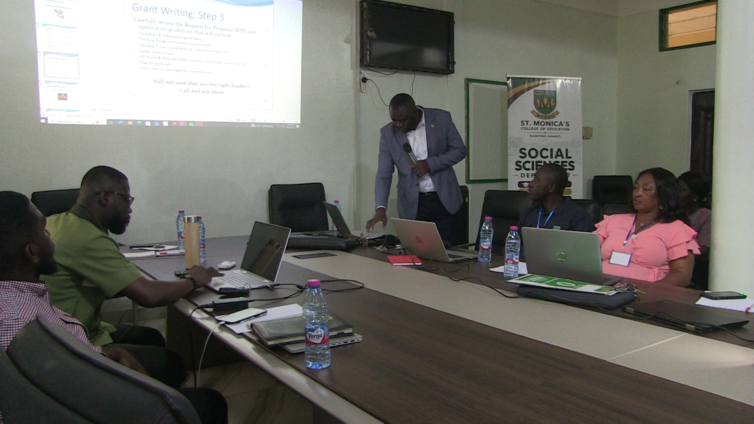
Tutors at St. Monica's College of Education in Asante-Mampong have completed a two-day academic retreat on grant writing, research development and scholarly publication, reflecting growing expectations for research output and external funding within Ghana's tertiary education sector.
The programme, organised by the Social Sciences Department, brought together participants from across the college, Mampong Technical College of Education and selected senior high schools. Organizers said 55 tutors attended the first day, with attendance rising to nearly 60 on the second day.
The retreat focused on manuscript preparation, proposal development, grant acquisition and practical approaches to producing research that addresses societal challenges.
One of the facilitators, Professor Razak Gyasi of the African Population and Health Research Centre in Nairobi and Southern Cross University in Australia, said research institutions increasingly depend on competitive grants because of the cost involved in conducting studies.
"Research is very expensive and sometimes it is difficult to dip your hand into your pocket to fund the research that we conduct," he said. "There is a need to write proposals to organisations that are ready to support research."
Prof Gyasi said the first day of the retreat was devoted to academic writing and manuscript development, including journal expectations and publication standards.
"So now they know how to structure and draft a manuscript, what to do and what not to do in order to get into a good journal," he said. "If you want promotion, you need to publish."
He described the participants as energetic and highly interactive, noting that the sessions encouraged contributions and continuous assessment rather than conventional lectures.
To ensure lasting impact, Prof Gyasi proposed forming research clusters after the programme, bringing together tutors with shared interests to collaborate on publications and grant applications.
"Within a year, we want to come back to see what has come out of it, whether they have been able to write papers and submit proposals for promotion," he said.
The Head of the Social Sciences Department and convener of the retreat, Akosua Baah, said the initiative was prompted by changing expectations within colleges of education.
"Gradually, colleges of education are moving to the tertiary level and one of the requirements has to do with publication," she said. "People say publish or perish, and since we do not want to perish, we need to learn the nitty-gritties when it comes to publication."
Akosuah said the department wanted tutors to gain practical skills in identifying research priorities and attracting funding to support institutional and community development.
"Government is doing its best and the institution is also doing its best, but we thought that as a department we can also come in to help," she said.
She explained that tutors often encounter challenges in partner schools during Supported Teaching in Schools activities and that successful grant applications could help address some of those issues.
The retreat, she added, formed part of activities marking the college's 95th anniversary celebrations and received support from the institution's leadership.
Although the Social Sciences Department has only seven members, participation was extended to other departments and institutions to broaden its impact.
"What we expect is that this should not be the usual seminar or workshop," Akosua said. "Six months from now, we want to hear that people have collaborated to write grants and publish papers."
The Registrar of St. Monica's College of Education, Emmanuel Amankwah, linked the programme to the college's long-term strategic plan.
He said a committee established three years ago identified grant writing, proposal development and publication as critical priorities for staff development as the institution aligned itself with tertiary education standards.
"One of the thematic areas was to introduce our staff to grant writing, proposal development and publication so that they can catch up with tertiary norms," he said.
Mr Amankwah said strengthening research culture was central to improving teaching and learning outcomes.
"As a tertiary institution, teachers and learners must always stay in touch with research, global developments and 21st-century skills," he said.
Principal of Mampong Technical College of Education, Professor Ebenezer Agyemang Badu, said the retreat highlighted the growing importance of research capacity and grant acquisition within higher education.
"These are what define any academic institution – your ability to research and your ability to leverage your skills to get grants and funding," he said.
He argued that government funding alone could not adequately support research and community interventions.
"There is a need to seek grants to solve societal problems," Prof Agyemang Badu said. "The amount of money government provides cannot comprehensively support what we do."
He added that proposal writing required specialised competencies and that proper training would encourage academics to pursue external funding opportunities.
Participants such as Isaac Aninakwah, a tutor in the Social Sciences Department, said the retreat reinforced the role of research in national development.
"Research has become the bedrock for every country," he said. "Before a country can develop, we need to identify societal problems, conduct systematic research and contribute findings that help solve those problems."
Mr Aninakwah said the sessions had strengthened his understanding of research methodologies, problem identification and academic communication.
He added that the responsibilities of tutors extended beyond classroom instruction to producing knowledge that benefits communities.
The college's Quality Assurance Officer, Bosco Aboagye, described publication and grant writing as essential for academic advancement.
"In today's academia, you cannot survive without publishing," he said.
Mr Aboagye encouraged other colleges of education to organise similar programmes to build institutional research capacity and prepare staff for the demands of tertiary education.
He said discussions during the retreat had clarified concepts that many participants previously found challenging and had improved confidence in proposal development and academic publishing.
Latest Stories
-
I am tired of being in opposition, my goal is to win in 2028 – Boakye Agyarko
3 minutes -
Ghana’s road maintenance funding gap deepens as only 37% of needs met – World Bank
3 minutes -
Roland Europe Group appoints Opoku Sanaa as Head of Sales, Middle East & Africa
5 minutes -
Sammyflex TV’s Roland Amartey girds up for 2026 Ghana Music Awards UK coverage
17 minutes -
U.S. bank queried payments for Ghana ambassador’s residence renovated by company owned by embassy’s IT officer
36 minutes -
GoldBod to generate US$1.4bn in FX in September
53 minutes -
GAF 2026/2027 enlistment opens September 3 for degree holders
54 minutes -
Reparatory justice: Mahama announces high-level UN side event in September
1 hour -
Bosome Freho Assembly invests first tranche Common Fund in water and education projects for 19 rural communities
1 hour -
YIPs Ghana honours 5 outstanding students at 2026 Tertiary Achievers Awards
1 hour -
NSMQ 2026: TAMASCO triumphs over St. Hubert and Labone to clinch ticket to the semi-finals
1 hour -
US and Iran trade strikes for first time in weeks
1 hour -
Non-interest banking will not replace conventional banking – Dr Johnson Asiama
1 hour -
Non-interest banking products available to everyone, not just Muslims – Asiama
1 hour -
Dolly Parton laid to rest alongside husband in Nashville
1 hour