

Audio By Carbonatix
Artificial intelligence is changing the way people learn, work and communicate. But as technology becomes more common in classrooms, future teachers in Ghana are being reminded that teaching will require more than digital skills. They will need the ability to understand people.
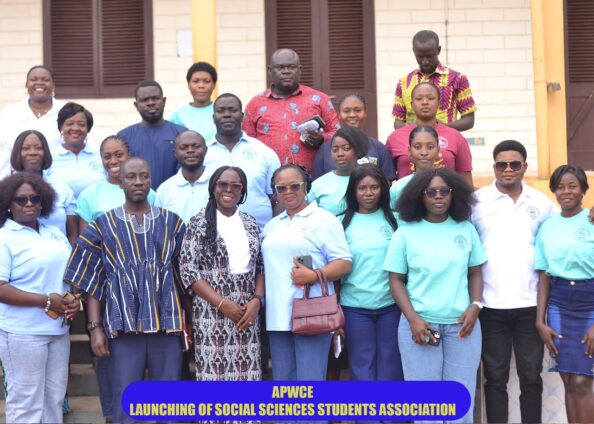
That was the message from Bosco Aboagye, a lecturer at St Monica’s College of Education, who was the guest speaker at the launch of the Social Sciences Students Association (SOSSA) at Agogo Presbyterian Women’s College of Education (APWCE).
Mr Aboagye told trainee teachers that while technology would continue to support education, it could not replace the human qualities at the heart of teaching.
“Technology will always aid humanity. Technology has no ethics, technology has no empathy, technology has no morals,” he said.
His comments came at a time when artificial intelligence tools are increasingly being used in education for research, lesson planning and assessment.
But Mr Aboagye warned that future educators must ensure technology remains a tool that serves people rather than replaces them.
“While AI can process information, it cannot replace human wisdom, human empathy, moral judgement, compassion or ethical reasoning,” he said.
“Technology is powerful, but it remains a tool. It is the human mind that gives technology purpose and direction.”
Understanding society before shaping it
For Mr Aboagye, preparing teachers for the future starts with helping them understand the society they will serve.
“The sole aim of our training here is to train the next generation,” he told students.
He said teachers are not only responsible for transferring knowledge but also for influencing attitudes, values and the future direction of communities.
“Understanding society begins with understanding people,” he said.
According to him, society is constantly changing through culture, technology, politics, economics, education, religion and human interaction.
“Society is dynamic. It is not static,” he said.
He urged students studying social sciences not to simply accept the world as it is, but to ask questions about the challenges facing society.
“Social scientists do not simply accept the world as it is. They ask questions,” he said.
He said those questions should include why poverty exists, why corruption occurs, why some educational policies succeed while others fail, and how societies can become more peaceful and prosperous.
Beyond certificates
The guest speaker also challenged students to develop skills beyond their academic qualifications. He said employers and institutions increasingly look for people who can communicate effectively, work with others, solve problems and adapt to changing circumstances.
“They seek individuals who can communicate effectively, collaborate with others, solve problems creatively, adapt to change, lead with confidence and manage conflict,” he said.
He encouraged students to develop research skills and improve their ability to use computers and digital tools.
“Today, whatever the lecturer will tell you, with a click of a button, you can find it and read more,” he said.
He urged them to read beyond lecture notes and develop the habit of independent research.
“As long as you want to remain in academia, you can't live in academic society without researching,” he said.
Why SOSSA was established
The launch of SOSSA was driven by concerns about the growing social challenges facing Ghana and the need to prepare student teachers beyond academic qualifications.
Head of the Social Sciences Department at APWCE, Collins Owusu Asante, said the department reflected on these challenges before deciding to establish the association.
“We sat down as a department and we thought through it and we saw the need to bring this association to fruition,” he said.
Mr Asante mentioned issues including flooding, corruption, family problems and difficulties graduates face in finding employment.
“Students are completing school and they are having difficulties getting jobs,” he said.
He said the department wanted students to develop the confidence to look beyond traditional employment opportunities.
“How can we train our students so that they can even look beyond government employment so that they can do something for themselves?” he asked.
He explained that SOSSA would provide opportunities for students to organise seminars, educational trips and engage with similar associations in other colleges.
The aim, he said, is to help students gain broader experiences and prepare for life after graduation.
Building teachers for Ghana’s future
The Principal of Agogo Presbyterian Women’s College of Education. Professor Lydia Aframea Dankyi said the new association fits into the institution’s broader vision of producing teachers capable of contributing to national development.
She said the college aims to become “an institution of excellence among the best in the country and beyond.”
She added that the college is focused on producing teachers who are disciplined, innovative, dedicated, competent, committed and selfless.
However, she cautioned students against allowing associations to create divisions within the college community.
She said the different groups should work together towards a shared goal.
“It is one college with one aim,” she said.
She urged students to support one another regardless of which association is organizing an activity.
“How can you collaborate and you stay aloof when it is somebody’s turn to perform?” she asked.
She said student associations should promote academic excellence, leadership development and collaboration rather than competition.
A platform for future educators
For the leadership of SOSSA, the association is intended to help student teachers better understand the communities they will eventually serve.
SOSSA President Mary Brobbey said the association would help students build stronger relationships with society and future learners.
“The association is going to shape us and understand society as well and help us to build the rapport with the students,” she said.
She said the group would contribute to shaping future leaders.
Vice President Grace Owusu said the association would also promote positive values among students.
Latest Stories
-
Black Sherif drops new 6-Track EP ‘Sun Sherif’
15 minutes -
GTA partners Africa’s Brain Bank for Medical City groundbreaking
27 minutes -
How to check 2026 WASSCE results on mobile phone
33 minutes -
President Mahama is a professional comedian – DKB
48 minutes -
Final day of Joy FM Back-to-School Fair: Come shop, save and prepare for the new school year
2 hours -
GSE showed strong performance in August 2026 despite recording more stock losses
4 hours -
If CJ needs ethics law to know SOE comments were wrong, he may not be worthy of office – Arthur Kennedy
5 hours -
Stop touring state agencies and focus on the Judiciary’s problems – Arthur Kennedy to CJ
5 hours -
Apologise and don’t do it again – Arthur Kennedy to Chief Justice over SOE comments
5 hours -
Chief Justice remains committed to judicial independence, justice and equality – Judicial Service
5 hours -
Ghana concludes evacuation of citizens from South Africa; total returnees reach 1,900 – Ablakwa
6 hours -
Africa must define its own green transition path – Prof Fatima Denton
6 hours -
WASSCE 2026: English Language performance falls to 62.4% – WAEC
6 hours -
WASSCE 2026: Social Studies records sharp rebound as Maths, Science also improve
7 hours -
2026 WASSCE entry rises by 11% as 512,862 candidates sit exams
7 hours