

Audio By Carbonatix
The opposition New Patriotic Party has described the government’s two-cedi diesel relief as a temporary measure, arguing that it should not be presented as an act of generosity.
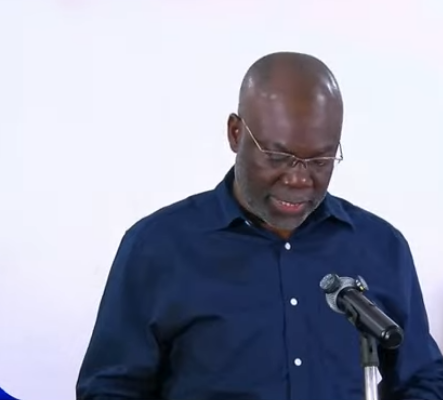
Ranking Member of Parliament's Energy Committee, George Kwame Aboagye, said the intervention does not return households and businesses to the fuel price levels they experienced in January 2025, arguing that consumers have already paid higher costs through petroleum-related levies.
Addressing the media on Wednesday, August 5, Mr Aboagye said the relief only offsets a fraction of increases experienced over the past 18 months.
"A two-cedi reduction is not generosity. It is a partial, temporary return of money already taken from consumers at midnight," he said.
According to him, even if the full two-cedi reduction is passed on to consumers, diesel prices would remain above January 2025 levels.
He explained that on 3 August 2026, GOIL Ghana Limited sold petrol at GH₵15.99 per litre and diesel at GH₵19.26 per litre. He compares this with January 2025 prices of approximately GH₵15.13 per litre for petrol and GH₵15.49 per litre for diesel.
Mr Aboagye also noted that the cedi had strengthened during the period, moving from about GH₵14.70 to the US dollar to approximately GH₵11.67 to the dollar.
"Petrol today is about 5.7 percent higher than in January 2025 and diesel is about 24.3 per cent higher. Even if the full two-cedi reduction is passed through to the public, diesel will still stand about 11.4 per cent above its January 2025 level," he said.
Minority questions sustainability of relief
The Ranking Member argued that the current intervention must not be assessed separately from previous government measures that increased costs for petroleum consumers.
He cited the Energy Sector Levies Amendment Bill, 2025, which Parliament passed on 3 June 2025 under a certificate of urgency, introducing an additional GH₵1 levy on every litre of petroleum products.
Mr Aboagye said the minority opposed the move and walked out of Parliament during the process.
He recalled that the finance minister assured Ghanaians that a stronger cedi would neutralise the impact of the levy and prevent consumers from paying additional costs.
According to him, the government projected that the levy would generate about GH₵5.7 billion annually to support the repayment of energy sector debt and help address recurring power challenges.
The levy took effect on 16 July 2025 and remains in place, he said.
"Consider the plain arithmetic: a consumer who has paid one cedi extra on every litre of petrol and diesel for more than a year now receives, at best, two cedis back on diesel for a single month and nothing at all on petrol," he stated.
Government must explain financial impact
Mr Aboagye also questioned the cost of the intervention, arguing that the government must explain how the revenue shortfall created by the reduction will be managed.
The government has described the measure as a reduction in regulatory margins rather than a subsidy.
However, Mr Aboagye said the distinction does not remove the financial implications.
"That distinction matters legally but not economically. Foregone revenue is still a cost," he said.
He estimated that the current one-month diesel relief could result in about GH₵400 million in foregone revenue, based on the previous diesel support programme which cost about GH₵800 million over two months.
Together with an earlier petrol relief programme costing about GH₵99.4 million, he estimated that the total cost of the 2026 fuel interventions could reach approximately GH₵1.3 billion.
"That GH₵400 million in a single month is money that cannot simultaneously service energy sector debt, maintain roads, or reduce the deficit," he argued.
He warned that if the intervention was not captured in the national budget, it could widen the government's financing gap, while delayed payments to petroleum sector players could affect the supply chain.
"There is no free relief. The only question is who pays and when."
Concerns over new fuel levy adjustments
Mr Aboagye further raised concerns about recent adjustments to petroleum-related levies approved by Parliament.
He said Parliament, on Friday, July 31, increased the Energy Sector Shortfall and Debt Repayment Levy on fuel oil from GH₵0.24 per litre to GH₵1.93 per litre and extended the Road Fund Levy to fuel oil.
The government, he said, explained that the move was aimed at addressing a misclassification loophole which allegedly cost the country about US$25 million between January and June 2026.
While acknowledging the need to prevent revenue losses, Mr Aboagye questioned the lack of clarity around the proposed refund system for eligible industrial users.
He said the government had not explained who would manage the refunds, which companies would qualify, how payments would be financed, or what would happen to rejected claims.
"Companies must pay upfront, and ...., that is a working capital burden on industry. Industry will pass it on," he said.
He questioned whether consumers who bear additional costs through higher prices would receive refunds if companies later recover their money.
"The company recovers its money, but the consumer who bore the passed-on cost does not."
World Bank concerns over energy sector.
He referred to a June 2026 World Bank assessment which downgraded Ghana's energy sector recovery programme from moderately satisfactory to unsatisfactory.
According to him, combined losses of the Electricity Company of Ghana (ECG) and Northern Electricity Distribution Company (NEDCo) increased from US$1.257 billion in 2022 to US$1.517 billion by May 2026, against a target of US$525 million for 2027.
He attributed the challenges to stalled reforms, delayed procurement, and weak governance.
"Ghana cannot solve a debt and arrears crisis by creating new hidden revenue losses," he said.
Minority demands answers
Mr Aboagye urged the government to provide clarity on the policy and outlined the following questions:
- Which specific margins, levies, or taxes are being reduced to finance the two-cedi diesel relief, and what is the total revenue loss?
- Has this been provided for in the 2026 budget, and what expenditure will be cut to offset it?
- What mechanism will ensure transport fares and prices of essential goods actually reflect the relief?
- Will the one-cedi-per-litre levy remain at its full rate during the relief period, and will costs previously transferred to consumers be refunded?
- What objective trigger determines whether the relief will continue, be reviewed, or be withdrawn?
He maintained that while the two-cedi diesel relief sought to ease the burden on consumers, the government must provide clarity on its funding, implementation, and measures to ensure that the intended benefits were fully realised.
Latest Stories
-
‘Whatever the personal cost, I will not abandon my duty’ – Baffour Awuah assures Salomey Bafoh
1 minute -
Government to increase funding for Houses of Chiefs to speed up dispute resolution
3 minutes -
Govt’ to introduce digital property rate system to boost MMDAs’ revenue – Mahama Ayariga
5 minutes -
Traditional Medicine Practice Council closes three unlicensed spa and massage centres in Ashanti Region
7 minutes -
Let’s accept the reality and move along – Mike Oquaye on NPP’s decision to make flagbearer party leader
9 minutes -
Early presidential primary helped cool tensions in NPP – Prof. Mike Oquaye
27 minutes -
NDC congratulates new NPP executives, urges national interest above party interests
30 minutes -
NPP implementing 2024 election review recommendations in stages – Prof Mike Oquaye
31 minutes -
Ghana Rugby Union announces managerial changes
31 minutes -
US removes all bombers from RAF Fairford base
32 minutes -
France closes up to 500 schools Monday over student protests
33 minutes -
Girl, 12, fatally shot in US during ‘dispute over parking space’
33 minutes -
NPP is a party for all classes – Prof. Mike Oquaye
34 minutes -
Chief Justice urges Judiciary to strengthen foundations of justice
34 minutes -
Rescuers suspend search for survivors after plane went missing off US coast
35 minutes