

Audio By Carbonatix
Businesses have been urged to use Artificial Intelligence (AI) simply as a tool for reducing costs as well as positioning it as a core strategic capability that drives innovation, growth and long-term competitive advantage.
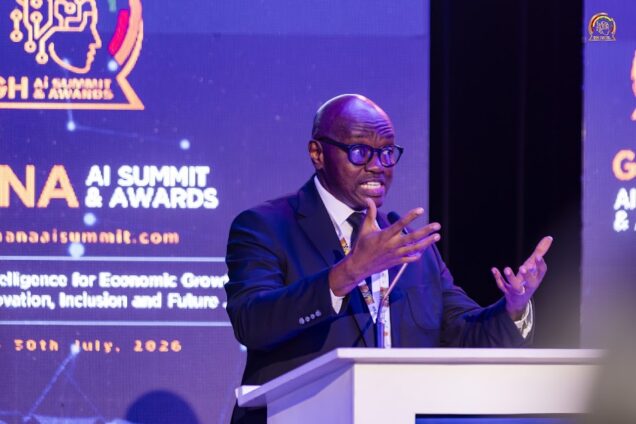
Speaking at the 2026 Ghana AI Summit and Awards, Edward Aikins, Senior Manager, Technology and Transformation, Deloitte, said while many organisations have embraced AI to improve efficiency and reduce operational costs, only a few are leveraging the technology to fundamentally transform their business models and create lasting value.
"Our research shows that most companies are using AI to reduce costs, improve efficiency, cut down delivery times and achieve some savings. However, organisations should leverage AI as a core strategic capability rather than simply as a cost reduction tool. Use AI to create sustainable competitive differentiation”, he noted, continuing that "since everyone has access to the technology, creativity will be the real differentiator." Stressing the importance of tailored enterprise solutions to drive growth.
His comments come months after the Ministry of Communication, Digital Technology and Innovation launched Ghana AI Policy, a framework aimed at shaping Ghana's AI and technological advancement as well as adoption.
Appropriate Infrastructure and Quality Data
Mr Aikins also emphasised that successful AI adoption depends on an organisation's ability to harness quality data across traditionally siloed institutions.
According to him, centralising data that sits silos is essential to unlocking AI's full potential, enabling organisations to generate more accurate insights, improve decision making and deliver greater business value, which fits the local market.
He further urged organisations to invest in future ready digital infrastructure capable of supporting the rapid pace of AI innovation.
He added that AI technologies evolve so quickly that systems can become outdated within months, making scalability and adaptability critical considerations in infrastructure planning.
"Design infrastructure that will support future AI capabilities. Your infrastructure strategy should enable you to scale because the technology is changing so fast. You need a long-term construction strategy that can keep pace with continuous innovation in AI," he concluded.
Latest Stories
-
UN housing expert urges Ghana to strengthen Rent Control Department amid housing affordability concerns
2 seconds -
Delta-BCI partnership reaches 166,000 people with breast cancer education
9 minutes -
Power restoration fault suspected in Kumasi Central Market fire
5 hours -
The 7-foot giant of Ngleshie Amanfro: Seven-foot Ghanaian Ephraim Saawa dreams of joining the national basketball team
6 hours -
Government promises support for Kumasi Central Market fire victims
6 hours -
Vibes The Movie: Big Ghun’s Ghanaian film earns five nominations at 2026 REFFA
7 hours -
‘I’m a fulfilled man’—Justice Korbieh on missing out on Supreme Court despite two nominations
7 hours -
MamaCare CEO warns unresolved conflicts among health workers could undermine maternal and neonatal care
7 hours -
Health professionals urged to translate medical knowledge into practice to save mothers
7 hours -
Retired judge Justice Francis Korbieh charges 1,568 new lawyers to uphold integrity
8 hours -
Conflicts among care providers linked to maternal, neonatal deaths – Expert
9 hours -
GIS marks 10th TIME conference, champions improved teaching practices
9 hours -
BRICS Or Balance? What Ghana’s bid really means
9 hours -
Adamus Resources launches breast cancer awareness campaign in Nzema
9 hours -
GPRTU wants full TRAFFITECH-GH implementation to start in 2027
10 hours