

Audio By Carbonatix
The Ghana Health Service (GHS) has called for stronger national support for breastfeeding, urging families, employers, communities and policymakers to play a more active role in helping mothers breastfeed successfully.
The appeal was made as Ghana joined the rest of the world in commemorating World Breastfeeding Week 2026 and Ghana's Breastfeeding Month, with this year's campaign focusing on strengthening systems that protect, promote and support breastfeeding.
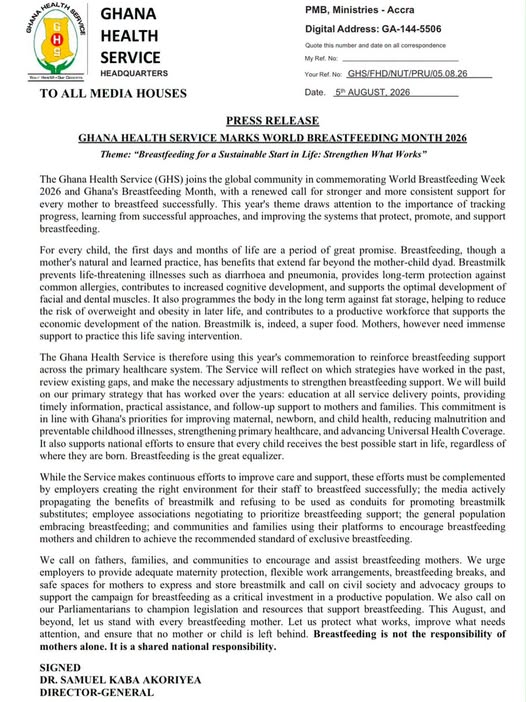
In a statement issued on Wednesday, August 5, the GHS said the 2026 theme highlights the need to monitor progress, learn from successful interventions and improve policies and programmes that enable mothers to breastfeed their children.
The Service described breastfeeding as one of the most effective ways of improving child survival and development, noting that while breastfeeding is a natural process, mothers require significant support to practise it successfully.
According to the GHS, breastmilk provides infants with the nutrients they need during the early stages of life while protecting them against several life-threatening diseases.
The Service said breastfeeding helps prevent illnesses such as diarrhoea and pneumonia, offers long-term protection against common allergies, promotes cognitive development and supports the healthy development of facial and dental muscles.
It also noted that breastfeeding contributes to better long-term health by reducing the risk of overweight and obesity later in life, adding that healthier children ultimately contribute to a more productive workforce and national economic growth.
"Breastmilk is, indeed, a super food. Mothers, however, need immense support to practice this life saving intervention," the statement said.
As part of this year's commemoration, the Ghana Health Service said it would reinforce breastfeeding support across the country's primary healthcare system.
The Service plans to review existing breastfeeding interventions, identify gaps in implementation and strengthen approaches that have proven effective over the years.
According to the GHS, education will remain its principal strategy, with healthcare workers continuing to provide information, practical assistance and follow-up support for mothers and their families at health facilities.
The initiative forms part of broader efforts to improve maternal, newborn and child health, reduce malnutrition and preventable childhood illnesses, strengthen primary healthcare and advance Universal Health Coverage.
The Service also said promoting breastfeeding supports Ghana's efforts to ensure every child has the best possible start in life, regardless of where they are born.
"Breastfeeding is the great equalizer," the statement noted.
The Ghana Health Service stressed that supporting breastfeeding should not be left solely to mothers or health professionals.
It called on employers to introduce family-friendly workplace policies, including adequate maternity protection, flexible working arrangements, breastfeeding breaks and designated spaces where mothers can safely express and store breastmilk.
The Service also urged the media to continue promoting the benefits of breastfeeding while avoiding the promotion of breastmilk substitutes.
Employee associations were encouraged to advocate stronger workplace support for breastfeeding mothers, while families and communities were urged to provide practical and emotional support to women during the breastfeeding period.
The GHS further appealed to fathers to play a more active role in supporting breastfeeding mothers, describing family support as critical to successful exclusive breastfeeding.
Civil society organisations and advocacy groups were also encouraged to continue promoting breastfeeding as a public health and economic investment.
In addition, the Service called on Members of Parliament to support legislation and allocate resources that strengthen breastfeeding policies and programmes across the country.
"This August, and beyond, let us stand with every breastfeeding mother. Let us protect what works, improve what needs attention, and ensure that no mother or child is left behind," the statement said.
The Service emphasised that breastfeeding is a shared national responsibility requiring the commitment of government institutions, employers, healthcare providers, communities and families to ensure that every child receives the best possible nutritional start in life.
"Breastfeeding is not the responsibility of mothers alone. It is a shared national responsibility."
Latest Stories
-
4 injured, including baby, in multi-vehicle crash at Sofoline flyover in Kumasi
2 minutes -
GES should consider regional processing of teacher promotions – FWSC CEO
5 minutes -
Minerals Commission suspends reconnaissance license of Gold Coast GRC Ghana Limited
8 minutes -
Yusif Sulemana assures contractor of support to deliver Bole roads on schedule
15 minutes -
Mahama Ayariga engages World Bank on building sustainable, resilient cities
15 minutes -
‘We can build it ourselves’ – Ibrahim Mahama reaffirms belief in Ghanaian entrepreneurship
20 minutes -
Constitutional reforms must give citizens greater say in local decisions – Sophia Akuffo
21 minutes -
Don’t deal with unlicensed loan firms – BoG cautions public against 20 loan apps
44 minutes -
Photos: IGP Yohuno decorates 22 newly promoted DCOPs
46 minutes -
We didn’t deliberately delay negotiations with teacher unions – FWSC
46 minutes -
‘Go back to the drawing board’ – Polo urges Black Stars to find solutions
48 minutes -
Kaerbo For Africa hands over three-classroom block to Gomoa Nyanyano SHS
49 minutes -
KNUST students win Pan African AI Summit Hack-AI-Thon with cocoa waste solution
50 minutes -
Cocoa prices risen by 95% since March 2026, to average US$5,670 in 2026
1 hour -
British national arrested in connection with RAF Fairford incident
1 hour