

Audio By Carbonatix
Ghana’s transition to clean energy is often discussed in terms of renewable electricity, solar power, energy infrastructure, electric mobility and national energy policy. However, one of the most important aspects of the transition happens at the household and community level, where women make daily decisions about cooking, energy use, livelihoods, waste, agriculture and community well-being.
Clean cooking is arguably the most immediate intersection between gender and energy in Ghana. Women traditionally carry a significant share of household cooking responsibilities. Where households depend on firewood or charcoal, women and girls can spend considerable time sourcing fuel whilst also bearing disproportionate exposure to household air pollution. The impacts extend beyond health to time poverty, education, income generation and participation in community life.
Ghana’s 2026 National Energy Compact acknowledges persistent gender disparities in clean cooking. It reports that female-headed households are more likely to use charcoal for cooking than male-headed households, and that women occupy only about 25% of jobs in public energy utilities.
For Ghana’s clean energy transition to be genuinely just and inclusive, grassroots women must be recognised not only as beneficiaries, but also as entrepreneurs, innovators, educators, community leaders and agents of change.
Empowering grassroots women is not only about creating livelihoods, but it is also about advancing Ghana's development priorities, strengthening communities, building local capacity, fostering inclusion, and accelerating progress towards the Sustainable Development Goals (SDGs).
Grassroots Women are Key Participants in the Clean Energy Value Chain in Ghana
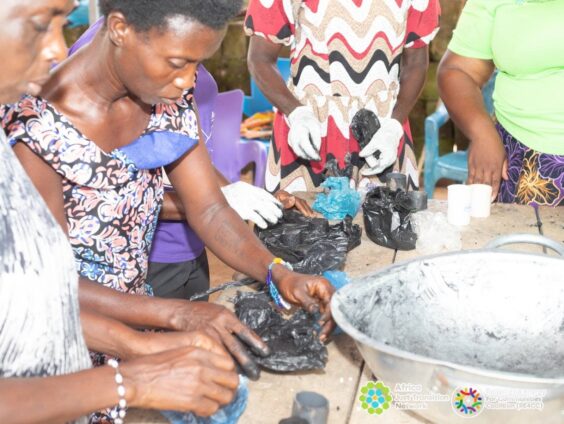
It is evident that a major opportunity exists for women to shift from simple energy consumers to become key participants in the clean energy value chain. At Wusuta in the North Dayi District of the Volta Region, a remarkable transformation is taking place. Women are turning what was once considered waste (coconut husks) into clean, affordable briquettes, creating a sustainable energy alternative while opening new pathways for economic empowerment.
Powered by the Africa Just Transition Network (AJTN) and the Renewable Energy for Communities Coalition (RE4CC), of which EcoClub 360 is a proud member, this initiative demonstrates the power of placing grassroots women at the heart of Ghana's just energy transition. EcoClub 360 was represented by its Founder and Executive Director, Ms Patience Ahiabor, who joined partners in supporting this community-driven effort.
Globally, development organisations and energy bodies such as Sustainable Energy for All (SEforALL) and the International Renewable Energy Agency (IRENA) recognise women’s crucial contribution to energy transitions.
In Ghana, the opportunity for Wusuta women is not only to simply produce briquettes. It is also a demonstration of how women are contributing to climate and environmental protection by connecting energy transition with climate adaptation, forest conservation, circular economy, biodiversity protection and women’s economic empowerment, which Ghana’s Nationally Determined Contributions (NDCs), under the Paris Agreement, explicitly integrate as core components of climate action. Additionally, the women’s traditional knowledge can help researchers, government agencies, development partners, NGOs and private companies design technologies that will contribute to sustainable energy, while creating opportunities to earn sustainable incomes, reducing dependence on conventional fuels, and strengthening the resilience of their families and communities.
Conclusion
Ghana’s clean energy transition will only be truly transformative when the women at the heart of our communities are empowered to actively participate, lead, and benefit. From transforming agricultural waste into clean energy briquettes to championing sustainable livelihoods and protecting local ecosystems, grassroots women’s contributions demonstrate that climate action can begin with solutions rooted in communities.
Our collective responsibility is to ensure that these women have access to skills, finance, technology, markets and decision-making spaces to scale their solutions. The future for Ghana’s clean energy transition should not be built for communities without communities. It must be built with the women who are creating change from the ground up. A just transition must therefore be inclusive, gender-responsive and community-driven. Let us accelerate Ghana’s sustainable energy future by empowering more grassroots women as core leaders in the clean energy sector.
Our Planet Our Future!
Patience Ahiabor
Founder & Executive Director
EcoClub 360
Latest Stories
-
Health investment beginning to improve access to care – Akandoh
7 minutes -
“It is meaningless” – Parent laments as teachers’ strike leaves boarding school students idle
8 minutes -
Austin Gamey predicts possible end to teachers’ strike, urges better negotiation
11 minutes -
Mahama and Trade Minister champion local manufacturing during Ghato Foods visit
12 minutes -
Labour Minister, ILO Country Director strengthen partnership on decent work and jobs
12 minutes -
Approved vaccine to be rolled out in Upper West next week-GHS
16 minutes -
Trump wants to reduce the cost of fuel as the midterms loom – will it work?
17 minutes -
Fear, institutional bias and lack of support deter domestic abuse victims from reporting – Lawyer
18 minutes -
Yellow fever outbreak is under control – Health Minister
20 minutes -
Communication Minister Sam George called to the Bar
25 minutes -
Kenteman’s Kentemusic weaves ‘Kente Love’
27 minutes -
Former JoyNews journalist Richard Kwadwo Nyarko called to the Bar
46 minutes -
Chopmoney Bookkeeping seeks to simplify bookkeeping for Ghana’s small businesses
49 minutes -
Beyond word of mouth: Bizella’s bid to build trust in Ghana’s services market
55 minutes -
Former JoyNews journalist Ayisha Ibrahim called to the Bar
1 hour