

Audio By Carbonatix
The government has announced plans to support the establishment of 100,000 hectares of new oil palm plantations as part of efforts to transform Ghana’s oil palm industry, create jobs and reduce the country’s reliance on imported palm oil.
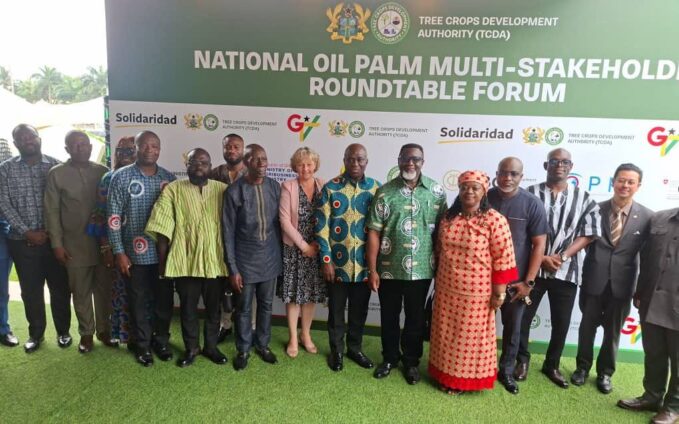
The Minister for Food and Agriculture, Eric Opoku, announced the initiative at the National Oil Palm Multi-stakeholder Roundtable Forum in Accra on Wednesday, August 12, 2026.
He said the expansion programme would form part of a broader strategy to move Ghana’s oil palm sector beyond policy commitments and studies towards practical interventions with measurable outcomes.
The forum, held under the theme, “From Policy to Practice: The Role of TCDA in Resetting Ghana’s Oil Palm Industry," brought together key stakeholders, including government officials, the Tree Crops Development Authority (TCDA), farmers, processors, investors, researchers, development partners and traditional authorities.
Mr Opoku said Ghana had developed several policies and conducted numerous studies on agriculture over the years, but argued that the focus must now shift towards implementation, coordination and accountability.
“Policy acquires value only when it changes lives,” the Minister said, stressing that the forum must result in clearly defined responsibilities, timelines, resources and measurable targets.
He described oil palm as a strategic crop with strong links to both agriculture and industry, noting that the sector provides livelihoods for farmers, nursery operators, transporters, processors, traders and manufacturers.
According to him, the industry also presents significant opportunities for women and young people, while palm oil and its by-products serve as raw materials for a wide range of industries, including soap and cosmetics, pharmaceuticals, confectionery, animal feed and bioenergy.
The Minister, however, acknowledged that Ghana continues to face a substantial gap between domestic palm oil production and national demand, forcing the country to rely on imports to bridge the shortfall.
He said the deficit should not be viewed simply as a supply challenge, arguing that it also represents lost jobs, lower incomes for farmers, underutilised processing capacity and foreign exchange that could otherwise be retained within the Ghanaian economy.
Mr Opoku said the government’s plan to expand oil palm cultivation was therefore intended to unlock the sector’s full potential by increasing domestic production and strengthening the entire value chain.
He called on stakeholders to use the roundtable to develop practical solutions that would improve productivity, attract investment, strengthen processing and create sustainable opportunities for farmers and other actors in the oil palm industry.
Latest Stories
-
Court hands Adjetey Sowah, two others lifetime bans after Amputee Football legal dispute
9 minutes -
NDC appoints Julius Kwame Anthony as a Deputy Communications Director
9 minutes -
Ghana repatriates 120 Nigerians rescued from suspected cybercrime centres
14 minutes -
NPP rejects Emelia Agbenyo’s appointment as Deputy EC Chair, demands withdrawal
18 minutes -
EOCO grants Suame MP John Darko enquiry bail in GH¢27m SIC investigation
22 minutes -
NPP cannot question EC appointment after appointing own people to Commission – Kwakye Ofosu
27 minutes -
BoG deepens public trust with regional stakeholder forum in Techiman
37 minutes -
‘We have turned the tide’ – Ato Forson says Ghana is ready to take off
42 minutes -
Police arrest man captured in viral video assaulting wife in Agona Nkwanta
44 minutes -
KATH Mother and Baby Unit construction stalled for 14 months over unpaid contractor arrears
58 minutes -
Government wanted to ‘tilt the balance’ with new EC appointments – Kwakye Ofosu
1 hour -
Angry Tema Community 25 residents threaten to sleep at GWL over water shortage
1 hour -
BoG takes financial literacy drive to Techiman, vows to protect depositors
1 hour -
‘Stop the distractions’ – Akosua Manu demands answers over GH¢49.7m South Africa evacuation cost
1 hour -
Formula 1 to return to Africa with Rwanda Grand Prix in early 2030s
1 hour