

Audio By Carbonatix
President of the Ghana Journalists Association (GJA), Albert Kwabena Dwumfour, has urged Ghana to adopt a broader approach to assessing the benefits and costs of mining, saying the economic value of gold must not overshadow the value of water, fertile land, healthy ecosystems and the wellbeing of communities.
Mr Dwumfour said mining decisions must take into account the people whose lives and livelihoods are directly affected by mineral extraction, arguing that the consequences of environmental degradation could extend far beyond the immediate financial returns generated by the industry.
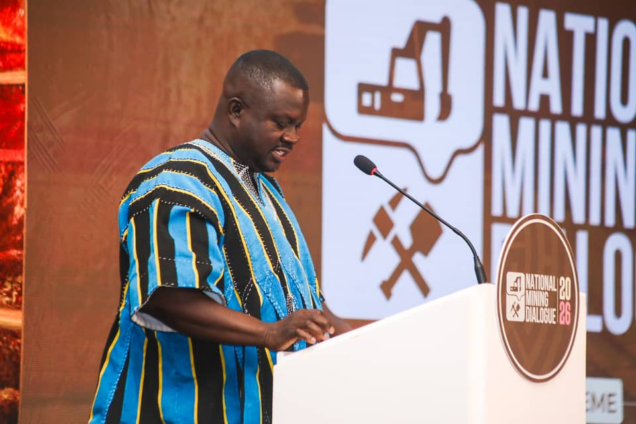
He made the remarks when he spoke at the National Mining Dialogue event organised by Asempa 94.7 FM and its flagship programme, Ekosiisen, in partnership with Semmis DS and the Ministry of Lands and Natural Resources.
“There is a community, there is a farmer, there is a household, there is a child,” Mr Dwumfour said, stressing that behind the economic statistics associated with mining are people whose lives depend on the land and natural resources being exploited.
The GJA President said Ghana's mineral wealth had undeniable economic value but cautioned against treating gold as the only resource that matters in areas where mining takes place.
“That is why we must look beyond the gold extracted from the ground,” he said.
“Gold has economic value, but so has water, so has fertile land, so has a healthy environment.”
He said these resources were essential to human life, agriculture and the sustainability of communities, and their value should therefore be considered when assessing the overall benefits of mining.
According to Mr Dwumfour, serious damage to natural resources cannot simply be offset by calculating a corresponding financial loss.
He noted that once water resources are polluted, productive land is degraded or ecosystems are damaged, restoration can be complex, expensive and, in some circumstances, difficult to achieve fully.
“While these resources are seriously damaged, restoring them is not as simple as replacing a lost financial figure,” he said.
Mr Dwumfour said Ghana's mineral resources should be exploited in a manner that allows the country to benefit economically without destroying the natural systems upon which communities depend.
“The real question is whether Ghana can benefit from its mineral resources whilst protecting the natural system that sustains life,” he said.
He said the issue should not be framed as a choice between mining and environmental protection.
“That is not an argument against mining, it is an argument for responsible mining,” he said.
Mr Dwumfour also stressed the importance of community acceptance of mining operations, arguing that legal approval alone does not guarantee that a company will enjoy the confidence of its host community.
“Social licence must be earned,” he said.
He linked the issue to the broader theme of the mining dialogue, stressing that mining companies must build relationships with communities in addition to complying with statutory requirements.
“A mining company may have obtained every legal permit required to operate. But a legal licence does not automatically guarantee acceptance by the community,” he said.
The distinction, he explained, is important because communities are often directly exposed to the social, economic and environmental consequences of mining.
For Mr Dwumfour, securing the necessary permits should be viewed as the beginning of a mining company's responsibility rather than the end of its obligations.
Companies operating in mining communities must also cultivate trust by engaging residents, respecting their concerns and demonstrating that their activities will not unnecessarily undermine local livelihoods.
That engagement, he suggested, must be continuous rather than limited to the period when a company is seeking approval to begin operations.
Latest Stories
-
Many Canadians are boycotting the US, so this is where they’re travelling instead
3 minutes -
Mining communities must be treated as development partners and economy shareholders – Sammy Gyamfi
8 minutes -
Nearly 9 metric tonnes gold refined locally this year – Sammy Gyamfi
8 minutes -
The world’s best countries for expats in 2026
12 minutes -
Social clubs must become engines of national development – Ace Anan Ankomah
14 minutes -
Harvard appoints former BoG Governor Ernest Addison as senior research fellow
16 minutes -
Sammy Gyamfi warns youth exclusion could threaten mining’s social licence
16 minutes -
Mining communities must not be left without social amenities – Sammy Gyamfi
21 minutes -
National Mining Dialogue 2026: We must remain independent in reporting on mining — GJA President
29 minutes -
Social licence must be reimagined as a development compact with the youth – Sammy Gyamfi
30 minutes -
Give indigenous landowners control to curb irresponsible mining – Dr Nana Kwao Adarkwa
38 minutes -
Interior Minister urges religious leaders to protect Ghana’s tradition of tolerance
39 minutes -
In Pictures: Dignitaries, stakeholders gather for National Mining Dialogue 2026
47 minutes -
BoG inaugurates Financial Advisory Council to drive non-interest banking in Ghana
49 minutes -
Mineral right is a privilege, not an absolute right – Minerals Commission
50 minutes