

Audio By Carbonatix
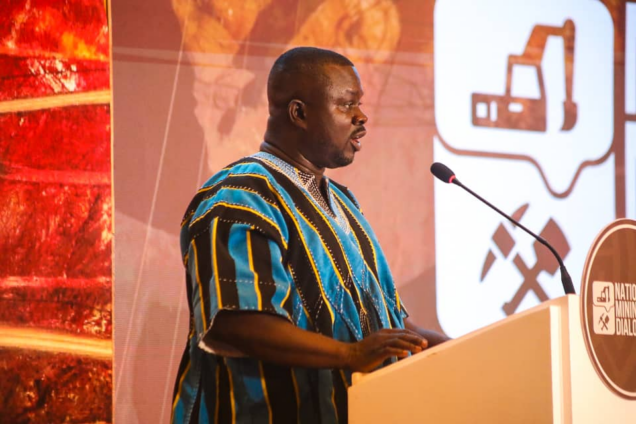
President of the Ghana Journalists Association (GJA), Albert Kwabena Dwumfour, has urged mining companies to treat host communities as development partners rather than obstacles, while calling on the media to uphold the highest standards of accuracy, fairness and accountability in reporting the mining sector.
Mr Dwumfour said the relationship between mining companies and communities must extend beyond legal agreements and public relations campaigns, stressing that genuine community acceptance could only be secured through sustained engagement, respect and trust.
He made the remarks when he spoke at the National Mining Dialogue event organised by Asempa 94.7 FM and its flagship programme, Ekosiisen, in partnership with Semmis DS and the Ministry of Lands and Natural Resources.
“Mining companies must therefore recognise that host communities are not obstacles to development; they are partners in development,” Mr Dwumfour said.
He argued that communities living in areas where mineral resources are extracted should be treated as key stakeholders whose interests and concerns must form part of decisions about mining operations and local development.
The GJA President said mining companies must understand that obtaining regulatory approval to operate was only one part of establishing a sustainable relationship with host communities.
“Social licence is not a public relations exercise,” he said.
“It is a relationship that must be built, respected and maintained.”
Mr Dwumfour said companies could not expect communities to automatically accept their operations simply because they had secured the necessary legal permits.
Instead, mining companies must invest in building trust with residents and demonstrate through their conduct that they respect community interests.
That, he said, required continuous engagement rather than occasional meetings or communication campaigns designed primarily to improve a company's public image.
He noted that mining operations can generate employment, business opportunities, infrastructure and other economic benefits. However, they can also affect land, water resources, agriculture and traditional livelihoods.
The GJA President said communities should therefore be regarded as partners whose wellbeing is integral to the success of mining operations.
Mr Dwumfour subsequently turned his attention to the role of the media, acknowledging that journalists themselves must be subject to the same standards of accountability they demand from other institutions.
“As President of the GJA, I must also speak frankly about the role of the media,” he said.
He noted that journalists had spent years demanding accountability from government, mining companies and regulators, but cautioned that the media could not credibly demand accountability from others while exempting itself from scrutiny.
“We cannot demand accountability from others while exempting ourselves,” he said.
Mr Dwumfour said journalists must be guided by four fundamental principles: truth, accuracy, independence and fairness.
He said these principles should inform every stage of the reporting process, from gathering information to publishing stories and responding to complaints or corrections.
“We must verify before publishing, we must investigate before accusing, we must give all sides a fair opportunity to respond,” he said.
Journalists, he said, must ensure that claims are properly investigated and supported by evidence before they are presented as facts.
Mr Dwumfour also urged journalists to remain focused on evidence rather than being driven by public pressure, speculation or sensational claims.
“And we must follow the evidence, not the noise,” he said.
The comment highlights the challenges facing journalism in an increasingly fast-moving information environment, where unverified claims can spread rapidly through traditional and social media.
For journalists covering mining, following the evidence means examining documents, speaking to affected communities, consulting experts and regulators, and giving companies and other accused parties a meaningful opportunity to respond.
It also means distinguishing between allegations and established facts.
The GJA President further warned journalists against sensational reporting designed primarily to attract attention and generate online traffic.
“We must also resist sensationalism,” he said.
He acknowledged that dramatic headlines could attract readers and generate clicks, but cautioned that the consequences of inaccurate reporting could be much more serious.
“A dramatic headline may generate clicks, but inaccurate reporting can damage reputations,” he said.
Such damage, he suggested, could affect mining companies, government officials, traditional authorities, community leaders and individuals whose names become associated with allegations that have not been properly verified.
Latest Stories
-
Digitalisation, AI key to Ghana’s tourism transformation – GHATOF
19 minutes -
Stronger GTA-private sector partnership needed to grow tourism – GHATOF
29 minutes -
Amazon eyes Ghana for broadband expansion after talks with Mahama
1 hour -
National Investment Quiz 2026: Six schools qualify for quarter-finals
2 hours -
‘Do not let Russia pay for its madness with lives of your people’ – Zelensky to Ghana, 46 other countries
2 hours -
6,079 promotion cases fully processed and paid – CAGD says amid nationwide teachers’ strike
2 hours -
Teacher unions to meet government Monday over nationwide strike
2 hours -
Photo story: Republic Bank-JoyNews Habitat Fair clinic wraps up after three days of housing solutions, expert engagement
2 hours -
National Peace Council urges investment in youth to sustain Ghana’s peace
3 hours -
Afenyo-Markin urges youth to speak up against injustice
3 hours -
CAF annuls Edo Queens victory, orders WAFU B final to resume from extra time
3 hours -
Interior Minister urges traditional authorities to enforce anti-bushfire bye-laws
3 hours -
3rd Republic Bank-JoyNews Habitat Fair Clinic ends on a high note after three days of strong patronage
3 hours -
Ten climbers missing after avalanche hits Himalayan base camp
4 hours -
NPP had more permanent fuel relief measures than current GH¢2 diesel cut – Amin Adam
4 hours