

Audio By Carbonatix
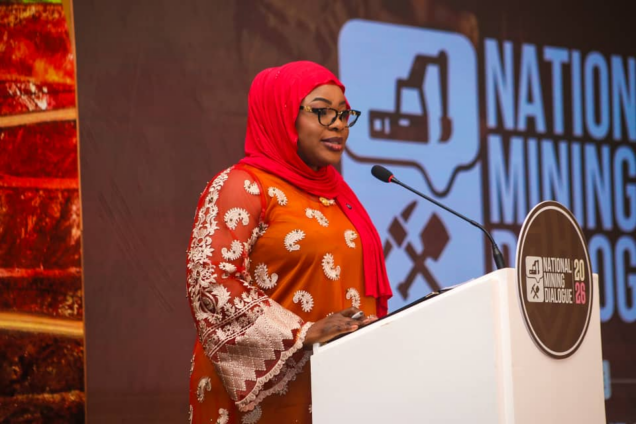
The Deputy Presidential Spokesperson, Shamima Muslim, speaking on behalf of the Chief of Staff, Julius Debrah, has warned mining companies that economic gains recorded at the national level will mean little to host communities if mineral wealth leaves their areas without corresponding improvements in livelihoods and local development.
She said mining companies must demonstrate tangible progress in areas such as employment, local procurement, skills development, knowledge transfer and Ghanaian participation if they are to maintain the trust and acceptance of communities where they operate.
Ms Muslim made the remarks on behalf of the Chief of Staff at the National Mining Dialogue, organised by Asempa 94.7 FM and its flagship programme, Ekosiisen, in partnership with Semmis DS and the Ministry of Lands and Natural Resources.
She said the success of mining should ultimately be judged not only by national production figures or economic indicators, but also by the everyday experiences of people living in mining catchment areas.
“If gold leaves a community year after year, but clean water, decent roads, jobs and opportunity do not arrive, something is wrong with the bargain,” she said.
Ms Muslim said Ghana could record impressive national figures from the mining industry while residents in mining communities experienced little corresponding improvement in their living conditions.
“The national figures may look impressive; the experience in the catchment area will tell a different story,” she said.
She argued that this gap between national economic performance and local experience was one of the reasons the national dialogue on mining was important.
For communities hosting mining operations, the benefits of mineral extraction are often judged through practical improvements in everyday life — access to potable water, reliable roads, employment opportunities, skills development and avenues for businesses to participate in the local economy.
The Chief of Staff’s representative said the concerns of these communities could not be overlooked when assessing the overall contribution of mining to Ghana's development.
Ms Muslim stressed that community acceptance of mining could not be secured once and assumed to last indefinitely.
She said mining was one of the world's oldest professions and industries and acknowledged the contribution made by responsible investors, operators and workers to Ghana's economy.
However, she said the legitimacy of mining operations ultimately depended on the communities whose lands and livelihoods were directly affected.
“Yet, a social licence is not issued once in Accra and kept forever,” she said.
“It is granted by communities whose land, whose water, whose homes and livelihoods carry the industry footprint, and it is renewed every day through trust.”
Ms Muslim also challenged mining companies to look beyond conventional corporate social responsibility initiatives when demonstrating their commitment to host communities.
“A donation cannot answer for procurement that excludes capable Ghanaian firms,” she said.
She argued that communities should benefit from mining through opportunities to supply goods and services, gain employment, acquire skills and participate in the wider value chain.
This approach, she said, would make local content more meaningful by connecting mining activity directly to local economic development.
Ms Muslim questioned situations in which capable Ghanaian companies might be excluded from supplying mining operations, despite the significant purchasing power associated with the industry.
She called for greater opportunities for competent local firms to participate in mining-related procurement.
Such participation could allow businesses in mining communities and elsewhere in Ghana to build capacity, create jobs and develop expertise that could remain valuable beyond the lifespan of individual mining projects.
The broader objective, she suggested, should be to ensure that the economic impact of mining extends beyond the mine site and contributes to the development of a stronger domestic private sector.
Ms Muslim also called on mining operators to demonstrate concrete progress in employment, training and knowledge transfer.
She criticised situations where limited pathways were created for local workers or where undertakings made to communities could not be independently verified.
“Operators therefore must plan, report, demonstrate progress in employment, procurement, training, knowledge transfer and Ghanaian participation,” she said.
She said this would help strengthen accountability and enable communities to assess whether mining companies were meeting their obligations.
Ms Muslim called for greater transparency in the implementation of commitments made to mining communities.
“What is promised must be measurable, what is measured must be open to scrutiny,” she said.
The principle, she argued, was essential to ensuring that local content translated into tangible economic benefits for Ghanaians.
Ms Muslim linked effective local content policies directly to the broader goal of community prosperity.
“That is how local content becomes local prosperity,” she said.
Ms Muslim also connected meaningful community participation to the long-term sustainability of mining companies.
“And that is how businesses become sustainable,” she said.
The Deputy Presidential Spokesperson also broadened the discussion beyond mining companies, saying government itself has a responsibility to earn and maintain the confidence of the people it governs.
“And that is how government also recognises they too must seek a social licence to continue to govern people rightly,” she said.
Latest Stories
-
New economy will boost local production and create jobs – Finance Minister
1 minute -
Real-Time VAT on cross-border digital services – not a new tax and does not violate double taxation principle
51 minutes -
Digitalisation, AI key to Ghana’s tourism transformation – GHATOF
1 hour -
Stronger GTA-private sector partnership needed to grow tourism – GHATOF
1 hour -
Amazon eyes Ghana for broadband expansion after talks with Mahama
2 hours -
National Investment Quiz 2026: Six schools qualify for quarter-finals
2 hours -
‘Do not let Russia pay for its madness with lives of your people’ – Zelensky to Ghana, 46 other countries
3 hours -
6,079 promotion cases fully processed and paid – CAGD says amid nationwide teachers’ strike
3 hours -
Teacher unions to meet government Monday over nationwide strike
3 hours -
Photo story: Republic Bank-JoyNews Habitat Fair clinic wraps up after three days of housing solutions, expert engagement
3 hours -
National Peace Council urges investment in youth to sustain Ghana’s peace
4 hours -
Afenyo-Markin urges youth to speak up against injustice
4 hours -
CAF annuls Edo Queens victory, orders WAFU B final to resume from extra time
4 hours -
Interior Minister urges traditional authorities to enforce anti-bushfire bye-laws
4 hours -
3rd Republic Bank-JoyNews Habitat Fair Clinic ends on a high note after three days of strong patronage
4 hours