

Audio By Carbonatix
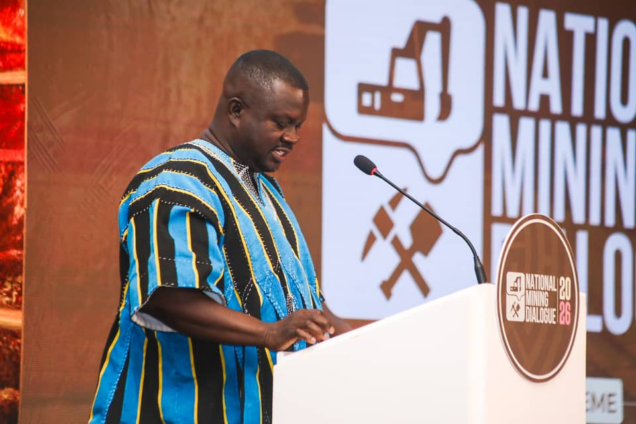
President of the Ghana Journalists Association (GJA), Albert Kwabena Dwumfour, has charged the media to maintain independence and credibility when reporting on Ghana's mining industry.
Mr Dwumfour said journalists must adopt a balanced and evidence-based approach to covering the sector, providing scrutiny where necessary while fairly reporting its contributions to the national economy.
“Our role is not to be an enemy of mining, neither should we become a public relations department for the mining industry,” he said.
He made the remarks when he spoke at the National Mining Dialogue event organised by Asempa 94.7 FM and its flagship programme, Ekosiisen, in partnership with Semmis DS and the Ministry of Lands and Natural Resources.
The GJA President said the media's ability to hold the mining industry, government and regulators accountable depended fundamentally on maintaining its editorial independence.
“We must remain independent,” he stressed.
Mr Dwumfour said the GJA would continue to support specialised training for journalists covering mining, environmental issues, finance and regulations.
He said journalists could not effectively scrutinise an industry without first understanding the technical and regulatory issues involved.
“The GJA will continue to [provide] specialised training for journalists covering mining, environmental issues, finance and regulations,” he said.
“A journalist cannot effectively interrogate an industry he or she does not understand.”
The GJA President said specialised knowledge was particularly important in mining journalism because the sector involves complex subjects, including mineral production, environmental regulations, corporate finances, land ownership, community agreements and regulatory requirements.
Without adequate understanding of these areas, journalists risk misinterpreting information or failing to ask the questions necessary to hold companies and public institutions accountable.
Mr Dwumfour said the GJA would encourage journalists to strengthen their use of fact-checking and investigative reporting when covering mining and related environmental issues.
He also called for the responsible use of data, arguing that journalists must ensure figures and technical information presented to the public are properly understood and accurately reported.
The GJA President further highlighted the importance of correcting errors when they occur.
He said responsible journalism requires news organisations and individual journalists to acknowledge and correct inaccurate information rather than allowing mistakes to remain unaddressed.
Such practices, he suggested, would strengthen public confidence in the media and improve the quality of reporting on the mining industry.
Mr Dwumfour said the media's credibility was central to its ability to perform its watchdog role.
“Because our credibility is our greatest asset, if we lose the public trust, we lose authority to hold others accountable,” he said.
He warned that inaccurate, biased or poorly researched reporting could undermine the confidence audiences place in journalists and weaken the media's ability to scrutinise powerful institutions.
For the GJA President, credibility must therefore be treated as an asset that journalists protect through accurate reporting, transparency and professional conduct.
He said journalists should neither approach mining companies with the assumption that the industry is inherently harmful nor allow commercial or institutional interests to influence editorial decisions.
Instead, journalists should examine the evidence and report both what is working and what is not.
The media, he suggested, has a responsibility to examine the actions of mining companies, government agencies and regulators while providing the public with reliable information on developments affecting mining communities and the wider economy.
However, that watchdog role must be exercised responsibly.
Investigative reporting should be based on evidence, while allegations should be properly verified and affected parties given an opportunity to respond.
Similarly, data should be presented accurately and in context to prevent the public from being misled.
However, the GJA President said journalists must not allow those relationships to compromise their editorial judgement.
At the same time, journalists should not allow criticism of the industry to become an automatic position against mining.
The responsibility, he said, is to follow the facts wherever they lead.
Latest Stories
-
Digitalisation, AI key to Ghana’s tourism transformation – GHATOF
8 minutes -
Stronger GTA-private sector partnership needed to grow tourism – GHATOF
18 minutes -
Amazon eyes Ghana for broadband expansion after talks with Mahama
1 hour -
National Investment Quiz 2026: Six schools qualify for quarter-finals
2 hours -
‘Do not let Russia pay for its madness with lives of your people’ – Zelensky to Ghana, 46 other countries
2 hours -
6,079 promotion cases fully processed and paid – CAGD says amid nationwide teachers’ strike
2 hours -
Teacher unions to meet government Monday over nationwide strike
2 hours -
Photo story: Republic Bank-JoyNews Habitat Fair clinic wraps up after three days of housing solutions, expert engagement
2 hours -
National Peace Council urges investment in youth to sustain Ghana’s peace
3 hours -
Afenyo-Markin urges youth to speak up against injustice
3 hours -
CAF annuls Edo Queens victory, orders WAFU B final to resume from extra time
3 hours -
Interior Minister urges traditional authorities to enforce anti-bushfire bye-laws
3 hours -
3rd Republic Bank-JoyNews Habitat Fair Clinic ends on a high note after three days of strong patronage
3 hours -
Ten climbers missing after avalanche hits Himalayan base camp
4 hours -
NPP had more permanent fuel relief measures than current GH¢2 diesel cut – Amin Adam
4 hours