

Audio By Carbonatix
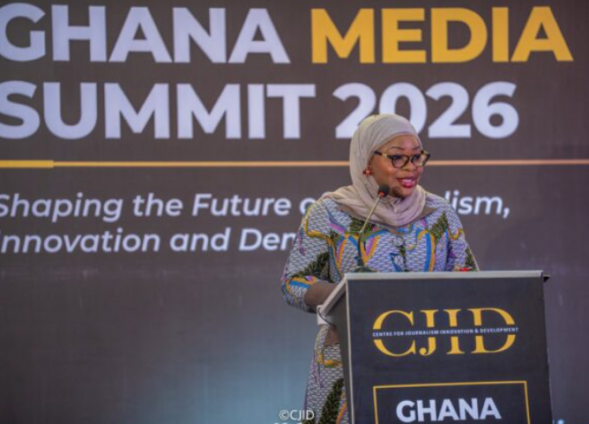
Deputy Government Spokesperson, Shamima Muslim, has praised the long-standing interaction between the media and successive governments, describing it as a key force behind Ghana’s democratic development and public accountability.
She said the media’s persistent scrutiny of government, together with the willingness of public institutions to respond to legitimate criticism, had helped the country navigate moments when democratic principles and transparency were under pressure.
Ms Muslim made the remarks at the Ghana Journalists Association’s 77th Anniversary Symposium and Lecture on Wednesday, August 19, 2026.
She said the media had played an important role in promoting the public’s right to information and bringing alleged corruption and abuse of public resources to national attention.
“Closely linked to the issue of right to information is our national anti-corruption and accountability campaigns,” she said.
According to her, investigations involving media organisations and institutions such as Parliament, the Public Accounts Committee, the Commission on Human Rights and Administrative Justice (CHRAJ) and the Office of the Special Prosecutor (OSP) had helped uncover several cases of public concern.
She said these efforts had reinforced the principle that individuals entrusted with public resources must be answerable for their actions.
“They have all contributed in exposing major scandals that shook the foundations of our democracy and that put the fear of the Lord in those who wield power and control the public purse,” Ms Muslim said.
The Deputy Government Spokesperson also highlighted the contribution of the media to constitutional and national reform discussions.
She cited the media’s engagement with the Constitution Review Commission in 2010, as well as more recent national processes, as examples of areas where government and the media had worked towards common national objectives.
She said media-led public education had also helped improve citizens’ understanding of voter registration and electoral processes.
Ms Muslim added that sustained media coverage had contributed to greater transparency in elections by increasing public awareness and scrutiny of the various stages of the electoral process.
“It has deepened transparency also in our election processes, from our ballot papers to our ballot boxes and all the things that we do to ensure we protect the choice and the will of the people,” she said.
She maintained that Ghana’s democratic gains could not be protected without continued cooperation between the media and state institutions.
“This couldn’t have happened without the holy alliance playing out between you and us,” she added.
Latest Stories
-
Legal tussle as ASG-ARC dispute moves to court
3 minutes -
‘Give caucus leaders adequate time to speak before ruling’ – Afenyo-Markin to Bagbin
8 minutes -
Petrosol gives back to society by donating 3,600 books and bags to Sawla DA Primary
15 minutes -
Bagbin dismisses Minority motion on narcotics seizures as inadmissible
20 minutes -
From Oversight to Impact: Why board committees will make or break Africa’s organisations
24 minutes -
‘Strong criticism is legitimate but insult is not argument’ – Speaker urges restraint in public discourse
26 minutes -
‘Don’t reward only bitter tongues’ – Bagbin tells political party leaders
26 minutes -
Nana Akua wins Dubai trip as Joy FM, Adansi Travels mark 10-year partnership
26 minutes -
NPP NEC election: John Boadu, JFK, Titus-Glover and Hawa Koomson in strong lead, according to latest national outlook survey
37 minutes -
TRAFFITECH-GH full implementation rescheduled to November 1
38 minutes -
‘Insults must not replace arguments’ – Bagbin cautions political actors against language that could undermine democracy
42 minutes -
Minority demands full data on Ghana narcotics seizures, arrests and prosecutions since 2025
45 minutes -
Man City found guilty of all charges of financial rule breaches, Premier League confirms
1 hour -
Jeffrey Nortey wins Screen Icon of the Year again at Ghana Entertainment Awards USA
1 hour -
Man Utd do not deserve Man City titles – Rooney
1 hour