

Audio By Carbonatix
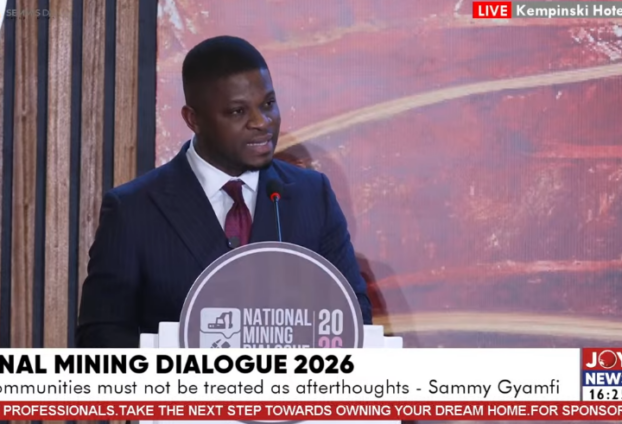
Chief Executive Officer of the Ghana Gold Board (GoldBod), Sammy Gyamfi, has called for greater local ownership and participation in Ghana’s mining industry, arguing that communities where mineral resources are extracted must benefit more directly from the wealth generated.
Speaking at a National Mining Dialogue on the theme “Rethinking the Social License to Operate”, organised by Asempa FM in partnership with GoldBod, the Ghana Medical Trust Fund and other stakeholders, Mr Gyamfi said mining communities should no longer be treated merely as locations where resources are extracted but must be recognised as key partners in the development of the sector.
“Mining communities must be treated as development partners and economic shareholders,” he said.
He questioned why, after more than a century of commercial gold mining in Ghana, many mining communities continue to have limited ownership and participation in the value generated from the country’s mineral resources.
According to him, Ghana’s mining sector has historically been largely foreign-led, with significant portions of the value generated from mining leaving the country through ownership structures, financing arrangements, imported inputs and offshore services.
“Ghana has mined gold commercially for more than a century. Yet for most of this long history, Ghanaians have not been the real owners of the mines,” Mr Gyamfi said.
He cited Obuasi as a clear example of the gap between mineral wealth and local development, questioning why the mining town has not achieved comparable levels of industrial development, investment and economic opportunities seen in other major mining cities such as Johannesburg.
Mr Gyamfi stressed that the mere presence of mineral resources does not automatically translate into economic transformation.
“Mines do not build niches by themselves. Niches build value through deliberate ownership, comprehensive partnerships, infrastructure linkages and disciplined policy management,” he stated.
He said Ghana must pursue policies that increase local ownership, strengthen domestic supply chains and promote value addition within the country.
According to him, the focus should be on ensuring that more of Ghana’s minerals are processed and transformed locally rather than exported in raw or minimally processed forms.
“If we want a new story, we must own more, provide more, process more, fabricate more and retain more. It’s as simple as that,” Mr Gyamfi said.
He argued that such an approach would enable mining communities and the wider Ghanaian economy to retain a greater share of the wealth generated from the country’s natural resources.
Latest Stories
-
US ban on Canadian alcohol and dairy takes effect as trade war drags on
4 minutes -
Baffour Awuah’s EOCO case reopens Equity Savings & Loans file as SIC recovery battle emerges
5 minutes -
Ghana ranked 5th source of cocaine seized at Antwerp, Belgium in 2025
5 minutes -
‘We knew there was disruption’ – Gambia boss claims Ghana players clashed at half-time
6 minutes -
Bagbin adjourns Parliament indefinitely
37 minutes -
African Most Beautiful USA Queen to host Community Zumba Dance session in Accra
37 minutes -
Cocaine probe: Speaker got it wrong by blocking parliamentary inquiry – Minority Leader
50 minutes -
FoSCel foundation calls for end to stigma and stereotyping against people living with sickle cell disease
1 hour -
Auditor-General to track audit recommendations as GH¢280.5m in surcharges remains unpaid
1 hour -
Walewale MP withdraws ‘rude’ comment on Bagbin’s Parliament recall, apologises
1 hour -
FoSCel founder urges curriculum reform to strengthen sickle cell education in Ghana
1 hour -
United States launches America.Gov for public services 5 years after Dr. Bawumia launched Ghana’s version Ghana.Gov
2 hours -
Cocaine probe: Majority used super majority with Speaker’s support to weaken Parliament – Afenyo-Markin
2 hours -
UGMC Research Director calls for deliberate pathway from research to patient care
2 hours -
IEAG calls on FDA to resolve delays in import code issuance
2 hours