

Audio By Carbonatix
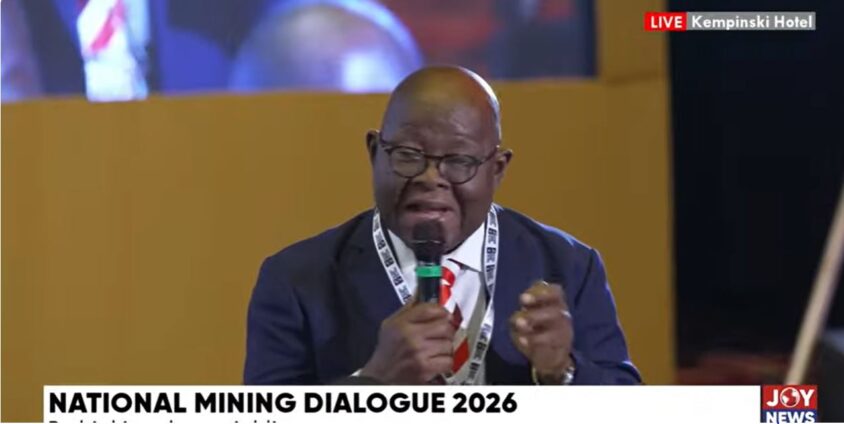
Former Speaker of Parliament, Prof. Aaron Mike Oquaye, has called for Ghana to take greater ownership and control of its mineral resources, arguing that the country must move beyond the traditional system of relying on royalties from foreign mining companies.
Speaking at the National Mining Dialogue 2026, Prof. Oquaye said Ghana’s gold, bauxite, diamond, manganese, lithium and oil resources represent a critical opportunity for economic transformation and must be managed in a way that delivers greater value to Ghanaians.
He said decades of reliance on royalties had not produced the level of economic transformation Ghana needs.
According to him, Ghana has repeatedly turned to the International Monetary Fund for financial assistance while possessing significant natural resources that could provide a stronger foundation for national development.
He questioned why Ghana had largely missed out on previous major global economic transformations, including the industrial revolution, and warned that the country risked being left behind again in the current ICT and knowledge-driven economy.
Prof. Oquaye said Ghana must therefore rethink how it manages its natural resources and ensure that the country has meaningful ownership of the minerals extracted from its soil.
He argued that foreign investors could still play a role by providing capital and expertise without necessarily owning Ghana’s mineral resources.
“If we talk about capital, none of those European countries hold back some money and bring them when you have the mineral. And it is true that if it is a bankable project, you will get money from the international capital market,” he said.
He also rejected the argument that Ghana lacked the technical expertise to take greater control of mining operations.
According to him, there are Ghanaian companies with significant experience in mining, while international experts can also be contracted where specialised expertise is required.
Prof. Oquaye said the key issue was for Ghana to retain ownership of the mineral product while engaging local and international expertise to support its exploitation.
He further advocated greater value addition to Ghana’s minerals, arguing that ownership would enable the country to develop industries around the resources and benefit from their by-products.
He noted that Ghana currently lacked sufficiently developed gold manufacturing capacity and said owning the metal would provide a stronger foundation for building such industries.
The former Speaker also acknowledged concerns about the management of state-owned enterprises, particularly the risk of political interference.
However, he said this should not prevent Ghana from pursuing national ownership because professional management could be secured locally or internationally.
“Today in this world, management can all be ceded to expertise abroad. It means therefore that ultimately we have no problem,” he said.
Prof. Oquaye also linked the need for greater national ownership to Ghana’s unemployment challenge, noting that young people continue to face significant difficulties finding jobs despite the country’s considerable natural wealth.
He said the ultimate objective should be to ensure that Ghana’s mineral resources create jobs, support industrialisation and improve the welfare of future generations.
The former Speaker urged Ghanaians to give serious consideration to a new approach to managing the country’s natural resources.
“God has given us that to save us, and we better take charge of our mines and other mineral resources,” he said.
His call echoes a broader debate in Ghana over national ownership of mineral resources, with the Institute of Economic Affairs also advocating greater Ghanaian control and value retention from the sector.
Prof. Oquaye congratulated the organisers of the National Mining Dialogue 2026, describing the initiative as an important platform for examining how Ghana can manage its mineral wealth in the national interest.
The National Mining Dialogue event is organised by Asempa 94.7 FM and its flagship programme, Ekosiisen, in partnership with Semmis DS and the Ministry of Lands and Natural Resources.
Latest Stories
-
GPL 2026/27: Medeama ease past Basake Holy Stars
32 minutes -
Appiah Adomako writes: Why DVLA must stop treating every expired licence holder as delinquent
36 minutes -
Localization must transfer decision-making power, not just project responsibilities
45 minutes -
Modernising Ghana’s traditional markets through the 24-Hour Economy markets initiative
47 minutes -
New economy will boost local production and create jobs – Finance Minister
53 minutes -
Real-Time VAT on cross-border digital services – not a new tax and does not violate double taxation principle
2 hours -
Digitalisation, AI key to Ghana’s tourism transformation – GHATOF
2 hours -
Stronger GTA-private sector partnership needed to grow tourism – GHATOF
2 hours -
Amazon eyes Ghana for broadband expansion after talks with Mahama
3 hours -
National Investment Quiz 2026: Six schools qualify for quarter-finals
3 hours -
‘Do not let Russia pay for its madness with lives of your people’ – Zelensky to Ghana, 46 other countries
3 hours -
6,079 promotion cases fully processed and paid – CAGD says amid nationwide teachers’ strike
4 hours -
Teacher unions to meet government Monday over nationwide strike
4 hours -
Photo story: Republic Bank-JoyNews Habitat Fair clinic wraps up after three days of housing solutions, expert engagement
4 hours -
National Peace Council urges investment in youth to sustain Ghana’s peace
4 hours