

Audio By Carbonatix
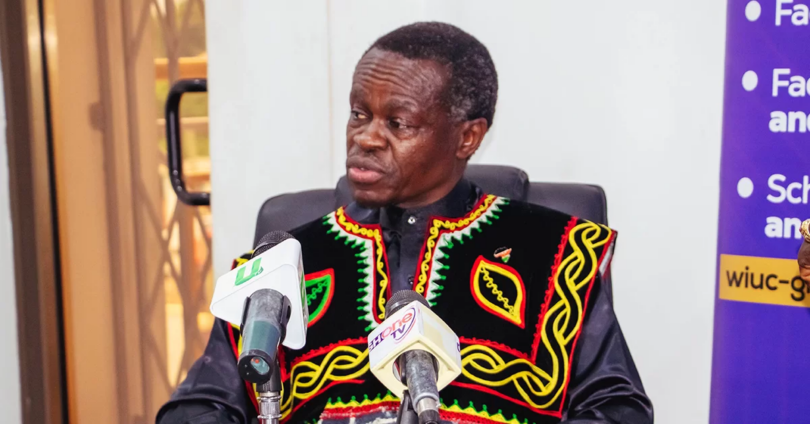
Renowned Pan-Africanist and anti-corruption crusader Professor P.L.O. Lumumba has warned that Africa’s continued dependence on foreign powers for its medicines, food, technology and global narrative represents a major unfinished chapter of Osagyefo Dr Kwame Nkrumah’s vision.
Speaking at NkrumahFest 2026 in Nkroful in the Ellembelle District of the Western Region, Prof. Lumumba said the most meaningful way to honour Nkrumah was to confront the challenges that continue to prevent African countries from becoming genuinely self-reliant.
The Kenyan scholar and public speaker said Nkrumah’s legacy went beyond Ghana’s independence, arguing that the former leader sought an Africa capable of determining its own political and economic destiny.
He said Nkrumah understood from Ghana’s independence in 1957 that the liberation of one African country could not be separated from the freedom of the continent.
“Ghana was free, but the independence of Ghana meant nothing if the rest of Africa was not free.”
Prof. Lumumba said Nkrumah’s Pan-African outlook made Ghana a centre for liberation movements and attracted leaders and intellectuals from across Africa and the diaspora.
He cited Julius Nyerere, Milton Obote, Kenneth Kaunda, Hastings Kamuzu Banda, Dawda Jawara, Jomo Kenyatta, Robert Sobukwe, Nelson Mandela, Sam Nujoma, Agostinho Neto, Eduardo Mondlane and Amílcar Cabral, among others.
He also highlighted the influence of figures such as W.E.B. Du Bois, George Padmore and Martin Luther King Jr., who were associated with Ghana during Nkrumah’s era.
Prof. Lumumba said Nkrumah’s call for African unity was not simply about political solidarity but also about the continent acquiring the capacity to provide for itself.
He recalled Nkrumah’s involvement in the Pan-African conferences of the late 1950s and early 1960s and his role in the movement towards the creation of the Organisation of African Unity (OAU).
In May 1963, 32 independent African states met in Addis Ababa, Ethiopia, culminating in the establishment of the OAU. The African Union identifies the OAU as a manifestation of the Pan-African vision of an Africa that was united, free and in control of its own destiny.
Prof. Lumumba said Nkrumah’s warning was that Africa could regain its political independence while remaining vulnerable economically and strategically if it failed to unite.
He said subsequent developments had demonstrated the relevance of that warning.
Prof. Lumumba argued that Africa’s continuing dependence on imported essentials was inconsistent with the self-reliant continent Nkrumah envisaged.
“When we are sick, we do not make medicine to cure ourselves.”
He said the same challenge applied to food production, agriculture, technology and industrialisation, arguing that Africa must develop the capacity to produce what its people need.
He also criticised the continent’s dependence on international media organisations to shape narratives about Africa.
According to him, Nkrumah’s vision of a Pan-African press was intended to ensure that Africans could tell their own stories rather than rely predominantly on foreign media organisations.
Prof. Lumumba said the continuing conflicts and insecurity in parts of Africa should also prompt a reassessment of the continent’s progress towards Nkrumah’s vision.
He cited conflicts in Somalia, Sudan and Cameroon’s Anglophone regions, terrorism in the Sahel and the migration of young Africans in search of opportunities abroad.
He said Nkrumah would be concerned by circumstances that force young Africans to leave the continent in search of better prospects.
“There is work to be done.”
He urged Africans to create conditions that would provide opportunities for young people at home and strengthen the continent’s capacity to determine its own future.
Prof. Lumumba used the internet and a drone capturing the NkrumahFest proceedings as examples of Africa’s technological dependence.
He observed that although Africans increasingly use sophisticated technologies, much of the equipment remains manufactured outside the continent.
He therefore called for greater African investment in science, technology and innovation so that the continent could move from being predominantly a consumer to becoming a producer.
“We look forward to the day when it will be different.”
He linked that ambition to Nkrumah’s development strategy, including his emphasis on energy infrastructure and the Akosombo project.
Prof. Lumumba said Nkrumah’s legacy should not be reduced to commemorative speeches and annual festivities.
He urged the current generation to translate the former leader’s ideas into practical efforts to strengthen African unity, food security, healthcare, technology, energy production and control over the continent’s narrative.
“We are not here just for an annual jamboree. We are here because we know that the work that was started by Kwame Nkrumah is incomplete.”
He said the responsibility of the present generation was therefore to ensure that Nkrumah’s vision of a united and self-reliant Africa did not remain merely a historical aspiration.
NkrumahFest 2026, held in Nkroful, was organised to commemorate Nkrumah’s 117th birthday under the theme “Nkrumah @117: Celebrating His Enduring Legacy – Africa Must Unite or Perish.”
Latest Stories
-
Tribute, tears flow as family bids farewell to 20-year-old law student
5 minutes -
2026 World Cup: Why pay a purse holder $10,000? – Assafuah questions Black Stars spending
21 minutes -
Stakeholders call for coordinated response to adolescent health challenges
33 minutes -
CNN and MS NOW say reporters denied White House access after Trump banned some media outlets
40 minutes -
Mahama directs AMA, sister assemblies to prevent renewed dumping at Agbogbloshie
47 minutes -
Deputy Health Minister charges military nurses to uphold compassion, excellence
58 minutes -
Deputy Health Minister charges military nurses, midwives to remain dedicated to service
1 hour -
Three suspected robbers killed as police dismantle gang in Upper East
1 hour -
EU Ambassador pays courtesy call on IGP to strengthen security cooperation
1 hour -
Africa’s dependence on foreign powers betrays Nkrumah’s unfinished vision – P.L.O. Lumumba
1 hour -
3 suspects shot dead, 2 officers injured in Tilly Forest robbery follow-up operation
1 hour -
Nkrumah’s unfinished Pan-African project must be completed – P.L.O. Lumumba
2 hours -
Mysterious illness leaves children struggling to walk, hear as Mafi Kope community appeals for urgent medical help
2 hours -
Ghana begins free rabies vaccination for 25,000 pets
2 hours -
Ghana Navy strengthens operational readiness with specialist seaman gunners training
2 hours