

Audio By Carbonatix
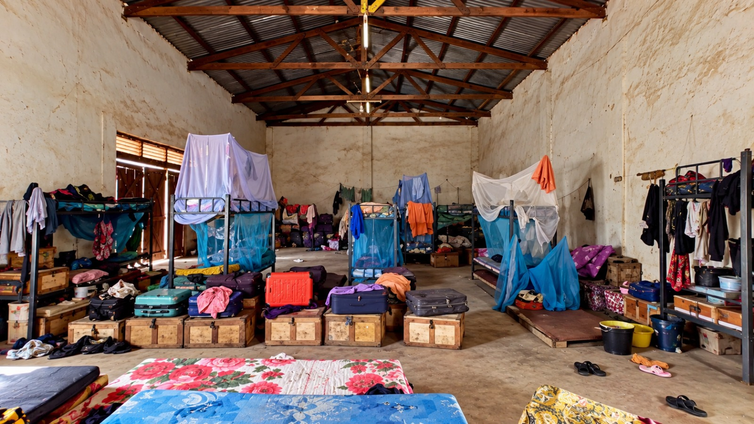
Students of the Navrongo Vocational Training Centre, also known as the Technology Solutions Centre, in the Kassena-Nankana Municipality of the Upper East Region, are studying under difficult conditions due to inadequate infrastructure.
The school lacks adequate classrooms, dormitories, furniture, toilet facilities, and a dining hall, affecting teaching, learning and the welfare of students.
The dormitories are overcrowded, with leaking roofs and no beds, forcing students to sleep on mattresses placed directly on the floor.
“Our dormitories are crowded and full of holes in the roofs. We would be sleeping, and all sorts of animals come into the dormitory,” one student said.
The situation is particularly challenging for female students, who have to use the school’s makeshift bathrooms constructed with wood and zinc sheets, offering little privacy.

“There is no privacy with the bathroom. Sometimes we would be bathing while people from the community are passing by,” a female student said.
The school also lacks adequate toilet facilities, forcing some students to resort to open defecation.
“We have no toilet facility, so we have no place to free ourselves. During the rainy seasons, we normally hide in bushes to free ourselves,” another student disclosed.
In the classrooms, inadequate furniture forces some students to stand and lean against walls while taking notes during lessons.
The school also has no dining hall and relies on the workshop of a nearby private mechanic as a temporary dining area, where students' plates are placed on the floor for meals to be served.
“We are served our food as though we are slaves or prisoners,” one student remarked. To help address the infrastructure challenges, Engage Now Africa, a non-governmental organisation working to improve living conditions in deprived communities, has cut sod for the construction of a 10-unit classroom block for the school.

The project, which is fully funded by the ASEA Advancing Life Foundation, is expected to be completed within eight months.
It is intended to provide additional classroom space, improve teaching and learning conditions and support technical and vocational skills development.
Speaking at the ceremony, the Country Director of Engage Now Africa, Cecilia Amankwah, said the organisation had previously provided a mechanised borehole for the school.
She explained that following further appeals from the Member of Parliament for Navrongo Central and an assessment of the school's infrastructure needs, the organisation decided to undertake additional interventions.
“Looking at what we have seen, we went back to assess what we could do to help improve the infrastructure. When we went back to ASEA, they also helped us develop a comprehensive plan for transforming this entire school. We have decided to start with one thing at a time,” she said.

Ms Amankwah explained that the construction of classrooms was the immediate priority, while the organisation continued to consider other infrastructure needs.
“Our first priority is the classrooms, because that is where knowledge is imparted and where learning takes place, while we continue to consider the other infrastructure needs and how best to address them in the future,” she added.
The Member of Parliament for Navrongo Central, Simon Aworigo, commended Engage Now Africa and the ASEA Advancing Life Foundation for their support towards improving educational infrastructure and vocational skills training in the constituency.
“This is the kind of partnership that changes lives, transforms societies and strengthens communities. It is a partnership that gives hope and creates opportunities for development,” he said.
He expressed hope that the partnership would continue to support development initiatives in Navrongo and other parts of Ghana.
The Paramount Chief of the Navrongo Traditional Area, Pe Aneakwoa Balinia Adda Asagpaare III, also welcomed the intervention and called on stakeholders to support Engage Now Africa to ensure the successful completion of the project.

When completed, the 10-unit classroom block is expected to improve the learning environment and increase the school's capacity to provide technical and vocational training.
The intervention is also expected to create opportunities for more young people to acquire practical skills for employment and self-employment.
However, the school will still require additional investments in dormitories, sanitation facilities, classroom furniture and dining infrastructure to fully address the challenges affecting students' welfare.
Latest Stories
-
How does a Ghanaian team make it to the BAL?
7 minutes -
Ghana’s investment climate presents opportunities for industrial growth, job creation.
8 minutes -
‘I paid thousands to a company for jobs that never came’
21 minutes -
SSNIT intensifies informal sector enrolment drive with Techiman float
45 minutes -
Ghana seeks long-term mining investments that benefit local communities – Armah-Kofi Buah
52 minutes -
GHATOF demands compensation for 85 businesses affected by La Pleasure Beach demolition
57 minutes -
Bono Regional Minister calls for investor education to drive economic growth
1 hour -
Ghana’s Ambassador to China, Kojo Bonsu, presents credentials to Nepalese President
1 hour -
Fairtrade Africa’s Cocoa Hubs Project strengthens rural service centres in cocoa-growing communities
1 hour -
MPs are not development officers – Edem Kpotosu
1 hour -
SEC cautions investors against fraudulent investment schemes
1 hour -
Land Ministry urges rCOMSDEP operators to reserve earnings for land reclamation
1 hour -
Commercial drivers give authorities one week to clear traders from lorry terminals, bus stops
1 hour -
Trump calls off livestream of Fort Hood attacker’s execution by firing squad
1 hour -
Nana B denies claims that Kojo Bamba was his driver and bodyguard
2 hours