

Audio By Carbonatix
Sexist attitudes are "rife" in school textbooks used in developing countries, according to Unesco.
The United Nations agency, marking International Women's Day, says negative stereotyping undermines the education of girls.
It says too often female figures are represented in textbooks as "nurturing drudges" in domestic roles.
This is a "hidden obstacle" to gender equality, says Unesco's Manos Antoninis.
What is International Women's Day?
Held on 8 March every year since 1913, and recognised by the United Nations since 1975.
The UN says it's a time to reflect on progress made, to call for change and to celebrate acts of courage and determination by ordinary women who have played an extraordinary role in the history of their countries and communities.
The theme of this year's day is "Planet 50-50 by 2030" - aiming to achieve global equality in areas such as education and end all forms of discrimination.
People can visit the IWD website and make a "pledge for parity", which also shows where events are happening. There is also a Women of the World Festival at London's Southbank which runs until 13 March.
Unesco has campaigned to provide education for tens of millions of children without access to school - and in many poorer countries girls are the most likely to miss out.
This report highlights how female characters frequently appear in a secondary role in the books they use at school - and warns that it limits girls' career expectations.
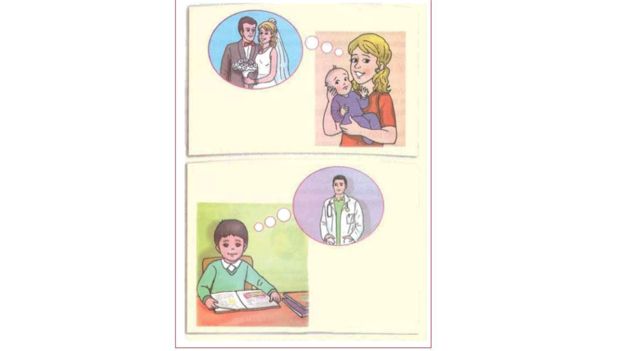
What do you want to do when you grow up? From a Turkish textbook
"Ensuring all boys and girls go to school is only part of the battle," says Manos Antoninis, from Unesco's global education monitoring report.
"What they are being taught is equally, if not more, important. Persistent gender bias in textbooks is sapping girls' motivation, self-esteem and participation in school."
Unesco is inviting people to send in their own examples from text books, using the Twitter hashtag #BetweentheLines.
With examples from countries in Asia and Africa, the report says that men in textbooks are more likely to be depicted as business leaders, shopkeepers, engineers, scientists and politicians, while women remain likely to be seen in roles such as cooking or childcare.
Apart from gender stereotyping, the study says that text books are much more likely to depict men than women - and that is even more pronounced in science or maths text books.
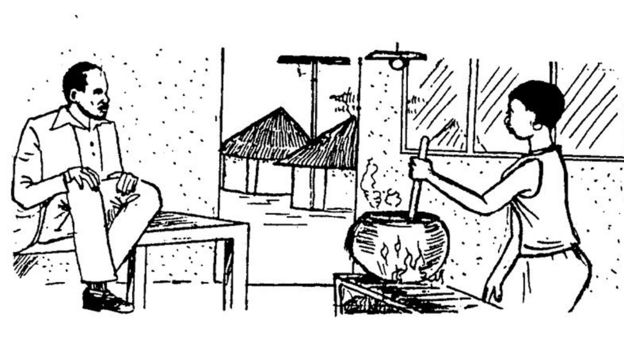
Textbook illustrations are criticised for perpetuating negative stereotypes
It says that in some cases only about one in 20 characters in science textbooks is female.
But the report says that there has been only slow progress in trying to get more equal representation.
It says there has been a lack of political will to pursue this and in some cases resistance from those responsible for school curricula or for producing textbooks.
Also marking International Women's Day is a report, Poverty is Sexist, from the development campaign group, One.
It says that gender inequality and poverty are interlinked, with women in poor countries, particularly in sub-Saharan Africa, likely to be worse off than their male counterparts.
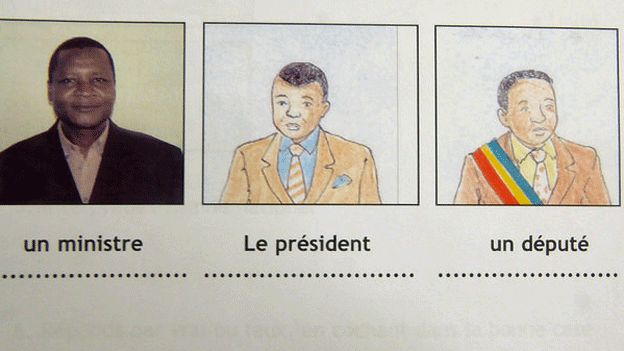
What does a politician look like? A textbook from DR Congo.
The report says there are half a billion women around the world who cannot read - two thirds of the global total. As an example, in Mali, 93% of girls will never attend school.
The campaign has drawn up a list of countries where it is "toughest to be born a girl", based on criteria such as access to health and education, economic opportunities, access to a bank account and political representation.
The top 10 in this ranking are: Niger, Somalia, Mali, Central African Republic, Yemen, DR Congo, Afghanistan, Cote d'Ivoire, Chad and Comoros.
Latest Stories
-
Rule of law must be protected – GBA condemns EOCO action against Baffour Awuah
16 minutes -
950,000 barrels of Sankofa crude head to TOR as GNPC deepens domestic refining
28 minutes -
Scales of deception removed – Annoh-Dompreh attacks new cocoa price
40 minutes -
Young Positivist Writes : My Experience with GCLP
2 hours -
Strong Day 1 turnout sets tone for Day 2 of Republic Bank-JoyNews Habitat Fair Clinic
2 hours -
Ghana Army warns new soldiers against social media misuse, uniform abuse
3 hours -
AMA calls for science-led action to tackle environmental health risks in Accra
3 hours -
NPP Canada Organizer BigMo urges Diaspora to support Kodua Frimpong
4 hours -
He entered at eight. He is now 16: Ghana’s children growing up in prayer camps
7 hours -
‘Development must not always begin from Accra’ — Anwelle Foundation launched in Jirapa
7 hours -
PKO trio eye victories at Odwira Festival
9 hours -
346 Ghana Navy recruits pass out after 26 weeks of intensive training
9 hours -
Newsfile to discuss EOCO-MP arrest, drug trafficking, speech arrests and $235m water debt
10 hours -
JoyNews gets results as listeners raise GH¢40,000 to help 17-year-old student with cerebral palsy attend SHS
10 hours -
Vice President calls for stronger local pharmaceutical production to reduce medicine imports
11 hours