

Audio By Carbonatix
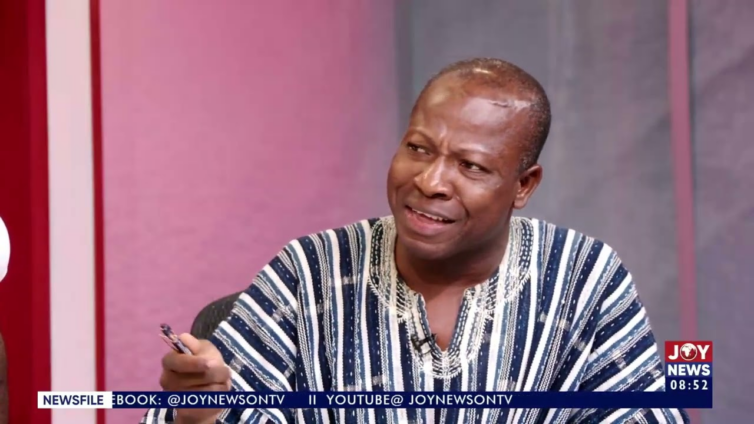
CEO of the Centre for Conflict and Security Studies (CenCES) and lecturer at the University of Professional Studies, Accra (UPSA), Dr James Kwabena Bomfeh Jnr, has said the Attorney General has a duty to account to Ghanaians for information available to his office concerning the alleged bribery scandal linked to the AKSA power deal, regardless of public concerns about mistrust in state institutions.
Dr Bomfeh said the Attorney General and Parliament may face questions over their handling of the matter, but that should not prevent the public from engaging with and demanding answers from those institutions.
Speaking on JoyNews’ Newsfile on Saturday, August 15, during a discussion on the AKSA power deal, he said the Attorney General “owes it to us” to explain what information his office has received about the case and what action is being taken.
“The Ghanaian public that pays the OSP and pays the Attorney General, what have they told us? I think the Attorney General owes it to us to tell us what information he has,” Dr Bomfeh said.
He added that the Attorney General should either disclose the information available to his office or demonstrate that steps are being taken to act on it.
“Or he should be seen taking steps to actualise what information is available to them regarding this particular matter,” he said.
His comments follow renewed attention to the controversial power transaction after a United States prosecution involving former Goldman Sachs banker Asante Kwaku Berko brought allegations of bribery connected to the power deal back into the spotlight.
Dr Bomfeh acknowledged that there were concerns about public confidence in institutions such as Parliament and the Attorney General’s office.
However, he said that doubts about their credibility could not justify abandoning the institutions or refusing to engage them in addressing matters of national interest.
“So yes, there's doubt. Yet we have got to work with these institutions,” he said.
He proposed a broader process involving institutions and groups outside government to examine the AKSA matter and related concerns about public contracts and the management of state resources.
“What we can do is to say that we open up and discuss beyond the Attorney General's office and Parliament, because the two institutions all have something to do with where we are now,” he said.
Dr Bomfeh proposed the establishment of a cross-sectoral committee or commission involving traditional leaders, religious leaders, the media, civil society organisations and, where possible, student groups.
“I want to suggest that there is a cross-sectoral committee or commission made up of chiefs, the clergy, the media, civil society, and if possible, student groups to interrogate this,” he said.
He said the proposal was necessary because the AKSA controversy was not an isolated matter and raised wider questions about how Ghana handles public contracts, particularly when governments are under pressure to respond to emergencies or other national challenges.
“What we are discussing is just one issue that touches on a number of other issues,” he said.
Dr Bomfeh said a key part of any investigation should be to establish where funds went and who benefited from the transactions.
“What we should be doing is first and foremost, follow the money. That's number one,” he said.
He said that a range of state and non-state institutions should be involved in examining the matter, even if there are concerns about their ability to act independently.
“All of us, even though we have issues of trust, we have no option but to go into these things. So yes, let's give ourselves the benefit of the doubt.”
Latest Stories
-
Kobe Boujee joins Olympics.com team for Dakar 2026 Youth Olympic Games
4 minutes -
Slaty egret’s shifting nesting sites offer clues to changing ecosystems
11 minutes -
First phase of arrears for promoted teachers to be paid on Friday – Haruna Iddrisu announces
14 minutes -
Caveman Watches partners with Mfantsipim School for 150th anniversary
35 minutes -
We’ll pursue GH¢15m defamation suit against Sammy Gyamfi to its logical conclusion – Afenyo-Markin’s lawyers
36 minutes -
Martin Kpebu urges Afenyo-Markin not to return to court over Sammy Gyamfi lawsuit
45 minutes -
GRA submits preliminary report on drug shipment case to Mahama – Commissioner-General
1 hour -
Sammy Gyamfi using ‘procedural roadblocks’ to dodge defamation case? – Afenyo-Markin’s lawyers
1 hour -
The illusion of a good deal: Why some everyday money-saving habits may be costing you more
1 hour -
Family seeks autopsy, police investigation into death of student 12 days after Abomosu SHS enrolment
2 hours -
Trade Minister urges employers to leverage industrial opportunities to create jobs
2 hours -
Asantehene plants trees to commence Jimi Watercourse Rehabilitation destroyed by galamsey
2 hours -
15 arrested, 6 trucks impounded over sandwinning activities on Kumasi-Accra Expressway
2 hours -
OFFICIAL: Vinicius will miss El Clásico, suspended four games
2 hours -
Prayer vigil held after four arson attack murders
2 hours