


Audio By Carbonatix
Absa Bank has set out to undo the most critical issue facing traders and small businesses in Ghana today - access to finance.
There is no doubt about it; SMEs contribute over 80% to the country’s GDP growth. These businesses are the bedrock of economic stimulation, advancement and stability. Ghana’s history and its performance to date is in some way attributable to the enterprising resourcefulness of its SMEs – especially micro-traders, artisans and small set-ups.
However, unlike their counterparts in large institutions, multinationals and other corporate setups, access to finance continue to be a critical bottleneck. In cases where access to finance becomes available, the rates are extremely high and exorbitant, which affects the willingness to apply or access.
The situation gets trickier when for specific loans, the insistence on collaterals is enforced to cut off a section of these small business operators. Many advocates have called for a second look at the economic regime and relaxed complications to enable such businesses to thrive.
The Ghana Union of Traders Association (GUTA), the mother body for most traders and retail businesses have often bemoaned the lack of flexibility in the financing regime and has called for government and the private sector to do something about it.
It is in this light, that Absa Bank Ghana partnered with the Mastercard foundation under the Young Africa Works (YAWS) scheme to fund and train 5,000 locally-owned businesses with the aim of creating 50,000 jobs in Ghana.
The 5-year (2020-2025) strategic partnership between Absa Bank Ghana and the Mastercard Foundation (MCF) has a goal to create dignified and fulfilling jobs for young men and women in Ghana. The project also supports MSMEs through capacity building, training and lending.
As part of implementing its capacity-building mandate, YAWS will assign Business Development Service (BDS) providers to these individual SMEs to identify the gaps in their business operations and proffer bespoke training and solutions in addressing them.
After the training, these businesses would be further assessed for lending purposes to ensure their establishments' sustainability.
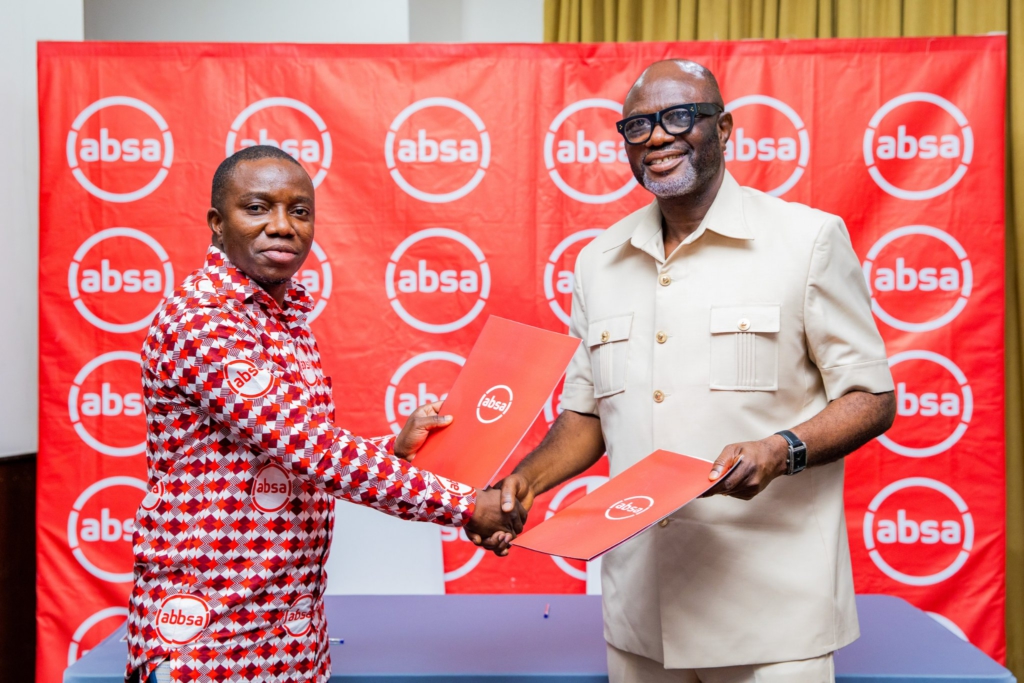
The other day in Accra, in front of over 350 members of GUTA, Absa signed a Memorandum of Understanding (MOU) with the executives of GUTA, outlining in great detail the terms of the partnership, including the nature of businesses that qualify to access loans under the YAWS scheme.
Absa Bank has even gone above its call of duty to defray a lot of associated costs that affect businesses when they access loans in Ghana. For example, the MOU allows businesses under GUTA to access loans of up to ¢500,000 without collateral and ¢1,000,000 without collateral to women-owned businesses, with an additional 1% discount for all eligible businesses.
“What Absa Bank has done is a welcome gesture in government’s drive to empower and sustain these businesses in advancing the country’s economic growth. I want to urge the traders and business folk gathered here to focus on how to carefully manage the returns on your business in order to ensure sustainability and continuity.
"Let us refrain from unnecessary spending on perishable items and instead reinvest in the business,’ said Deputy Minister, Nana Ama Dokuah, who was the special guest of honour at the MOU signing ceremony.
The faces of the traders at the ceremony reflected a high sense of optimism and excitement about the prospect of seeing their businesses transform with the partnership. To add to the energy in the room, videos of former loan recipients sharing testimonies of their transformation were shared on the screens by Absa Bank. These videos did a lot in reinforcing the viability of the partnership and a call to action.
Commenting on the collaboration with GUTA, Managing Director, Abena Osei-Poku, with excitement in her voice, highlighted what the association with GUTA means for the bank.
“I hope that by the end of this session and the signing of the MOU, you will be left in no doubt about Absa’s commitment to stand beside you, in ensuring that your success and growth are guaranteed, making you ready to participate fully in the huge opportunity that the African Continental Free Trade Agreement (AFCTA) presents. We hope to use this avenue to firmly entrench our position as the go-to bank for all your needs and expectations.”
So, whether you are a micro-level business operator or fall in the category of a medium-sized business in Ghana, you need not be burdened by the inadequate access to funds for expansion and diversification. The Absa – Mastercard Foundation partnership falls right into the heart of your specific need and is the panacea for overcoming future challenges in the sector.
Latest Stories
-
World Cup visa scandal: Sports Ministry not shielding anyone – Sports Minister’s special aide
18 minutes -
World Cup visa scandal: Over 30 people misrepresented as GTA board members to US Embassy – Vincent Assafuah alleges
19 minutes -
Fire destroys wooden structure near Yesu Mo Villa at Bush Road
21 minutes -
NDC threatens sanctions over oversized campaign posters, gives aspirants 5 days to comply
1 hour -
Star Oil paid GH¢2.7bn in taxes, levies in nine months of 2026
1 hour -
Samson’s Take: The rule of law is cheaper before the bulldozer
1 hour -
GRA blames system failure for delay in issuing receipt over passenger’s customs duty
2 hours -
Livestream: Newsfile discusses World Cup visa scandal, beach demolitions, education strikes, BRICS bid
2 hours -
NC-PTAs welcomes end of teachers’ strike, urges parents to prepare children for Monday
2 hours -
Government procures over 2,000 transformers as Ghana’s electricity access hits 89.13% – Energy Minister
2 hours -
UTAG-UG threatens strike on October 19 over unpaid allowance
3 hours -
Let The Constitution direct Chieftaincy to deliver “All Development Is Local”
4 hours -
John Jinapor outlines renewable energy, nuclear power priorities for 2027
4 hours -
Ghana explores centre of excellence for hearing, communication and cochlear implant care
5 hours -
Schizophrenia-related disorders lead mental health cases recorded in Ghana
6 hours