

Audio By Carbonatix
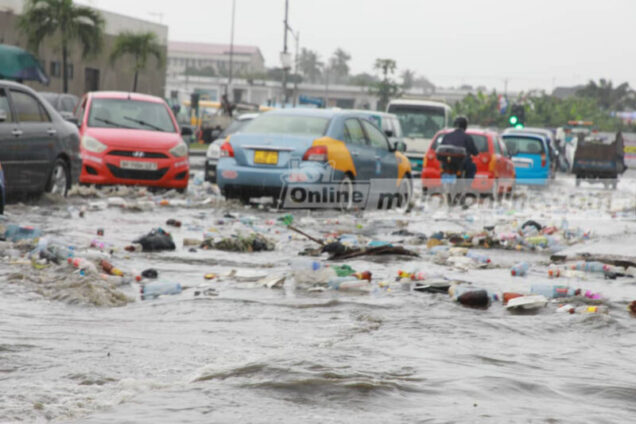
The Ghana Meteorological Agency (GMeT) has warned that Accra faces heightened flood risk this June, with rainfall totals projected between 100 and 150 millimetres across the coastal zone.
According to the agency, Accra’s flood vulnerability has worsened over the years, with as little as 30 millimetres of rainfall now enough to inundate parts of the city.
Speaking in an interview with Graphic Online, the Deputy Director and Head of Research and Applied Meteorology at the GMet, Francisca Martey, said the city’s capacity to absorb and drain rainwater had significantly reduced over the years due to human activities, making flooding more frequent and severe.
She explained that flooding in Accra was not caused solely by rainfall within the city, but also by runoff from surrounding communities, including areas on higher elevations.
“When it rains in Accra, Accra rains do not collect only in Accra. It counts Berekusu and other surrounding areas. All of them come to Accra,” she said.
Mrs Martey stated that natural flood retention areas that previously held excess rainwater had largely been taken over by development.
“All those places are naturally made to collect rainwater. Now all those places have been built into. So what are we expecting,” she questioned.
She said the situation could worsen this month given the rainfall projections.
Effect of urbanisation
According to her, urbanisation had concentrated stormwater into narrow drainage channels that are often unable to accommodate heavy flows.
“At first, the rain would spread over a broad area and gradually seep into the ground. Now we have brought all of it into narrow gutters.
Once the volume exceeds their capacity, the water spills out and floods surrounding areas,” she explained.
“When you get to Bel Aqua in Tema, you realise the area sits on a watercourse. The last time I travelled through there, it took me more than two hours to get from the overhead bridge to the junction after work. Bel Aqua is built on a watercourse, which contributes significantly to the flooding challenges in the area,” she said.
While stressing that GMet’s role was to provide weather forecasts and early warnings, she said city authorities, planners and engineers were best placed to implement long-term solutions.
“The city authorities know exactly what to do. The town and country planning authorities know exactly what to do. I give the forecast. They know what to do,” she said.
The warning forms part of GMet’s June 2026 Rainfall Outlook, which predicts predominantly wet conditions across most parts of the country, particularly within the Forest and Coastal zones.
In the Savannah Zone, including Navrongo, Zuarungu, Tamale, Walewale, Bole and Yendi, rainfall is expected to remain near normal, with stronger chances of normal to above-normal rainfall over Wa and Bolgatanga, where cumulative rainfall totals are projected to range between 150 and 210 millimetres.
The Transition Zone is expected to record varying rainfall patterns. Areas around Kintampo, Wenchi, Atebubu, Mim, Salaga and Kete Krachi are likely to experience normal to above-normal rainfall, with estimated totals of between 200 and 250 millimetres.
However, Bui, Sunyani, Dormaa and Ejura are forecast to experience normal to below-normal rainfall conditions.
In the Forest Zone, areas such as Dunkwa, Kumasi and Akim Oda are expected to record enhanced rainfall activity, with cumulative rainfall ranging between 200 and 400 millimetres.
Akuse and the surrounding communities, however, are expected to receive relatively lower rainfall amounts.
The Coastal Zone is forecast to experience predominantly normal to above-normal rainfall, with cumulative rainfall amounts projected between 100 and 150 millimetres.
Mrs Martey advised disaster management institutions to strengthen emergency preparedness measures due to the risk of localised flooding.
She said that although the anticipated rainfall would benefit agriculture and improve water availability, authorities and community leaders must remain vigilant and implement appropriate risk reduction measures.
Latest Stories
-
Mobile Money Fintech LTD, UMB train hairdressers and beauticians
18 minutes -
Asylum votes show people want help, says Kemi Badenoch
1 hour -
Badenoch welcomes expanded grooming gangs inquiry
1 hour -
GACL MD sues Samuel Buabeng over alleged Facebook defamation
2 hours -
Christa Pike in critical condition after surviving two lethal injections, lawyer says
2 hours -
Kemi Badenoch backs face covering ban at protest
2 hours -
Man City not ‘above the rules’, says No 10 after backlash to Burnham remarks
2 hours -
Real Madrid submit ‘substantial’ dossier in Barca payments case
2 hours -
Messi completes purchase of second Spanish club
2 hours -
Government must engage horticulturists on tomato crisis – GhIH
2 hours -
King Promise’s ‘Can’t Tame Us’ becomes official Chelsea anthem
2 hours -
Afenyo-Markin demands Baffour Awuah’s release from EOCO’s custody, end to alleged political intimidation
2 hours -
Rapper Rick Ross arrested on domestic violence charges
3 hours -
Minority demands security review of Ghana-Colombia visa waiver and port deals
3 hours -
Pursue drug kingpins, not persecute political opponents – Afenyo-Markin tells EOCO
3 hours