

Audio By Carbonatix
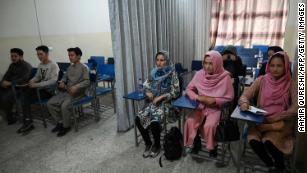
Afghanistan's public universities opened on Wednesday with female students allowed back on campus for the first time since the Taliban took over the country last year.
The Taliban administration has not officially announced its plan for female university students, but education officials said women were permitted to attend classes on the condition they were separated from male students.
Khalil Ahmad Bihsudwal, the head of Nangarhar University, told Reuters male and female students at the institution would attend separate classes.
A female medical student at the university, who asked not be named for security reasons, said classes had been split by gender, but it was not clear if women could be taught by male lecturers or interact with male students outside the classroom.
"Only our studying shifts are separated, although we have been told not to walk around the university until the boys' time is complete," she said.
"Despite all the changes and conditions, I still want to continue because my education should not be incomplete."
Shaker Wahidi, an Afghanistan Ministry of Higher Education official told CNN public universities in warmer provinces -- in Nangarhar, Paktia, Paktika, and Kandahar -- would reopen to all male and female students from Wednesday.
He added that universities in the colder areas of the country would be opening in March for both men and women.
Temperatures have plunged well below zero in the coldest parts of Afghanistan during a winter plagued by food shortages and a lack of foreign aid that was withdrawn when the Taliban resumed power on August 15.
Under their previous rule from 1996 to 2001, the hardline Islamist Taliban barred women and girls from education. But the group has been vague on its plans for the education of girls and women during its new rule.
Some private universities have reopened, but in many cases female students have not been able to return to class, and in many provinces girls have still not been allowed to return to high school.
Bilal Karimi, Taliban deputy spokesman confirmed to CNN the Afghanistan Education Ministry is working on a plan to restart girls' secondary education for the new school year on March 21.
The Taliban have denied claims that Afghan girls would be banned from secondary schools but said they needed to set up a secure transportation system for female students before allowing them back into the classrooms.
Human rights lawyer and researcher with Amnesty International's Crisis Response Program Nicolette Waldman welcomed the university openings but said more guidance is needed for younger students.
"Now waiting for similar news on secondary schools, which the vast majority of Afghan girls are still blocked from attending. #LetAfghanGirlsLearn," Waldman tweeted.
The international community has made education of girls and women a key part of its demands as the Taliban seek more foreign aid and the unfreezing of overseas assets.
Aid groups have raised the alarm that the stalled financial system and a stark drop in foreign funding that used to form the backbone of the economy are creating a humanitarian catastrophe in the country, already battered by decades of war.
The United Nations late on Tuesday praised the inclusion of female students at public universities.
"Let's all support the return of Afghan young female and male students to the universities across Afghanistan," the UN's Secretary General's Special Envoy for Afghanistan, Deborah Lyons, added in a Tweet.
"Supporters can consider a range of scholarship programs and ongoing support to female and male professors," she said.
An education official who asked not be named because he was not authorized to speak to the media said universities had been given different options to keep female students isolated, including separated classes and staggered operating hours.
On Wednesday, the US Treasury Department said international banks can transfer money to Afghanistan for humanitarian purposes, and aid groups are allowed to pay teachers and healthcare workers at state-run institutions without fear of breaching sanctions on the Taliban, according to Reuters.
The UN said more than half the country's 39 million people suffer extreme hunger and the economy, education and social services are facing collapse. UN Secretary-General Antonio Guterres last week warned Afghanistan was "hanging by a thread."
Latest Stories
-
GAEC must retain nuclear scientists for Ghana’s nuclear ambitions – Minister
20 minutes -
Man reportedly mistaken for game and shot by hunter dead in forest
22 minutes -
19-year-old mason jailed 15 years for defiling seven-year-old pupil
27 minutes -
Ghana’s banking sector assets rise 20.47% to GH¢500.2bn – BoG Governor
31 minutes -
22 injured as Sprinter bus overturns at Sege after tyre burst
32 minutes -
UN housing expert urges Ghana to strengthen Rent Control Department amid housing affordability concerns
41 minutes -
Delta-BCI partnership reaches 166,000 people with breast cancer education
50 minutes -
Power restoration fault suspected in Kumasi Central Market fire
6 hours -
The 7-foot giant of Ngleshie Amanfro: Seven-foot Ghanaian Ephraim Saawa dreams of joining the national basketball team
7 hours -
Government promises support for Kumasi Central Market fire victims
7 hours -
Vibes The Movie: Big Ghun’s Ghanaian film earns five nominations at 2026 REFFA
7 hours -
‘I’m a fulfilled man’—Justice Korbieh on missing out on Supreme Court despite two nominations
7 hours -
MamaCare CEO warns unresolved conflicts among health workers could undermine maternal and neonatal care
8 hours -
Health professionals urged to translate medical knowledge into practice to save mothers
8 hours -
Retired judge Justice Francis Korbieh charges 1,568 new lawyers to uphold integrity
9 hours