

Audio By Carbonatix
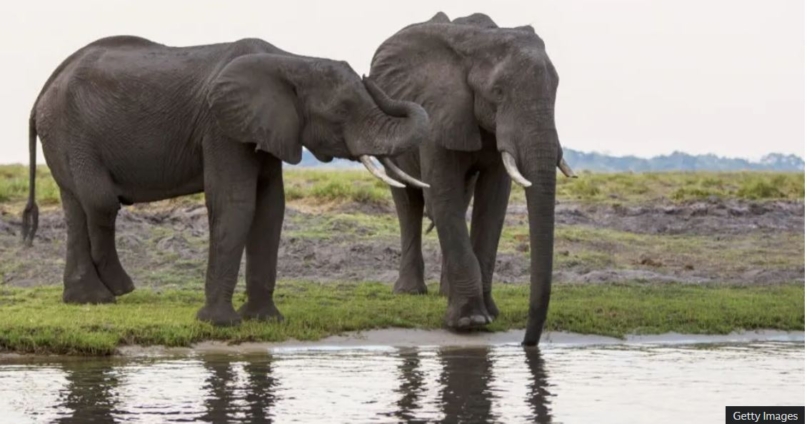
African elephants call each other and respond to individual names — something that few wild animals do, according to new research published Monday.
The names are one part of elephants’ low rumbles that they can hear over long distances across the savanna. Scientists believe that animals with complex social structures and family groups that separate and then reunite often may be more likely to use individual names.
“If you’re looking after a large family, you’ve got to be able to say, ‘Hey, Virginia, get over here!’” said Duke University ecologist Stuart Pimm, who was not involved in the study.
It’s extremely rare for wild animals to call each other by unique names. Humans have names, of course, and our dogs come when their names are called. Baby dolphins invent their own names, called signature whistles, and parrots may also use names.
Each of these naming species also possesses the ability to learn to pronounce unique new sounds throughout their lives — a rare talent that elephants also possess.
For the study in Nature Ecology & Evolution, biologists used machine learning to detect the use of names in a sound library of savanna elephant vocalizations recorded at Kenya’s Samburu National Reserve and Amboseli National Park.
The researchers followed the elephants in jeeps to observe who called out and who appeared to respond — for example, if a mother called to a calf or a matriarch called to a straggler who later rejoined the family group.
Analyzing only the audio data, the computer model predicted which elephant was being addressed 28% of the time, likely due to the inclusion of its name. When fed meaningless data, the model only accurately labelled 8% of calls.
“Just like humans, elephants use names but probably don’t use names in the majority of utterances, so we wouldn’t expect 100%,” said study author and Cornell University biologist Mickey Pardo.
Elephant rumbles include sounds that are below the range of human hearing. The scientists still don’t know which part of the vocalization is the name.
Researchers tested their results by playing recordings to individual elephants, who responded more energetically, ears flapping and trunk lifted, to recordings that contained their names. Sometimes elephants entirely ignored vocalizations addressed to others.
“Elephants are incredibly social, always talking and touching each other — this naming is probably one of the things that underpins their ability to communicate to individuals,” said co-author and Colorado State University ecologist George Wittemyer, who is also a scientific adviser for the nonprofit Save the Elephants.
“We just cracked open the door a bit to the elephant mind.”
Latest Stories
-
Ghana must stop turning rivers into gutters through encroachment – Kwadwo Poku
40 seconds -
‘We’ll never compromise on quality’ – Agbodza tells Accra-Kumasi bypass supervisors
6 minutes -
Roads Minister urges motorists to drive cautiously on Accra-Kumasi Highway
7 minutes -
Hohoe MCE appeals for more relief supplies as flooding displaces residents
8 minutes -
‘Free Salomey now!’ – Women march to EOCO over Salomey Awitey Baffoe’s continued detention
10 minutes -
GES appeals to teachers to rescind strike and return to class as efforts to resolve concerns intensify
10 minutes -
Effiduase hospital begins new maternity ward construction amid maternal health concerns
11 minutes -
World Vision calls for stronger prevention of child malnutrition across West Africa
12 minutes -
Ghana and Philippines agree to boost trade, investment and labour mobility
13 minutes -
Ziavi Chieftaincy dispute: E.P. Church Moderator appeals for peace
14 minutes -
Roads Minister rejects claims government has abandoned Accra-Kumasi by-pass project
16 minutes -
Rainfall in Togo driving rising floodwaters in Hohoe – MP
17 minutes -
Mrs Victoria Keren Lamiorkor Adomakoh
20 minutes -
PUWU postpones protest against private sector participation in ECG
20 minutes -
Remains of dozens of suspected kidnap victims found in Nigerian forests
21 minutes