

Audio By Carbonatix
The Governor of the Bank of Ghana has stated that all customers of the nine failed banks and over 95 per cent of customers of Specialised Deposit-taking Institutions (SDIs), which were affected by the banking sector clean-up have received their deposits.
Dr Ernest Addison said the first phase of the banking sector clean-up involved the revocation of licenses of nine banks, for which all depositors were paid in full.
“The second phase has to do with the SDIs – these are the savings and loans, microfinance institutions and finance houses. In their case, for individual depositors who have been fully paid, the data that we have suggests that more than 95% of depositors have been fully paid,” he said.
The Governor continued, “So there are just about 5% depositors who have large amounts, these are the high net worth individuals that were settled with loans which were to be retired over five years. So, we think that most of it has been done.”
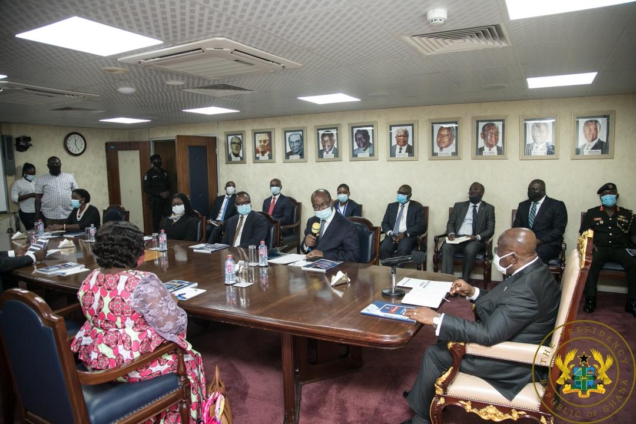
Dr Ernest Addison said this on Tuesday, when the President, Nana Akufo-Addo, visited the Bank of Ghana to familiarise himself with the operations of the Bank.
Touching on deposits of customers of GN Savings and Loans and First Allied Savings and Loans, the Bank of Ghana Governor noted that, over the last three weeks, all customers have been paid.
“The Government has provided a bond worth ¢1.7 billion, for which we have monetized ¢700 million. So, the receiver is also working at clearing the last few customers that are left in that segment. So, I think that we have made a lot of progress, Mr. President, with this depositor issue,” he added.
On helping to ensure the maintenance of a strong banking sector in the country, and to prevent the recurrence of a banking crisis, Dr Ernest Addison told President Akufo-Addo that the first step taken has been to pass the new corporate governance directive.
This, he said, had become necessary because, at the heart of the financial sector crises, was a breakdown in corporate governance in the various banks whose licenses were revoked.
“The second one has to do with misreporting of data, because of a lot of falsification of data by the financial institutions to the Central Bank.
So we have brought in a new technology which will allow us to get the data directly from sources, so that no human interventions will be in there to distort the data that they send,” the Governor indicated.
The third step, he added, “has to do with the capital verification process, because a lot of the banks reported that they had capital when, in fact, they didn't have any capital at all.”
He continued, “So we have reviewed the entire capital verification process of the bank, and it's almost impossible now for us to have a bank that doesn't have any capital, and yet it's allowed to operate, and, of course, in addition to that, for all the staff of the banking solution department we have had a lot of training programmes with the IMF and other technical assistance have been provided.”
To the President Akufo-Addo, the BoG Governor thanked him on behalf of the country’s banking sector for the role he played in sanitising the space, which has brought in its wake more confidence.
“Your clear leadership and understanding of the role of the financial sector in the government’s transformation agenda, gave the leadership of the Bank the confidence and courage to embark on the comprehensive banking sector reforms over the last three years, which saw an increase in the minimum capital requirements, clean-up of the financial sector by the revocation of licenses of weak and insolvent institutions, and a revamp of the regulatory framework to stabilise and strengthen the sector,” he added.
The clean-up of sector, he stressed, has resulted in a stable financial sector with fewer banks and Specialized Deposit-Taking Institutions (SDIs) that are well capitalised, liquid, and solvent, and better able to support our nation’s economic growth agenda.
“These efforts helped to earn the Bank international acclaim as the Central Bank of the Year in 2019.
“By the end of 2019, all the financial sector soundness indicators showed strong improvements as capital adequacy ratio, profitability, and liquidity levels increased significantly while non-performing loans declined,” he added.
Latest Stories
-
John Boadu pledges unity, reconciliation as he takes over as NPP National Chairman
1 minute -
‘Whatever the personal cost, I will not abandon my duty’ – Baffour Awuah assures Salomey Bafoh
3 minutes -
Government to increase funding for Houses of Chiefs to speed up dispute resolution
5 minutes -
Govt’ to introduce digital property rate system to boost MMDAs’ revenue – Mahama Ayariga
7 minutes -
Traditional Medicine Practice Council closes three unlicensed spa and massage centres in Ashanti Region
9 minutes -
Let’s accept the reality and move along – Mike Oquaye on NPP’s decision to make flagbearer party leader
11 minutes -
Early presidential primary helped cool tensions in NPP – Prof. Mike Oquaye
29 minutes -
NDC congratulates new NPP executives, urges national interest above party interests
31 minutes -
NPP implementing 2024 election review recommendations in stages – Prof Mike Oquaye
33 minutes -
Ghana Rugby Union announces managerial changes
33 minutes -
US removes all bombers from RAF Fairford base
34 minutes -
France closes up to 500 schools Monday over student protests
34 minutes -
Girl, 12, fatally shot in US during ‘dispute over parking space’
35 minutes -
NPP is a party for all classes – Prof. Mike Oquaye
36 minutes -
Chief Justice urges Judiciary to strengthen foundations of justice
36 minutes