

Audio By Carbonatix
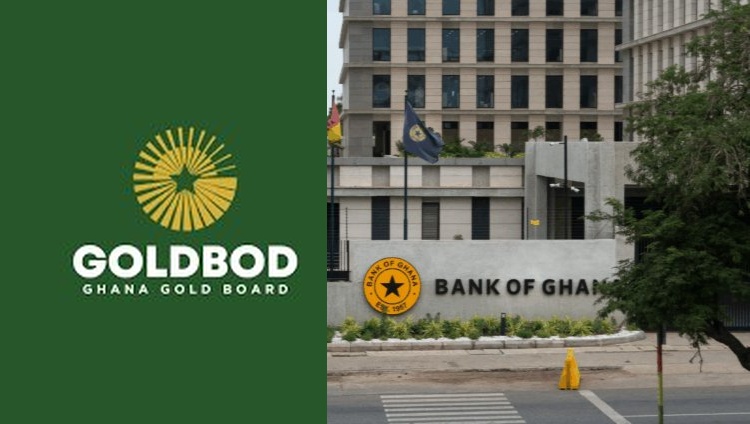
When the Ghana Gold Board (GoldBod) announced last week through its financials that it had assayed a total of 103.8 metric tonnes of ASM gold valued at $10.8 billion and 101 metric tonnes of large-scale gold valued at $9.7 billion in 2025 — while still ending the year with a surplus of over GH¢5.4 billion — it certainly told a story of a successful state entity.
The new kid on the block, established through the Ghana Gold Board Act, 2025 (Act 1140), was set up to oversee, monitor and undertake the buying, selling and export of gold and other precious minerals. It was also to promote value addition, support responsible mining, accumulate gold reserves for the Bank of Ghana, and help generate foreign exchange.
It effectively replaced the Precious Minerals Marketing Company, but with greater monopoly powers over the trade of gold and other minerals. GOLDBOD, per its Act, was to be the sole exporter of gold in the country.
On face value, the numbers pointed to a state institution that delivered on its mandate. But reading those numbers alongside the Bank of Ghana's own 2025 financial results tells a very different story.
The same programme that produced GOLDBOD's surplus handed the central bank a GH¢9.05 billion net loss — deepening the hole in an already precarious financial position.
How GOLDBOD was to operate
GOLDBOD was to be funded by a $279 million revolving fund allocated in the 2025 budget, which would allow it to buy doré gold directly from artisanal and small-scale miners on its own balance sheet and trade independently.
That fund only arrived in December 2025.
For the entire year, GOLDBOD did not carry active trading positions on its own books. It operated primarily as an intermediary — collecting funds from the Bank of Ghana, going into the field to buy gold on the central bank's behalf, and earning service charges and fees on every transaction after assaying the gold.
For twelve months, the Bank of Ghana supplied the capital and absorbed any losses. GOLDBOD collected transactional fees and kept its balance sheet intact.
That is the structure that produced two very different sets of financials for the same year, under the same programme.
The IMF alarm
Even before the full financial damage had been tallied, the IMF raised the flag.
In its fifth review of Ghana's economic recovery programme, the Fund disclosed that losses from the artisanal and small-scale doré gold transactions had already reached $214 million by the end of September 2025 alone — about 0.2 percent of GDP — mostly trading losses, with a small portion in GOLDBOD's fees.
The Fund warned that the domestic gold purchase programme posed risks to the financial sustainability of the BoG and that those losses should not be borne by the central bank.
The policy design that was never going to balance
Despite the original plan of a revolving fund for GOLDBOD, the government and the central bank continued an existing arrangement — one that had operated between the PMMC and the BoG under the now-defunct gold-for-oil programme. That programme was itself discontinued in March 2025 over its cost to the bank's balance sheet, having incurred a total net loss of GH¢2.14 billion across 2023 and 2024.
Under that arrangement, the Bank of Ghana provided foreign exchange to PMMC at the official BoG rate to buy gold from small-scale miners. The problem was that miners were paid at the unofficial forex rate, under the justification that no miner accepts the BoG rate.
The gold purchased was also not refined bullion. It was raw doré, which trades at a discount on international markets to account for refining, assay risk, transport, and financing costs. The offtaker discount offered by the BoG initially stood at 2.25% below world market prices, later reduced to 1.25% in the last quarter of 2024 and further to 1.1% in 2025.
On top of that, the central bank paid PMMC a 0.5% ad valorem service fee and a 0.258% assay fee on every transaction.
The BoG was buying at a premium, selling at a discount, and paying fees throughout. The losses were essentially built into the design.
That arrangement did not end with the establishment of GOLDBOD. It simply escalated. GOLDBOD became the sole exporter of ASM gold, inheriting the same fee structure — 0.5% ad valorem and 0.258% assay fee — until December 2025 when those were reduced to 0.4% and 0.2% respectively.
More significantly, GOLDBOD was buying at spot — sometimes above spot, to deter smuggling — while the Bank of Ghana was selling below it.
JoyNews Research data shows that in October 2025, when the global gold price averaged $4,054 per ounce, Ghana realised $3,919 — a shortfall of $135 on every ounce.
The losses were therefore expected but the bigger question was always how deep.
What the BoG's full accounts revealed
When the Bank of Ghana finally opened its books last week, the number was no longer $214 million.
The net loss of the Domestic Gold Purchase Programme had ballooned to GH¢9.05 billion for the year.
But even that headline failed to tell the full picture.
Whereas the three-month loss from the discontinued gold-for-oil arrangement was GH¢203.03 million, the central bank incurred a gross loss of GH¢21.89 billion on its doré gold trade with GOLDBOD. So although GOLDBOD, through its assayer role, exported ASM gold valued at $10.8 billion, that came at a cost of GH¢21.89 billion — approximately $2 billion — to the Bank's balance sheet.
Per the financials of both parties, the BoG paid GOLDBOD over GH¢827 million in charges in 2025, with nearly GH¢560 million comprising service charges alone. That meant, excluding the government's GH¢4.5 billion grant to GOLDBOD, approximately 82% of GOLDBOD's 2025 revenue came directly from the Bank of Ghana.
But those fees are a relatively small portion of the GH¢21.89 billion gross loss. The single largest contributor was the rate gap — embedded in every single transaction from the start.
Atta Issah, MP for Sagnarigu and member of Parliament's Finance Committee, who uncharacteristically broke the news of the Banks’ losses sought to explain the core mechanism:
"Bank of Ghana gives money to GOLDBOD to go and purchase the gold. BoG purchases at an International Traded Currency, USD. So it will give USD to GOLDBOD at, for example, $1 to GH¢10. But when they go into the field, you and I know that no gold trader will sell his gold at BoG rate. So the difference between the forex market and BoG rates reflects the loss."
Here is a clean explanation of a messy problem.
If the cedi was GH¢10 at the BoG window but GH¢11 on the forex market, then for every GH¢11 the central bank gave GOLDBOD, it received gold worth GH¢10. When the cedi strengthened and paradoxically widened the gap between the BoG rate and the retail rate, the Bank paid more for less gold. And with the programme scaling dramatically — doubling in volume from 56 tonnes to 111 tonnes — that meant more transactions, a wider gap, and a bigger loss.
Simply put, as GOLDBOD's revenue grew and export volumes rose, the BoG's expenditure deepened and its capital depleted even more rapidly.
The central bank took on the full currency risk, the full price risk, and the full market execution risk. The underlying trade was structured in a way that made losses almost unavoidable.
The GH¢21.89 billion gross loss only improved to GH¢9.05 billion on the central bank's income statement after being partially offset by a GH¢5 billion government cost-share intervention and GH¢7.9 billion in realised gains on gold bullion sales reclassified from reserves.
The way forward
GOLDBOD's CEO announced late last year that the Board was expected to fully take over the artisanal and small-scale gold trading programme from January 2026, and no longer operate as an intermediary for the Bank of Ghana.
Under this arrangement, GOLDBOD would be responsible for purchasing, trading, and selling gold on its own — giving the central bank's balance sheet some much-needed breathing space.
But with the full financial risk now back on GOLDBOD, the programme needs structural fixes before it scales further.
The practice of indexing field purchase prices to the forex rate rather than a published market benchmark must be reconsidered. Cocoa prices are indexed to the BoG rate, and farmers receive accordingly. Gold cannot be treated differently under the guise of preventing smuggling. The cost of smuggling must be made expensive through enforcement — not by paying above-spot prices that hollow out the central bank.
GOLDBOD has in recent times explored discount buying, but needs to be firmer and braver with that decision. The fear of market resistance and a short-term drop in export volumes is understandable. But the potential financial cost far outweighs any temporary dip in numbers. If the arrangement cost the central bank over GH¢20 billion in gross trade losses in a single year, the question worth asking is how many months — perhaps days — it would take GOLDBOD to exhaust its GH¢4.5 billion working capital simply to maintain the same pace of exports.
The full picture, now told
While GOLDBOD may have had a good year on its own books, the Bank of Ghana paid for it.
The argument that Ghana needed the reserves is never in doubt, but a programme structured so that one entity captures the gains while another absorbs the losses is a programme that needs to be fixed.
The cost to the BoG will eventually be borne by Ghanaians through taxes. That is the part GOLDBOD's "beautiful" financials did not show.
Latest Stories
-
Photos: Mahama swears in Emelia Afi Agbenyo, Joseph Kwaku Asamoah as EC Deputy Commissioners
2 minutes -
Centre for CSR, West Africa partners with Climate x Culture Summit to champion corporate sustainability at Google AI Centre
8 minutes -
Petrosol donates medical equipment to Bolgatanga Hospital
9 minutes -
Zongo Health Campaign screens over 110 Mamobi residents
23 minutes -
Cybercriminals using AI tools to carry out operations – Cyber Security Authority
30 minutes -
Ghana must invest more in mental health and healthier workplaces – Nurse advises
30 minutes -
NAPG Summit equips Administrative Professionals for strategic impact and the AI-driven workplace
39 minutes -
NHIA urges amendment of Health Insurance Act to accommodate free primary healthcare
42 minutes -
Ghana is tackling cybercrime head-on, not becoming a hub for it – CSA
44 minutes -
We’ll deliver without fear or favour – New EC Deputy Chairpersons assure Mahama
45 minutes -
Six Ukrainian energy sites hit by Russia since Trump announced ceasefire, Zelensky says
1 hour -
Government directs GTEC to prepare public universities for weekend reopening as it intensifies efforts to end GAUA strike
1 hour -
Multimedia Group’s Raymond Nii Doodo Larbie called to the Ghana Bar, seeks to combine HR practice with law
1 hour -
Credible elections are the cornerstone of democracy – New Deputy EC Chairperson
1 hour -
Mahama charges new EC deputies to put national interest above political loyalties
1 hour