

Audio By Carbonatix
At least 40 Chadian soldiers have been killed after their base was attacked on Sunday evening, the presidency says.
President Mahamat Déby has ordered a counter-mission to track down the culprits, according to a statement from his office.
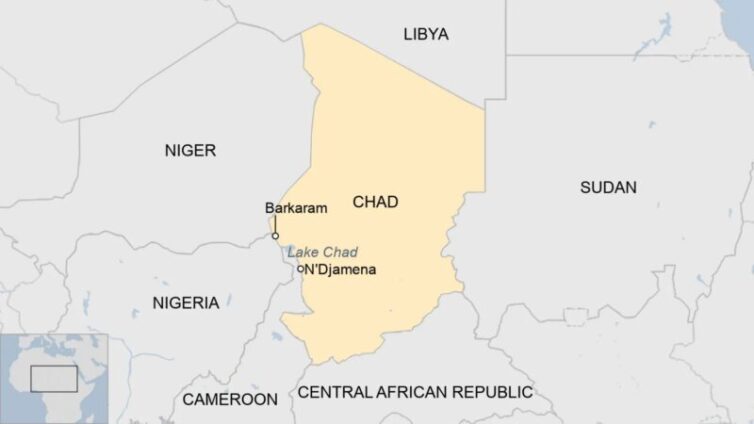
The attack reportedly happened on an island called Barkaram, in a vast marshy region that was once covered by the waters of Lake Chad before its dramatic shrinking in recent decades.
No suspects for Sunday's attack are named in the presidency's statement, but the area is close to the border zones of Nigeria and Niger where Islamist militants are known to operate.
Latest UN figures indicate more than 220,000 people have been forced from their homes following years of insecurity and violence from armed groups.
Sunday's attack is one of the worst suffered by Chadian soldiers since 2020, when about 100 soldiers died in a raid which prompted then-President Idriss Déby to launch an operation against Islamist militants.
Local residents have told the AFP news agency they believe fighters from Boko Haram - an Islamist militant group based over the border in Nigeria - were to blame for this latest attack, and say at least 200 soldiers were stationed at the garrison at the time.
The attackers had time to seize ammunition and equipment before they left, AFP adds.
It is a blow to President Déby, who is an elite soldier by training, and the son of the former president who was killed three years ago in a battle with rebels close to the Libyan border.
In its public communications, the Chadian presidency has presented Déby as a hands-on leader with military nous, who visited the site of the attack early on Monday, "assessing the situation on the ground, paying his respects to the deceased soldiers, showing his compassion to the wounded, and lifting the morale of his brothers-in-arms".
The Lake Chad basin is bordered by Cameroon, Chad, Niger and Nigeria - all of which are part of a Multinational Joint Task Force that seeks to stamp out the armed groups operating in the region.
But Islamists "often regroup when troops withdraw", and better funding and planning is needed, says the International Crisis Group.
In recent years, there have been several coups in the region, in Niger, Mali and Burkina Faso. The military in each country cited the inability to deal with the Islamist militant threat as one of the reasons for the ouster of the civilian governments.
Analyst Paul Melly writes that, surrounded by so many regional crises, Chad stands out as an island of continued stable partnership with the West - and is now deepening relations with Russia in a ploy that irritates and pressures France and the US.
Chad has also reportedly become a key conduit for arms flowing into Sudan, though it denies this, and is hosting large numbers of refugees from Sudan's civil war in camps near its eastern border.
Latest Stories
-
World Cup visa scandal: Sports Ministry not shielding anyone – Sports Minister’s special aide
5 minutes -
World Cup visa scandal: Over 30 people misrepresented as GTA board members to US Embassy – Vincent Assafuah alleges
7 minutes -
Fire destroys wooden structure near Yesu Mo Villa at Bush Road
8 minutes -
NDC threatens sanctions over oversized campaign posters, gives aspirants 5 days to comply
1 hour -
Star Oil paid GH¢2.7bn in taxes, levies in nine months of 2026
1 hour -
Samson’s Take: The rule of law is cheaper before the bulldozer
1 hour -
GRA blames system failure for delay in issuing receipt over passenger’s customs duty
2 hours -
Livestream: Newsfile discusses World Cup visa scandal, beach demolitions, education strikes, BRICS bid
2 hours -
NC-PTAs welcomes end of teachers’ strike, urges parents to prepare children for Monday
2 hours -
Government procures over 2,000 transformers as Ghana’s electricity access hits 89.13% – Energy Minister
2 hours -
UTAG-UG threatens strike on October 19 over unpaid allowance
2 hours -
Let The Constitution direct Chieftaincy to deliver “All Development Is Local”
4 hours -
John Jinapor outlines renewable energy, nuclear power priorities for 2027
4 hours -
Ghana explores centre of excellence for hearing, communication and cochlear implant care
5 hours -
Schizophrenia-related disorders lead mental health cases recorded in Ghana
5 hours