

Audio By Carbonatix
Sweden's government is championing a renewed focus on physical books, paper and pens in classrooms, designed to reverse falling literacy levels.
But doubling down on analogue tools has drawn criticism from tech companies, educators and computer scientists, who argue that it could affect pupils' employment prospects and even damage the Nordic nation's economy.
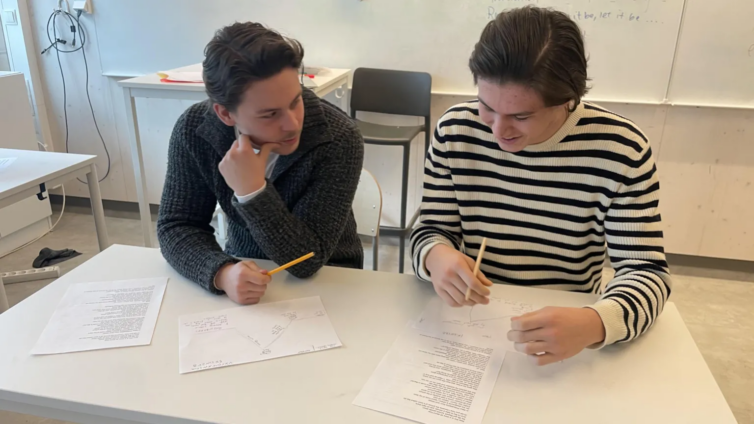
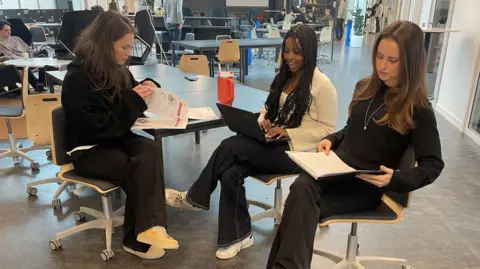
At a high school in Nacka just outside Stockholm, final-year students are unpacking laptops from rucksacks and tote bags, alongside items they say they used less frequently a few years ago.
"I now go home from school with new books and papers often," says Sophie, 18. She says one teacher "has started printing all the texts that we use during the lesson", while a digital learning platform in maths lessons has been replaced with textbook-only teaching.
It's an image that clashes with Sweden's reputation as one of Europe's most tech-savvy societies, thanks to high levels of digital skills and a thriving tech start-up scene.
Laptops became mainstream in Swedish classrooms in the late 2000s and early 2010s. By 2015, around 80% of pupils at municipal state-funded high schools had individual access to a digital device, according to official data.
The compulsory use of tablets in pre-schools was included in the curriculum in 2019, as part of the previous Social Democrat-led government's mission to prepare even the youngest children for an increasingly digital work and private life.
But the current right-wing coalition, which came to power in 2022, is moving teaching in a different direction.
"We're trying, actually, to get rid of screens as much as possible," says Joar Forsell, an education spokesperson for the Liberal party whose leader is Sweden's education minister.
"With higher ages in school, you might use them a little bit more, but with lower ages, or in school, I don't think we should use screens at all."
The government has frequently used the slogan "från skärm till pärm", which sounds catchy in Swedish and translates to "from screen to binder".
It argues that screen-free lessons create better conditions for children to concentrate and develop their writing and reading skills.
Since 2025, pre-schools are no longer required to use digital tools, and tablets aren't given to children under the age of two.
Later this year a ban on mobiles in schools – even for educational use – comes into force.
Schools have already been allocated more than 2.1bn krona ($200m; £157m) in grants to invest in textbooks and teacher guides. A new curriculum designed to enforce textbook-based learning is due in 2028.
"Reading real books and writing on real paper, and counting with real numbers on real paper, is much better if you want kids to get the knowledge they need," argues Forsell.
The shift in approach followed a consultation in 2023 involving academic researchers, teaching organisations, public agencies and municipalities.
"There's been an increased awareness of the disruption that technology is causing in classrooms," says Dr Sissela Nutley, a neuroscientist affiliated with the Karolinska Institute in Stockholm, who is amongst those who have raised concerns about the use of digital tools.
Nuttley says that pupils can lose concentration when they see what other children are doing on screens. She also points to a growing body of international research suggesting that reading texts on digital devices can make it harder for children to process information, and that heavy screen use can even affect younger pupils' brain development.

The government hopes the shift back to more traditional teaching methods will help improve Sweden's standing in the Pisa rankings - the Organisation for Economic Co-operation and Development's (OECD's) benchmark for core educational subjects. Once a star performer, Sweden's scores plummeted in 2012 and, after a brief recovery, fell again in 2022, with significant declines in maths and reading.
Although still slightly above the OECD average, the country performed worse in literacy in 2022 than countries including the UK, the US, Denmark, and Finland. Almost a quarter (24%) of students aged 15 or 16 did not reach a basic level of reading comprehension.
"We know that the kids that have been going through the whole school system with a lot of screens – that they're lagging behind in international surveys," says Forsell.
A report into education in Sweden, released by the OECD in January of this year, concluded that, on balance, Swedish pupils benefit from access to digital tools.
However, it highlighted a high prevalence of digital distractions in Swedish classrooms and found that heavy use of digital devices in maths lessons correlated with lower results. Although scores were notably still higher than those of those who used no digital devices at all.
Andreas Schleicher, director for education at the OECD, urges caution in attributing "cause and effect", yet suggests that Sweden's earlier, more "extreme" adoption of technology compared to other countries is likely to have affected its results.
"It just put a lot of devices and technology into classrooms without clear pedagogical intent, without clear goalposts," he argues.
But in Sweden, the government's back-to-books strategy has sparked fierce debates in the business community.
A new report from trade association Swedish Edtech Industry warns that a more analogue education risk pupils being underprepared for future jobs.
"Everybody needs digital basic skills in order to enter the workforce," argues Jannie Jeppesen, the association's CEO and a former teacher. She cites a recent EU report which estimates that 90% of jobs will soon require digital skills.
Jeppesen is also worried about the impact on entrepreneurship and innovation. Sweden is currently Europe's leading factory for tech "unicorns" (companies valued at $1bn [£740m] or more), relative to its population.
These include the music streaming service Spotify and Legora, an AI platform for the legal profession. These types of companies "will move elsewhere" if they can't find the right IT competencies in Sweden, argues Jeppeson.

There is also the issue of the growing global use of artificial intelligence (AI). The Swedish government wants secondary schools to start teaching about the opportunities and risks of using AI, but some critics argue that AI should also be part of the curriculum for younger children.
Without such measures, younger children from richer families, whose parents are more likely to be able to help them understand how to use AI tools, will gain an advantage, creating a "digital divide", warns Prof Linnéa Stenliden, at Linköping University's Department of Behavioural Sciences.
But back at Sweden's parliament, Forsell insists children should not be taught about AI before they've mastered other basic skills, and rejects the idea that the government's more traditional approach to education will broaden inequality.
"You can only give people the opportunities that inequality is taking away from them by giving them proper education," he says.
However, Jeppesen, the Swedish EdTech industry CEO, argues this is a "populistic" stance. She says the government's focus on digital versus analogue classrooms steers attention away from other factors that could be impacting results.
This includes the unequal distribution of educational resources and teaching capabilities, highlighted by a March report from Sweden's Education Agency.
In Nacka, the views of final year pupils are also divided.
"The internet has kind of taken over the younger generations, and I've noticed them kind of lose focus easier," says Alexis, 18, who doesn't want his younger siblings to use digital tools in school as much as his generation did.
But others, like 19-year-old Jasmine, are in favour of a digital education, even for primary school-aged children. "Let's focus more on computers. Because if we are being realistic, the whole world is using computers."
Latest Stories
-
‘I am disappointed’ – Yaw Ampofo Ankrah breaks silence after NSA suspension
9 minutes -
Douglas Boateng receives IMM Institute Supply Chain Lifetime Achievement Award
23 minutes -
Pentecost University to host international sustainability conference
54 minutes -
Ampofo Ankrah did not collect World Cup visa money – Lawyer
1 hour -
Baffour Awuah to spend night in EOCO custody – Atta Akyea
1 hour -
Torgbiga Wenya III opposes proposed elevation of 36 Anlo chiefs to Paramount status
1 hour -
The strengthening El Niño and what it could mean for Ghana
1 hour -
Baffour Awuah formally charged with money laundering, loss of public funds – Lawyer
1 hour -
Drone flight over EOCO building could attract 30-year jail term – Security consultant
1 hour -
Flying drone over EOCO premises is strictly prohibited – Security consultant
1 hour -
SIC file was surrendered to client, EOCO has no reason to search Manhyia South MP’s firm – Atta Akyea
1 hour -
EOCO search of Baffour Awuah’s law firm raises confidentiality concerns – Atta Akyea
1 hour -
“I will never ignore an invitation from EOCO if I had received one” — Manhyia MP
1 hour -
Baffour Awuah ready to cooperate fully with EOCO investigation – Bosome Freho MP
2 hours -
How a Ghanaian technology is helping fish farmers detect hidden threats before fish die
2 hours