

Audio By Carbonatix
Salamba Ndiaye was 22 when she first tried to get to Spain, dreaming of a career as a real estate agent. Without her parents’ knowledge, she made it onto a small fishing boat known as a pirogue, but the Senegalese police intercepted the vessel before it could leave.
A year later Ndiaye tried again, successfully making it off the coast but this time a violent storm forced the boat to stop in Morocco, where Ndiaye and the other passengers were sent back to Senegal.
Despite her two failed attempts, the 28-year-old is determined to try again. “Right now, if they told me there was a boat going to Spain, I would leave this interview and get on it,” she said.
Ndiaye is one of thousands of young Senegalese who try to leave the West African country each year to head to Spain, fleeing poverty and the lack of job opportunities. Most head to the Canary Islands, a Spanish archipelago off the coast of West Africa, which is used as a stepping stone to continental Europe.
Since the beginning of the year, more than 22,300 people have landed on the Canary Islands, 126% more than the same period last year, according to statistics released by Spain’s Interior Ministry.
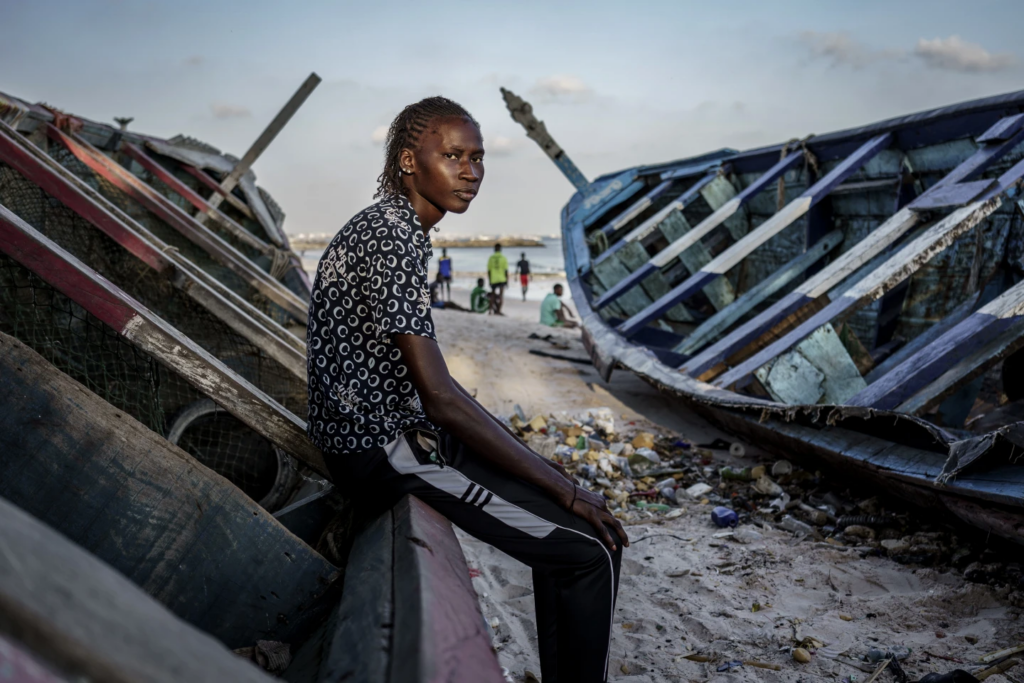
While most migrants leaving Senegal are young men, aid workers in the Canary Islands say they are increasingly seeing young women like Ndiaye risk their lives as well.
Earlier this year, the EU signed a 210 million euro deal with Mauritania to stop smugglers from launching boats for Spain. But the deal has had little effect on migrant arrivals for now.
The Spanish Prime Minister Pedro Sánchez will visit Mauritania, Senegal and Gambia this week to tackle irregular migration. The West African nations are the main launching pads for migrants traveling by boat.
The Atlantic route from West Africa to the Canary Islands is one of the deadliest in the world. While there is no accurate death toll because of the lack of information on departures from West Africa, the Spanish migrant rights group Walking Borders estimates the victims are in the thousands this year alone.
Migrant boats that get lost or run into problems often vanish in the Atlantic, with some drifting across the ocean for months until they are found in the Caribbean and Latin America carrying only human remains.
But the danger of the route is not a deterrent for those like Ndiaye, who are desperate to make a better living for themselves and their families in Europe. “Barsa wala Barsakh,” or “Barcelona or die” in Wolof, one of Senegal’s national languages, is a common motto of those who brave the deadly route.
“Even if we stay here, we are in danger,” said Cheikh Gueye, 46, a fisherman from Thiaroye-sur-Mer, the same village on the outskirts of Senegal’s capital that Ndiaye is from.
“If you are sick and you can’t pay for treatment, aren’t you in danger? So, we take our chances, either we get there, or we don’t,” he added.
Gueye also attempted to reach Europe though the Atlantic route but only made it to Morocco following bad weather, and was sent back to Senegal.
Like many inhabitants of Thiaroye-sur-Mer, he used to make a decent living as a fisherman before fish stocks started to deplete a decade ago due to overfishing.
“These big boats have changed things, before even kids could catch some fish here with a net,” Gueye said, pointing at the shallow water.
“Now we have to go more than 50 kilometers out before we find fish and even then we don’t find enough, just a little,” he adds.
Gueye and Ndiaye blame the fishing agreements between Senegal and the European Union and China, which allow foreign industrial trawlers to fish in Senegalese waters. The agreements impose limits on what they can haul in, but monitoring what the large boats from Europe, China and Russia harvest has proven difficult.
Ahead of the Spanish prime minister’s visit to Senegal on Wednesday, Ndiaye’s mother, Fatou Niang, 67, says the Senegalese and Spanish governments should focus on giving young people in the West African country job opportunities to deter them from migrating.
“These kids don’t know anything but the sea, and now the sea has nothing. If you do something for the youth, they won’t leave,” Niang says.
“But if not, well, we can’t make them stay. There’s no work here,” she said.
Latest Stories
-
Anthony Joshua declines showdown with Tyson Fury but admits they ‘probably’ clash next
8 minutes -
Tyson Fury dominates Makhmudov, calls out Joshua next
28 minutes -
I have supported highway authority financially to fix roads in my constituency – A Plus
2 hours -
US, Iran fail to reach peace agreement after marathon talks in Pakistan
2 hours -
ECG kicks off Phase Two of transformer upgrades at Lashibi; brief outages expected
3 hours -
Port crises loom as 11,000 drivers threaten four-day strike
3 hours -
A source of excellence across generations – Vice President Opoku-Agyemang lauds Mfantsipim
4 hours -
(Photos) Mfantsipim School launches historic 150th anniversary
5 hours -
Knights and Ladies of Marshall group backs Catholic Bishops’ stance on anti-LGBTQ+
6 hours -
Bright Simons writes: All the Filla in the Ibrahim Mahama/E&P – Gold Fields Saga
6 hours -
Monetise Idiocy In Ghana
6 hours -
The Ghanaian prophet and the mysterious death of his scottish wife Charmain Speirs
7 hours -
Nearly 400 sentenced in Nigeria for links to militant Islamists
7 hours -
Ghana’s recovery supported by gold strength despite global oil price pressures – Standard Bank Research
7 hours -
Methodist Church hails Mfantsipim@150; calls for “fresh consecration” to excellence
8 hours