

Audio By Carbonatix
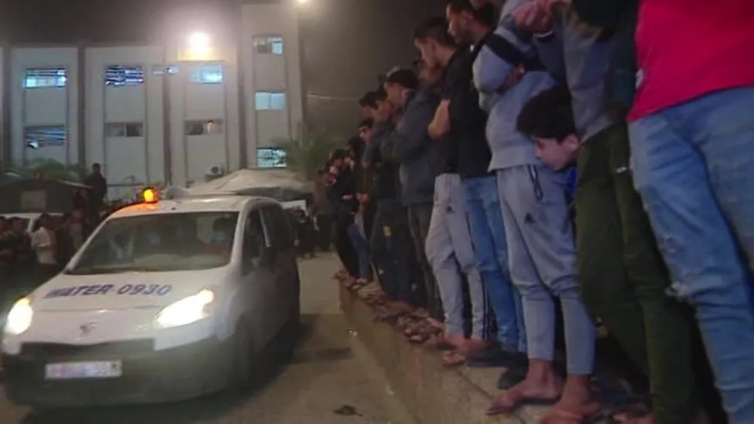
Young men in jeans and flip-flops stand in line in front of Nasser Hospital in Khan Younis, as if they are watching a funeral procession.
It's another night in the tense gloom outside the accident and emergency department.
Medical personnel in scrubs are poised to receive more casualties. Voices are raised and men crowd around.
Public order is starting to break down - people are traumatised and exhausted.
A car pulls up, its horn blaring and lights flashing. A young man is pulled out and put onto a stretcher, then rushed inside.
Then another car arrives, covered in dust, and a child who is only four or five is helped out. He is able to walk.
Hospitals in Khan Younis - the Gaza Strip's second largest city - have been overwhelmed since the Israeli air force intensified its bombardment of the south on Friday.
Israeli tanks and troops have also now entered the city, after the ground offensive was widened following the collapse of a temporary truce with Hamas.
Gaza's Hamas-run health ministry says at least 1,200 people have been killed across the territory since the fighting resumed.
That has brought to more than 16,000 the total number killed in Gaza during the war, which was triggered by Hamas's attacks on southern Israel on 7 October.
Gunmen from Hamas - a proscribed terrorist organisation in Israel, the UK, US and EU - killed at least 1,200 people and took more than 240 back to Gaza as hostages.

Many of Gaza's 2.3 million residents sought refuge in the south after the Israeli military ordered civilians to leave the north in the early days of the war.
But with the fighting spreading to Khan Younis, they're running out of places to flee to.
Thousands of displaced people are crammed inside the grounds and corridors of the city's European Hospital.
"When we are playing and there is bombardment, we immediately run to the tents near the walls and [pretend to be] asleep," says one of the children there as the sounds of explosions fill the air.
"We are afraid. The glass of windows shatters above us."
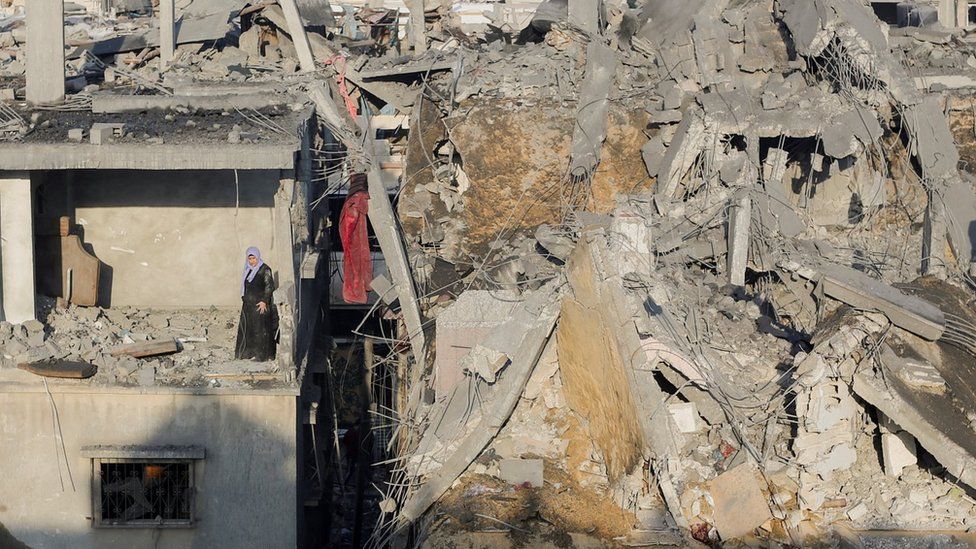
A woman at the hospital says she fled to al-Fakhari, an area east of Khan Younis, after receiving phone calls telling them that it was a "safe zone". But now, she says, the area is being bombarded and the situation is "very bad".
"I don't see any area being safe when it comes to us, nor is any area habitable."
A 75-year-old man agrees that nowhere is safe.
"The situation is indescribable. There are children and women. We, as elderly, can withstand what is happening," he says.
"Listen to the ongoing sounds - how could someone sit and wait for the opportunity to leave a safe zone? Where is the safety? We can't sense it. Every place we go to, they say it is safe but we can't find that."
In downtown Khan Younis, Samah Ilwan waves two empty water bottles in the air and says her six children - five girls and one boy - are thirsty.
"We have become like cats and dogs. Perhaps cats and dogs get shelters. We don't have any. We're stranded in the street."
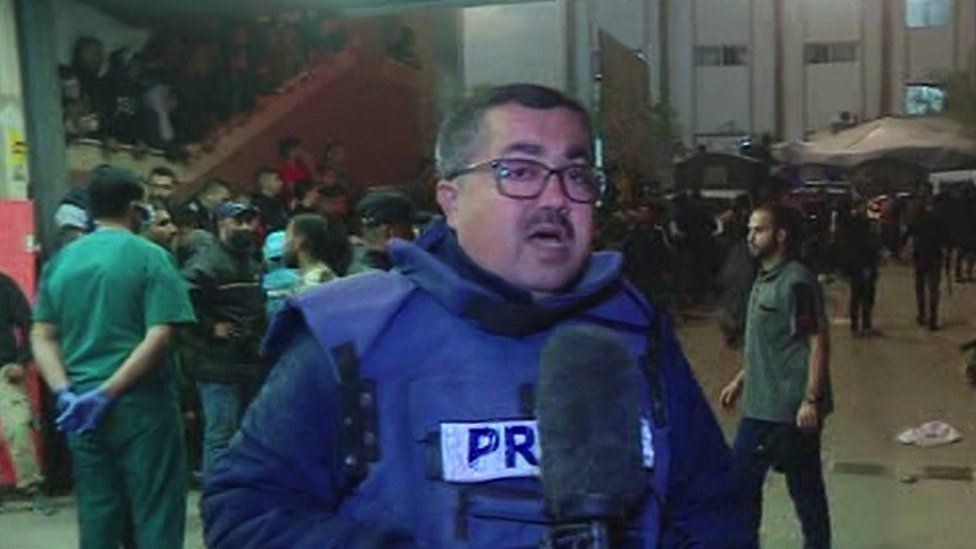
Life is also closing in on me.
Despite everything that has happened to me and my family since the start of the war, this is the first time that I feel completely lost.
All willpower and control have been ripped from me.
I'm used to keeping my family safe and secure, coming up with a plan. Now, I am torn by indecision.
I'm originally from the north but I fled south with my family after being ordered to do so by the Israeli army, who said the south was "safe".
Currently, I am alone in Khan Younis, while my family is in central Gaza.
I was able to travel up to see them every few days. But now, the Israelis have shut one road and the second one is very dangerous.
Should I go south to Rafah, keep working and hope that my family will be ok?
Or should I try to get back to them, stop reporting, and if it comes to the worst, then at least we die together?
I hope no-one else ever has to face this awful choice, which is not a choice at all.
Latest Stories
-
Gov’t will not curb free speech under Mahama – Kwakye Ofosu
39 minutes -
NDPC, UNIDO discuss new partnership to drive Ghana’s industrial development
47 minutes -
Mahama Ayariga calls for innovative financing to make housing more affordable
54 minutes -
NDPC reviews 22-year-old guidelines for regional, district planning units
1 hour -
Ghana to champion ECOWAS adoption of Accra Convention on cargo documents – Trade Minister
1 hour -
NHIS coverage rises from 57% to about 70% in less than two years under Mahama — Health Minister
1 hour -
BRICS membership could give Ghana more options in global diplomacy — analyst
1 hour -
GoldBod sells $125m to commercial banks in maiden FX auction
1 hour -
Bawumia mourns former NPP chairman Odoi-Sykes
1 hour -
Oguaa Omanhene endorses GMTF, says ‘there is hope for the future’
2 hours -
Opportunities in agriculture are enormous – Young entrepreneur tells fellow youth
2 hours -
PAC gives CWSA 30 days to recover GH¢2.5m debt
2 hours -
Gov’t reconsidering ‘One Constituency, One Ambulance’ model to distribute 100 new vehicles – Akandoh
2 hours -
ECOWAS gets five new community court judges
2 hours -
450 suspected yellow fever cases recorded across Ghana since June – Health Minister
2 hours