

Audio By Carbonatix
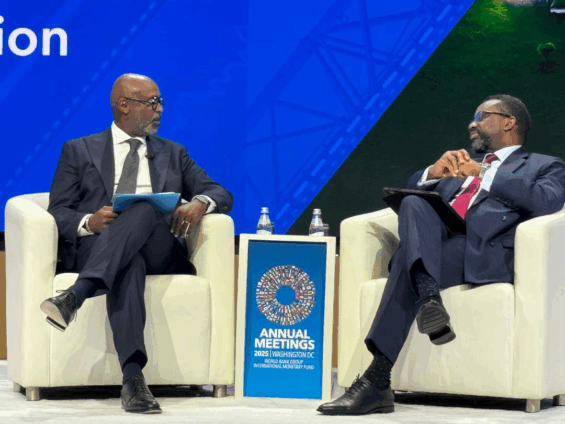
Governor of the Bank of Ghana (BoG), Dr Johnson Asiama Pandit, says recent pressures on the foreign exchange market were triggered by large energy sector payments and investor exits, not by direct market intervention from the Central Bank.
Speaking in an interview with the International Monetary Fund (IMF) at the ongoing IMF/World Bank Spring Meetings in Washington, D.C., on October 16, he said the Bank of Ghana had to undertake a series of “lumpy” foreign exchange payments between July and August to clear long-standing energy debts and other domestic obligations.
“Yes, there were allegations about whether we were intervening in the market. But that was not exactly the case,” he explained.
The Governor’s remarks come amid renewed public scrutiny of the Bank of Ghana’s foreign exchange management practices and growing interest in the country’s energy sector debt, which continues to weigh heavily on fiscal stability.
“Between the second and third quarter, we had to do a number of lumpy payments. There were all these large arrears in payments to some of the IPPs. These were billions of US dollars.”
He revealed that the Central Bank also faced additional outflows from some domestic bondholders who decided to liquidate their investments after the cedi appreciated.
“We also had some of the domestic debt-affected bondholders who wanted to exit. They felt that because the currency had appreciated, it was the right time to take up their investment. We had to allow them to go,” he said.
The Bank of Ghana Governor said those combined pressures temporarily tightened liquidity in the foreign exchange market.
“We did a lot of lumpy payments between July and August, and you might have seen some bit of that,” he noted.
Dr. Pandit further disclosed that the situation coincided with a decline in remittance inflows, which typically provide over US$6 billion in annual FX injections.
“Because all these inflows accrue to the central bank, and it was happening at a time when we saw some decline in remittance inflows, the central bank needed to step in to meet all those lumpy payments,” he said.
According to him, the interbank foreign exchange market “had dried up” during that period, forcing the Bank of Ghana to provide temporary support.
“The central bank needed to provide that support. But I’m happy to say that the interbank FX market has come back,” Dr Pandit said.
He explained that the Central Bank has since written to mining firms to route their inflows through commercial banks to improve liquidity in the FX market.
“We are beginning to see some pick-up in interbank FX market activity,” he said, clarifying that the directive covers all commodities except gold.
Dr Pandit stressed that with improved market conditions, the Central Bank no longer needs to be heavily involved in supplying dollars.
“As of yesterday, we had committed to make available $150 million. This morning, when I checked, the market had picked up only $90 million, so $60 million automatically goes into our reserves,” he said.
“Same thing Tuesday — we made available $150 million, and the markets picked up less than half that. So automatically, it goes into our reserves.”
He dismissed claims that the Bank was over-supporting the market.
“We do not over-support the markets at all. All we seek to do is to limit volatility and ensure smooth market dynamics. That’s the framework we will maintain going forward,” Dr Pandit emphasised.
Latest Stories
-
Putin warns West that Russia is ready to use every weapon to protect Kaliningrad
1 hour -
Mobile Money Fintech LTD, UMB train hairdressers and beauticians
3 hours -
OpenAI fires workers for mishandling ‘sensitive information’
3 hours -
What’s gone wrong at Nike? How the world’s sportswear giant lost its mojo
4 hours -
Carney pitches oil pipeline as a response to US-Canada trade war
4 hours -
Badenoch welcomes expanded grooming gangs inquiry
4 hours -
GACL MD sues Samuel Buabeng over alleged Facebook defamation
4 hours -
Asylum votes show people want help, says Kemi Badenoch
4 hours -
Christa Pike in critical condition after surviving two lethal injections, lawyer says
4 hours -
Kemi Badenoch backs face covering ban at protest
5 hours -
Man City not ‘above the rules’, says No 10 after backlash to Burnham remarks
5 hours -
Real Madrid submit ‘substantial’ dossier in Barca payments case
5 hours -
Messi completes purchase of second Spanish club
5 hours -
Government must engage horticulturists on tomato crisis – GhIH
5 hours -
King Promise’s ‘Can’t Tame Us’ becomes official Chelsea anthem
5 hours