

Audio By Carbonatix
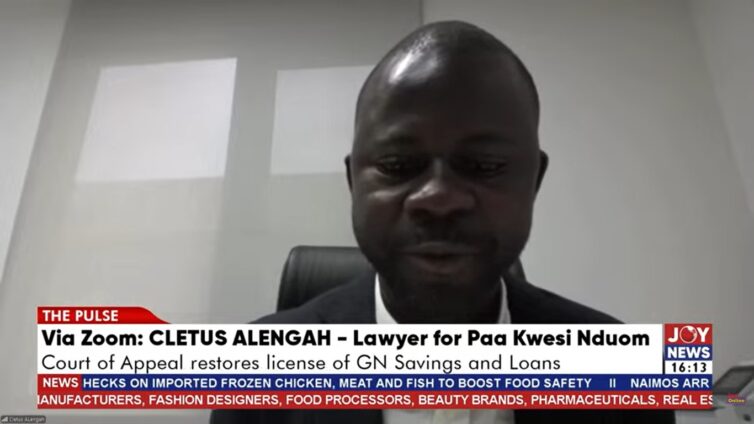
Counsel for Papa Kwesi Nduom, Cletus Alengah, has criticised the decision by the Bank of Ghana (BoG) following the revocation of the licence of GN Savings and Loans seven years ago.
He argued that key considerations were allegedly overlooked in the process.
Mr Alengah said this on JoyNews' The Pulse on Thursday, May 21, 2026, after the Court of Appeal ruled in favour of the financial institution. The court ordered the Bank of Ghana to restore the revoked license and return all assets to the shareholders of GN Savings and Loans.
The counsel contended that the Bank of Ghana and the High Court proceeded based on insolvency without adequately applying what he described as the necessary regulatory safeguards and assessment procedures.
He maintained that the GN Savings and Loans had sufficient capital at the time and was capable of continuing operations, adding that the High Court and Bank of Ghana failed to follow the appropriate steps required before taking the drastic measure of licence revocation.
"There were several things that the Bank of Ghana should have taken into consideration, but they have failed to take into consideration, and these were key material facts we put before the High Court. The High Court didn't give so much attention to these specific materials," he said.
"Remember, the revocation was done under Section 123. And under Section 123, there is only one reason for revoking the license of a financial institution, and that is that the institution is insolvent,
Once you say an institution is insolvent, the mandate is on the Bank of Ghana to prove that the institution is indeed insolvent. In fact, at the High Court, it reserved the burden of proof and said that Papa Kwesi Ndoum and Group Ndoum should rather prove that GN Savings was not insolvent, but it is the other way round, which the Court of Appeal agreed that the mandate should have been on the Bank of Ghana to prove the insolvency," he explained in the interview.
According to him, questions of insolvency, by regulatory practice, ought to be determined by the central bank rather than imposed on the affected institution to disprove.
He further argued that the High Court’s earlier position placed an undue burden on the company to demonstrate its financial adequacy, a stance he believes conflicted with established regulatory principles.
Latest Stories
-
Power restoration fault suspected in Kumasi Central Market fire
4 hours -
The 7-foot giant of Ngleshie Amanfro: Seven-foot Ghanaian Ephraim Saawa dreams of joining the national basketball team
5 hours -
Government promises support for Kumasi Central Market fire victims
5 hours -
Vibes The Movie: Big Ghun’s Ghanaian film earns five nominations at 2026 REFFA
5 hours -
MamaCare CEO warns unresolved conflicts among health workers could undermine maternal and neonatal care
6 hours -
Health professionals urged to translate medical knowledge into practice to save mothers
6 hours -
Conflicts among care providers linked to maternal, neonatal deaths – Expert
7 hours -
GIS marks 10th TIME conference, champions improved teaching practices
7 hours -
BRICS Or Balance? What Ghana’s bid really means
8 hours -
GPRTU wants full TRAFFITECH-GH implementation to start in 2027
8 hours -
How 10-mile walks for basic education birthed a 50-year legal career for Justice Korbieh
8 hours -
Mahama announces plans to import electric wheelchairs for PWDs
8 hours -
KGL U17 Colts 2026: Western beat Prempeh Elite Academy to set up final final with Greater Accra Region
9 hours -
Late Solanke strike salvages 10-man Spurs draw at Man United
9 hours -
Gender Ministry to monitor welfare of Nana Akua Addo’s children amid domestic violence case
9 hours