

Audio By Carbonatix
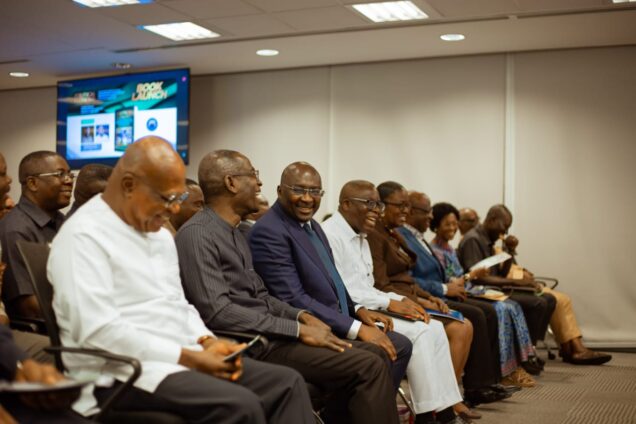
Policymakers, development practitioners, academics, government officials and stakeholders in governance and public sector management gathered at the World Bank Country Office in Accra on Wednesday, 10 June 2026, for the official launch of Political Economy of Institutionalising Monitoring & Evaluation Practice in Africa: 21st Century Perspectives. Authored by Professor Kwaku Appiah-Adu and Mr. Andrew Osei Asibey, the book is expected to make a substantial contribution to discussions on governance, accountability, public policy implementation and sustainable development across the African continent.
The publication explores the political, institutional and socio-economic factors that shape the successful institutionalisation of monitoring and evaluation (M&E) systems in Africa. Drawing on contemporary experiences and twenty-first-century realities, it highlights how stronger evidence-based policymaking can improve governance, public sector performance and long-term development outcomes.
The event was chaired by Mr. Patrick Awuah, founder of Ashesi University and a respected educationist and leadership advocate. He observed that technological advancement alone cannot guarantee development without effective governance and capable institutions. Describing the book as relevant to policymakers, practitioners and citizens alike, he called for a shift from compliance to learning, from reporting to impact and from data collection to informed decision-making. He stressed that the launch should not be seen as the end of a process but the beginning of an important conversation on strengthening governance systems, improving service delivery and enhancing the well-being of African citizens. He also commended the authors for their dedication, intellectual rigour and contribution to governance and development discourse.
Representing the World Bank, Mr. Smile Kwawukume emphasised that monitoring and evaluation has become a central pillar of effective governance and development planning. He added that governments, development agencies and civil society organisations increasingly depend on robust M&E systems to monitor performance, measure impact and ensure accountability in the use of public resources. Moreover, he noted that the lessons presented in the publication would be valuable to development partners and policymakers seeking to strengthen institutions and improve development outcomes across the continent.
The book was reviewed by Mr. Djabanor Narh, an Alumnus Partner of Ernst & Young (EY), who described it as a timely contribution to Africa’s governance landscape. He explained that the publication outlines the political and institutional realities influencing the success of M&E reforms, while providing practical guidance on embedding evidence-based decision-making within public institutions. In his view, the book offers policymakers and practitioners fresh perspectives for strengthening governance and achieving better development results.
During an interview with MC Winston Amoah, the authors argued that sustainable M&E systems require far more than technical expertise. Political commitment, visionary leadership, supportive institutional cultures and active stakeholder engagement, they noted, are equally essential to embedding evaluation practices in public institutions. They acknowledged the financial support of Twende Mbele, a Pan-African organisation hosted by the University of Witwatersrand in Johannesburg and expressed appreciation to the Institute of Monitoring and Evaluation Practitioners, Ghana, for creating platforms that enriched the knowledge and experiences reflected in the publication.
His Excellency Dr. Mahamudu Bawumia, Ghana’s Vice President from 2017 to 2025, served as Guest of Honour. In his address, he emphasised that effective governance systems must combine technical rigour with respect for human dignity while consistently delivering measurable results. He described the publication as arriving at a pivotal moment, when governments face rapid digital transformation, growing access to data and increasing public expectations for accountability. Learning from evidence, he argued, is no longer optional but essential. Without it, even well-designed policies risk remaining aspirations rather than becoming instruments of transformation. He characterised the book as a call to action for policymakers to prioritise evidence in monitoring and evaluation, practitioners to strengthen learning systems and governments to ensure that development is guided by results rather than intentions. He subsequently declared the book officially launched.
The closing address was delivered by Emerita Professor Isabella Quakyi, President of the Ghana Academy of Arts and Sciences. She urged participants to continue the conversation on monitoring and evaluation beyond the event and to apply its lessons within their organisations and professional responsibilities. She emphasised that accountability, continuous improvement and results-oriented governance should become integral to planning and decision-making if African countries are to achieve sustainable development and meaningful transformation.
As African nations pursue ambitious development agendas amid increasingly complex political and economic realities, the importance of effective monitoring and evaluation systems continues to grow. Political Economy of Institutionalising M&E Practice in Africa: 21st Century Perspectives arrives at a critical moment, offering valuable insights into strengthening governance institutions, promoting accountability and embedding evidence-based policymaking. Its launch is expected to stimulate important conversations and inspire reforms that enhance public sector performance and sustainable development across the continent. Adding a cultural touch to the occasion, Mr. Stephen Aidoo Borsah (Saxborsah) provided a musical interlude before and during the launch.
Latest Stories
-
National Investment Quiz: Corpus Christi, Wesley Girls, advance to semi-finals
19 minutes -
Is Ghana losing the fight to protect children online?
29 minutes -
Ghana Institution of Surveyors pushes for Governing Council Bill, conference reforms
29 minutes -
Professional collaboration key to Ghana’s land, property development – Western Regional Minister
39 minutes -
UPSA holds first session of 18th Congregation.
45 minutes -
Why demand another country’s medical records? – Mahama on Ghana’s rejection of ‘humiliating’ US health compact
49 minutes -
Mentorship critical to survival and growth of MSMEs – Sinapi Aba Trust
49 minutes -
Nsawam Adoagyiri MP joins residents to oppose Agbogbloshie waste relocation to his constituency
1 hour -
New monitoring system rolled to step up fight against child labour in Ghana
1 hour -
Patrick Donkor
1 hour -
GHS, Oxfam sensitise young people in Ekon on contraception, reproductive health to mark World Contraception Day
1 hour -
Let private sector drive economic transformation – Alan Kyerematen
1 hour -
GoldBod changes gold assay regime, makes XRF testing definitive from October 1
1 hour -
Ghana sees geopolitical tensions as opportunity to end dependence – Ablakwa
1 hour -
Empower community radio stations to strengthen public engagement – Former Sports Minister
1 hour