

Audio By Carbonatix
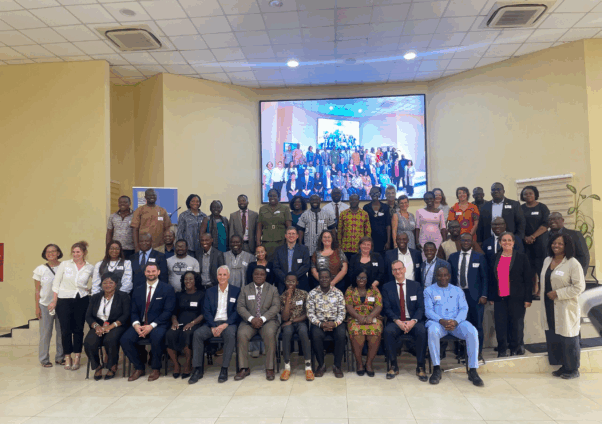
As digital payment systems continue to grow across Africa, the Merian Institute for Advanced Studies in Africa (MIASA) brought scholars and policymakers together to examine the enduring role of cash in a continent navigating financial disruption.
Held under the theme “Cash in Crisis in Africa: Navigating Financial Realities in Times of Disruption,” the conference addressed how African societies are responding to economic shocks while balancing traditional financial tools with emerging innovations.
The annual MIASA conference, hosted at the Institute of Statistical, Social and Economic Research (ISSER) at the University of Ghana, convened local and international experts to explore the evolving nature of finance on the continent.
MIASA’s director (Ghana), and Associate Professor of Linguistics at the University of Ghana, Professor Grace Diabah, noted the timeliness of the conference.
“The financial turbulence from COVID-19 to funding cuts has not only affected institutions but also exposed some of our cultural vulnerabilities,” she said. “As an institute, we promote cross-boundary dialogue among scholars, practitioners, and civil society leaders.”
Professor Joseph Awetori Yaro, Provost of the College of Humanities, emphasised the relevance of the discussions.
“The questions raised here speak directly to the realities of millions of Africans,” he said. “How value is created or lost during moments of crisis has a direct impact on the political, economic, and social processes that shape our lives.”
Delivering the keynote address, Fabio Knümann of Deutsche Bundesbank provided a global perspective on the evolving role of cash.
He stressed that despite the global rise of digital payments, cash remains central to daily life for many people across the world, especially in Africa.
“Cash is still a companion for millions,” he said.
Citing data from the South African Reserve Bank, Knümann highlighted that 56% of respondents had used cash in their most recent transaction, demonstrating that even amid mobile money growth, cash continues to dominate.
“These systems do not replace cash. They coexist with it.”
He recounted the story of a woman he met in northern Namibia who sold vegetables but had no mobile phone or bank account.
“She told me, ‘If I can hold it, I can trust it.’ That one sentence captures something fundamental,” he said, illustrating the trust that physical money commands, particularly in informal economies.
Mr. Knümann explained that during times of crisis—from pandemics to natural disasters—demand for cash often increases.
“Cash becomes a fallback. It works unconditionally—without passwords, apps or electricity,” he said.
While digital systems offer speed and convenience, Knümann cautioned against assuming a universal model.
“There is no single African or European payment culture. What works in one place may be fragile in another,” he stressed. The goal, he said, should be to support a hybrid infrastructure that includes both digital and cash options, offering resilience and choice to users.
He praised the efforts of African central banks, including the Bank of Ghana’s strategic distribution policy, which ensures access to cash in both urban and remote areas. He also cited South Africa’s community partnerships for cash availability in underbanked regions as a best practice.
“These are practical, data-driven measures that treat cash as a form of public good,” he said.
On policy design, Knümann called for smart infrastructure planning and inclusive decision-making.
“Supporting cash does not mean resisting innovation,” he said. “It means ensuring digital development does not unintentionally reduce choice, especially for those who depend on analog systems.”
He urged central banks and governments to include groups often left out of payment infrastructure planning, such as the elderly, visually impaired, and rural dwellers.
“These groups are directly affected by changes in how cash is accessed, but they’re rarely consulted,” he observed.
Looking ahead, he described three possible futures from a recent Bundesbank study: a hyper-digital world with minimal cash usage, a “cash renaissance” where its benefits are rediscovered, and a slow marginalisation of cash where access dwindles and acceptance drops.
“These aren’t predictions,” he said. “They’re scenarios to help us understand the decisions we face today.”
He pointed to Africa’s mobile money systems as innovative responses tailored to local needs, functioning even without stable network access and bridging informal and formal economies.
“The real opportunity is not to export a single truth, but to bring together different perspectives and generate new ideas,” he said.
Mr. Knümann called for collective responsibility in shaping the future of payments.
“You may think, ‘I’m not a policymaker, I don’t design payment systems.’ But if you value cash, the most effective way to support it is simply to use it,” he said.
The payment system is like a fleet of ships on a rough sea. We may not all be in the same boat, but we are on the same ocean. And if we share signals, if we listen, if we learn, I believe we can navigate it together,” he added.
Latest Stories
-
Adu-Boahene case: Atta Akyea files no-case submission, cites evidential gaps and missing witnesses
6 minutes -
Manchester City ‘found guilty of majority of 115 charges’
14 minutes -
From abandoned ruins to model residence: How Techiman North DCE fulfilled 9-month promise
17 minutes -
Francis Spio Jungo appointed to FanteFest 2026 planning committee
20 minutes -
Roots and Routes uses health walks, air sensors and tree planting to tackle air pollution in Ghana
25 minutes -
Stanbic Bank moves to boost electric vehicle through ‘Be Powered’ campaign
31 minutes -
Tears in Damongo court as accused persons show alleged torture wounds while in police custody
32 minutes -
Telecel Business Runaway in Takoradi equips SMEs with practical tools for growth
37 minutes -
Education Ministry to meet teacher unions on Monday as strike begins over promotion arrears
42 minutes -
Gender Minister calls for stronger financing, accountability to improve lives of Africa’s children
46 minutes -
Shoot to maim illegal miners if ‘shoot to kill’ is opposed – Kwame Jantuah
46 minutes -
24-hour Economy Secretariat to support 2026 Inter Tourism Expo
48 minutes -
Ghana must produce more of what it imports to create jobs – Mahama
52 minutes -
New cocoa producer price looms as COCOBOD seeks funding for 2026/27 season
56 minutes -
From paddle and sail to smart ships: What maritime industry means to the world and why Ghana must turn policy into practice
56 minutes