

Audio By Carbonatix
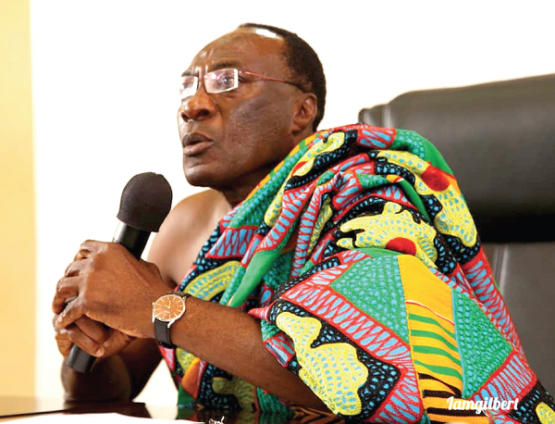
A Paramount Chief of the Anfoega Traditional Area, Togbe Tepre Hodo IV is lauding the Supreme Court’s ruling against chiefs engaging in partisan politics.
According to him, the ruling clarifies what chiefs can and cannot do when politicians visit their area.
“Basically, I think it was a terminal decision by the Supreme Court which ought to be commended,” he said in an interview on JoyNews’ The Probe on Sunday, June 4.
In a unanimous ruling this week, the Supreme Court established that any chief who publicly or covertly urges his subjects to support a specific political party, has violated Article 276(1) of the 1992 Constitution of the Republic of Ghana by engaging in "active party politics."
The verdict was rendered in response to a request from an LLM student requesting that the Apex Court use its original jurisdiction to clarify what is meant by active party politics by a Chief under Article 276 Clause 1.
According to him, the provision of the Constitution in Article 276 Clause 1 was ambiguous.
He added that for this reason, most chiefs were unable to ascertain what was constitutional or not.
But Togbe Hodo IV added that he could be confident that the recent decision from the Supreme Court will prompt the members of the various Houses of Chiefs to read the verdict and familiarise themselves with where to draw the line when dealing with politicians.
He also emphasised there is a difference between a chief endorsing the candidature of a politician and a chief lauding the policy of a government or a politician.
He then contended that the Supreme Court’s current interpretation of what chief participation in active politics means was very clear and void of ambiguity.
As the country prepares for elections, he emphasised the importance of intensifying education about the many circumstances that could come off as a chief taking part in active politics.
This, Togbe Hodo IV explained, will help chiefs become more aware and prudent.
The paramount chief further pointed out that the essence of the verdict is to guide and regulate the conduct of chiefs in order to avert unnecessary conflict.
He, therefore, advised that “chiefs, as leaders of the community, need to be guarded in what they say.”
Latest Stories
-
“NSA did not tell us of any embassy arrangement” – Kofi Adams
15 minutes -
Glasner suffers loss on Selhurst return as Palace beat Forest
2 hours -
WAFU B U17: ‘We won but I expected more from my boys’ – Kassim Ocansey
2 hours -
Man City cruise to statement win over 10-man Liverpool
2 hours -
Be careful with cross-border lending, foreign currency exposures – BoG to financial institutions
4 hours -
GPL 2026/27: Medeama go three clear as Hearts of Oak recover and Bechem stage stunning comeback
5 hours -
Ntiamoah Foundation launches “BEYOND 20” anniversary campaign
5 hours -
Credit Risk Management Directive: BoG to begin implementation for banks, others from July 1, 2027
5 hours -
Ghana Brands Awards 2026: Leading brands, business trailblazers to shine on November 20
5 hours -
T-bills auction: Demand improves as government exceeds target by about 76%; interest rates soften
6 hours -
Ziope undertakes initiative to build a technologically inclined community, commissions self-help ICT lab
6 hours -
ECG announces power outage in parts of Tema, Central Region due to network fault, maintenance
6 hours -
When the Gospel Becomes a Weapon: The church, blackmail and the abuse of faith
7 hours -
JoyNews’ Jacqueline Ansomah Yeboah selected for UK Media Excellence for Emerging Technologies Fellowship
7 hours -
Mental Health Alliance urges government to operationalise Mental Health Fund
7 hours