

Audio By Carbonatix
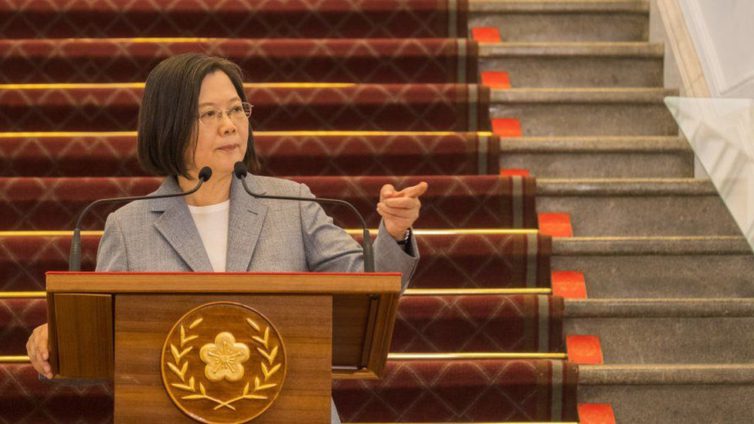
President Tsai Ing-wen says Taiwan will not bow to pressure from China and will continue its democratic way of life, as tensions over the island continue.
"The more we achieve, the greater the pressure we face from China," Ms Tsai said.
Her speech on Taiwan's National Day came after China's President Xi Jinping vowed to "fulfil reunification".
Taiwan considers itself a sovereign state, while China views it as a breakaway province.
Beijing has not ruled out the possible use of force to achieve unification.
China has sent a record number of military jets into Taiwan's air defence zone in recent days. Some analysts said the flights could be seen as a warning to Taiwan's president.
Ms Tsai said Taiwan was "standing on democracy's first line of defence". The island could not be forced to take "the path China has laid out for us", which she said did not offer freedom, democracy or sovereignty
China's military flights into Taiwan's air defence zone had seriously affected national security and aviation safety, she said, and the situation was "more complex and fluid than at any other point in the past 72 years".
Taiwan would not "act rashly" but would bolster its defences, she said.
She repeated an offer to talk with Chinese leaders on an equal footing, a suggestion Beijing - which brands her a "separatist" - has so far rejected.
Ms Tsai was re-elected by a landslide last year on a promise to stand up to Beijing. Her speech was followed by a fly past of Taiwanese fighter jets.
On Saturday China's President Xi said unification should be achieved peacefully, but warned that the Chinese people had a "glorious tradition" of opposing separatism.
"The historical task of the complete reunification of the motherland must be fulfilled, and will definitely be fulfilled," he added.
Despite the recent heightened tensions, relations between China and Taiwan have not deteriorated to levels last seen in 1996 when China tried to disrupt presidential elections with missile tests and the US dispatched aircraft carriers to the region to dissuade them.
The US has a longstanding "One China" policy under which it recognises China rather than Taiwan.
But this agreement also allows Washington to maintain a "robust unofficial" relationship with Taiwan. The US sells arms to Taiwan as part of Washington's Taiwan Relations Act, which states that the US must help Taiwan defend itself.
In an interview with the BBC this week, US national security adviser Jake Sullivan said the US will "stand up and speak out" over any actions that may "undermine peace and stability" across the Taiwan Strait.
Latest Stories
-
Photos: Housing solutions take centre stage at Day 2 of the 3rd Republic Bank-JoyNews Habitat Fair
19 minutes -
Video: Immunity should be exercised without creating classism – Inusah Fuseini on cocaine bust
52 minutes -
Ghana Air Force passes out 293 recruits after six months of intensive training
60 minutes -
EOCO vrs Baffour Awuah: EOCO should have secured warrant before arrest attempt at court – Inusah Fuseini
1 hour -
Triple fibre cuts disrupt telecom services across Northern, Oti regions – Sam George
1 hour -
Politicisation could undermine parliamentary probe into cocaine seizures – Dr Osae-Kwapong
1 hour -
EOCO chases MP: Can Section 41 cure lacuna in EOCO Act? – Inusah Fuseini asks
1 hour -
GNFS, GWL inspect fire hydrants in Ministries enclave; 23 found faulty
1 hour -
Gov’t directs release of 50,000 bags of grain to ECOWAS
1 hour -
Ghana, Germany deepen cooperation on railways, labour mobility
1 hour -
Huge crowds greet Pope in Paris for open-air Mass
2 hours -
‘I never said I’ll declare a state of emergency’ – President Mahama on galamsey
2 hours -
Bobby Banson condemns EOCO’s attempted arrest of Nana Agyei Baffour Awuah
3 hours -
When Kumasi begins to look like somebody is in charge
3 hours -
Parliamentary probe into cocaine seizure would be a waste of time – Inusah Fuseini
3 hours