

Audio By Carbonatix
In November 2023, Asantehene Otumfuo Osei Tutu II launched the Heal Komfo Anokye Project (HeKAP), an initiative to raise $10 million to repair dilapidated infrastructure at the Komfo Anokye Teaching Hospital (KATH) in Kumasi. Some of the blocks had not seen a major renovation after nearly 70 years of construction.
More than two years into the initiative, tens of millions of cedis have been raised through donations from state agencies, private companies, MPs, Ministers of State, the then Vice President, Dr Mahamudu Bawumia, and other private individuals, religious and other groups.
About GHS 50 million of the money raised has been spent on the project. About GHS 13 million is still owed to contractors, an amount the committee said they had yet to validate.
But when the board and management of the KATH sought accountability from the implementers and asked that the project be handed over to KATH, the chairman of the HeKAP Committee told them they had no authority to make such demands.
Months of our investigation, as well as information contained in an audit of the project, reveal serious irregularities that have the potential to undermine “donors' trust and confidence,” as observed by the auditors.
The issues range from procurement issues to missing pages in the donors’ receipt books to a tussle over the ownership of the project, which some individuals say is their private initiative, not that of KATH.
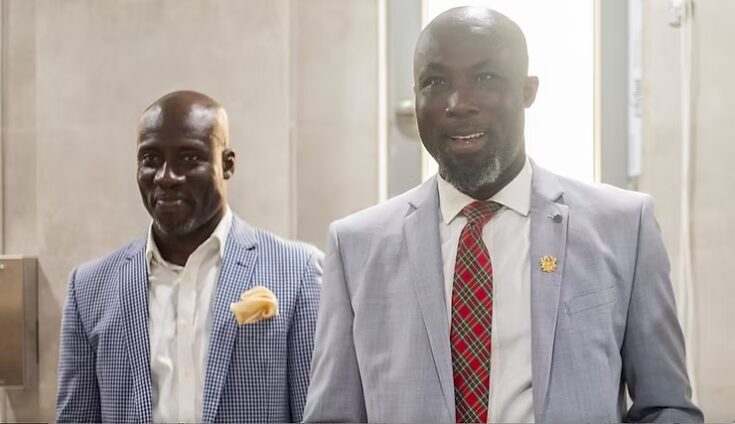
The donations to HeKAP and the implementation of the project are managed by Heal Komfo Anokye Hospital Foundation. According to information at the Registrar of Companies, the directors of Heal Komfo Anokye Hospital Foundation are Samuel Adu Boakye, a journalist with Kumasi-based Kessben FM, and Kojo Darko Asante, a chief architect at the Public Works Department in the Ashanti Region.
The two directors and the company are not linked to Komfo Anokye Hospital and have not been authorised by the hospital's board and management to run HeKAP or receive donations on KATH’s behalf.
Auditors of the project have observed that during their audit, “no Memorandum of Understanding between Komfo Anokye Teaching Hospital and Heal Komfo Anokye Project was seen.”
In the absence of a memorandum, the auditors observed that “the legal and operational activities and structure of HeKAP remained unclear” and the “ownership of properties and exchange of sensitive information could not be controlled.”
Samuel Adu Boakye told me in an interview that the CEO of KATH at the time of registering HeKAF, Professor Addai-Mensah, was not aware that he had registered HeKAP as a private company.
He said, “At some point, he was even angry, [and asked], how did I register this thing and didn’t tell him? I said, ‘Look, you’re the CEO of Komfo Anokye, and I am the chairman of Heal Komfo Anokye, how do I come and tell you to be part of it?’ That would amount to something else.”
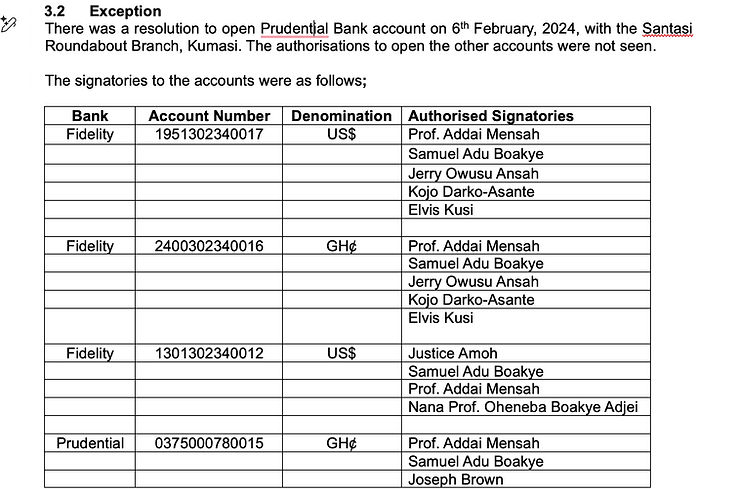
Despite this claim that Professor Addai-Mensah did not know about the registration of the company because of his position as CEO of KATH, he is captured by auditors as a signatory to HeKAP’s bank accounts.
Heal Komfo Anokye Hospital Foundation is registered as a private company limited by guarantee, with its principal activity and object of the company stated as “Raising funds to support Okomfo Anokye Hospital.”
HeKAP was officially launched on November 10, 2023, meaning that Komfo Anokye Hospital Foundation, which was registered to run the Heal Komfo Anokye Project, was incorporated four months after the project's launch.
The immediate past CEO of KATH, Prof. Otchere Addai-Mensah, said that the registration was needed to create bank accounts for HeKAP. However, there is evidence that multiple bank accounts were opened in the name of HeKAP and donations were being collected four months before the private company owning those accounts was registered.
For instance, the official Heal Komfo Anokye Facebook page posted a flyer on November 13, 2023, three days after the launch of HeKAP, advertising the bank accounts into which donations to the project should be made. This was before the company was registered on March 25, 2024, raising questions about how the banks opened accounts for a company that did not yet exist.
In my interview with him, Prof. Addai-Mensah said that before the company was incorporated, Fidelity Bank was holding the donations. Asked how it was possible for the bank to keep money when there was no account, he said that the question should be directed to the bank.
He said KATH already had accounts with Fidelity Bank, but the decision not to open a HeKAP account in KATH's name or tie its operations to the hospital was due to the "laborious" requirements of the Public Procurement Act and the Public Finance Management Act, which could delay the project's implementation.

"We won’t account or hand over to KATH"
In July 2025, the Board of KATH wrote to the managers of HeKAP, requiring accountability and handing over of the project to the CEO of KATH. In a response dated July 8, 2025, the Chairman of the HeKAP Committee, Samuel Adu Boakye, said “the Heal Komfo Anokye Project (HeKAP) was launched and is being implemented by the Heal Komfo Anokye Hosptial Foundation, a private corporate entity with the active support of the Asantehene, Otumfuo Osei Tutu II.”
Mr Adu Boakye further stated that “HeKAP has never been a KATH-initiated project, even though KATH is the beneficiary of its activities, and that KATH, as an institution or through any of its officers, has never been part of the corporate entity.”
He added that “the HeKAP committee has never been a committee of KATH set up by the management and/or the Board of Directors.”
A request for comment sent to the Manhyia Palace about the alleged support of Otumfuo and whether the Asantehene was aware of the private registration of the project, which he has passionately canvassed support for, is yet to receive a response, as the Asantehene is currently out of the country.
However, a source close to Manhyia Palace has said Otumfuo requested an audit of HeKAP's operations. The audit was submitted to the palace three weeks ago, and sources close to the Manhyia say Otumfuo is scheduled to meet with the HeKAP committee and stakeholders upon his return to Ghana to discuss the audit findings and the way forward for the project.


Is HeKAP a private initiative or a KATH-initiated project?
The refusal to hand over HeKAP to the management of Komfo Anokye is based on the argument that the project is a private initiative. When I interviewed Samuel Adu Boakye for this story, he stated that the Heal Komfo Anokye project was his initiative.
“This is not a project of the hospital,” he said. “I initiated the project. However, in corporate governance, the CEO [of KATH] had to own it…He also takes it as his baby.”
Samuel Adu Boakye’s claim that he initiated HeKAP has been refuted by multiple sources. The immediate past CEO of KATH, Professor Otchere Addai-Mensah, supports Samuel Adu Boakye’s position to register the project as a private entity. But even he told me in an interview that the project was a vision he had nurtured before he was appointed the CEO of KATH and set in motion immediately after his appointment, contradicting Samuel Adu Boakye’s claim that the initiative did not originate from KATH.
During this investigation, three versions of the origins of HeKAP emerged, with most sources pointing to officials of KATH as the project's initiators.
The first account, backed by Dr K.K. Sarpong
Multiple sources have said the current CEO of KATH, Dr Paa Kwesi Baidoo, was the initial brain behind HeKAP. Dr Baidoo, the sources said, had successfully raised funds to renovate the trauma centre when he was its head. He then sold the idea of expanding the initiative to cover the wider hospital to the CEO, Professor Addai-Mensah, who bought into it.
Two sources familiar with the project, who spoke on condition of anonymity, said one of the first people the KATH management approached about Dr Baidoo’s idea was Dr K.K. Sarpong, the former CEO of Ghana National Petroleum Corporation (GNPC) and Chancellor of the University of Professional Studies, Accra (UPSA).
Professor Addai-Mensah has confirmed that, as KATH CEO, he met Dr K.K. Sarpong together with Dr Paa Kwesi Baidoo (the current KATH CEO), Kwame Frimpong (the KATH PRO), and Dr Frankie, a medical doctor at KATH.
Asked when this meeting took place, Professor Addai-Mensah said he did not remember the date, but he remembered the persons with whom he met Dr K.K. Sarpong, all of whom were KATH officials.
Dr K.K. Sarpong confirmed that some management members of KATH approached him about the project.
“They were about four of them,” Dr K.K. Sarpong recalled. “They came with a concept and requested that I help them to raise funds. I reviewed what they had and said I didn’t think it would make a bigger impact.”
He said he advised them to involve Asantehene Otumfuo Osei Tutu II, whose influence, he believed, would yield a much bigger impact. Dr Sarpong said he also advised them to consider pitching the initiative as Otumfuo’s 25th anniversary legacy project.
After that meeting, Dr K.K. Sarpong said he was not involved in the project's activities and did not know how much was raised or spent. Being involved in the initial discussions, however, he said he would be surprised to hear that HeKAP was owned by private people.
“I don’t think that any private individual can claim it. I’ll be surprised, unless they [KATH management] told different people different stories, he said. “At the meeting, they said it was for them.”

Professor Addai-Mensah’s side
Professor Addai-Mensah described himself as the “visioner” of HeKAP. He said that shortly after his appointment as KATH’s CEO, the Asantehene visited an important dignitary who was admitted to the hospital, so he (Professor Addai-Mensah) raised the issue of KATH’s deplorable infrastructure with him. Otumfuo, he said, readily expressed his own concerns and set up a meeting to discuss the way forward. Dr Addai-Mensah said the Asantehene encouraged him during that meeting to proceed by drafting a concept note.
On his second visit to Otumfuo to discuss the initiative, Professor Addai-Mensah said he went with Samuel Adu Boakye, a journalist. He said that before they shared their plan, Otumfuo had already laid out in detail what they could do.
“The only thing we added was that we wanted to tie the project to his 25th anniversary celebration,” Samuel Adu Boakye said.
Two more persons were brought on board to flesh out the initiative, and they worked with them until a committee was set up and inaugurated by the Asantehene to begin the project.
Samuel Adu Boakye’s angle
Samuel Adu Boakye, who also claims ownership of the HeKAP initiative, said his involvement began with the meeting he and Professor Addai-Mensah had with Otumfuo. This was after the KATH CEO had already met the Asantehene on the subject.
Samuel Adu Boakye said since that meeting, he spearheaded the project and used Professor Addai-Mensah as “the figurehead.” He said he identified members to be included in the HeKAP Committee he set up afterwards.
Are HeKAP donations private funds or public funds
Neither Samuel Adu-Boakye nor Professor Addai-Mensah could say exactly how much has been received in donations for HeKAP and how much has been spent os of June 2026. However, a management letter from the auditors, with responses from the HeKAP Committee, shows that over GHS 50 million had been raised by the time of the audit.
The audit covered the period from March 25, 2024 (when the company was incorporated to run the project) to April 30, 2025.
When asked whether donations received for the HeKAP project were private or public funds, Prof. Addai-Mensah refused to answer, despite the question being repeated 14 times.
“So, you can’t tell if this was public funds or private funds?” I asked at some point.
“Manasseh, that’s your opinion,” Prof. Addai-Mensah said.
“What’s your opinion, as the CEO of the hospital at the time this project was initiated and at the time donations started coming in? Did you consider it private funds or public funds?”
“Manasseh, the Heal Komfo Anokye Project was under the auspices of Manhyia. It was registered as a charity foundation limited by guarantee.”
“So, the monies that came in were private funds?”
“Manasseh, you want us to continue shouting.”
“I think we have to end it because I have asked this question about ten times, and you’re not answering.”
“Yes, it’s because you have asked it in different ways,” Professor Addai-Mensah said.
Despite refusing to say whether the donations for HeKAP were private or public funds, he said public funds should be subject to the Public Financial Management Act, and procurements made by them should be subject to the Public Procurement Act.
The management of donations for the HeKAP project did not follow the above laws because the foundation registered to implement the project is a private company. Even with that status, auditors raised several irregularities with the spending, as contained in an audit management letter sighted in the course of this investigation.
Audit irregularities

In an audit management letter submitted to HeKAP management, the auditors identified infractions, some of which were not wrongdoings but could create opportunities for wrongdoing or blur the lines of accountability. For instance, the auditors said, “No documented procurement policy was seen during the time of audit.”
The absence of a procurement policy, they said, created a “difficulty in establishing the basis for selection and approval of the acquisition of goods, services and works as well as value for money."
On this issue, management of HeKAP did not respond, to which the auditors said, “The lack of a management response suggests a lack of urgency in addressing this high-risk area.”
The auditors also said no “evidences of written contracts were made available during the time of audit, the procurement procedures used in the selection and award of contracts were not seen, and inspection reports on or certificates for work done could not be seen to confirm payments were properly done.”
The HeKAP management provided the following response for this audit observation:
“Management acknowledges the observations. During the initial phase of the project, activities were executed on an informal basis, and as such, formal written contracts and documented procurement procedures were not consistently maintained.
“Contractors and service providers were engaged primarily based on trust, by donors for items donated by them. While this ensured timely execution of activities, formal procurement documentation, including contracts and evidence of selection procedures, was not adequately retained.
“With regard to inspection reports and certificates for work done, Management confirms that works were supervised and verified internally before payments were made; however, formal documentation to evidence such verification was not consistently prepared or filed.”
Though HeKAP is run by a private company and KATH had no hands in the operations, the audit report noted: “Receipt books were kept at KATH with an administrative assistant responsible for issuing receipts for cash and cheques received.”
The auditors also noted that a receipt register and register of value documents were not maintained.
They added: “Some receipt leaflets were missing from the receipt book and were neither attached nor marked as void or cancelled.”
To this, management gave the following response:
“Management acknowledges the observations. The noted issues arose primarily due to the inexperience of the cashier engaged during the early phase of the project, which resulted in lapses in receipt issuance, documentation, and record-keeping.
“The officer in charge would tear off the unused and cancelled receipts. Instructions have been given as to the best procedure.
“As a further measure, all donations were published to enable donors to ensure their donations have been accounted for. The only comments we received were names wrongly spelt. Thus, all donations have been verified.”
The auditors proceeded to “suggest that these be investigated, especially those not completely filled out.”

These and other irregularities have been flagged by the auditors. According to Samuel Adu Boakye, these do not suggest malfeasance.
“There’s no iota of malfeasance in the project, except administrative errors, which any audit points out. I don’t see anything wrong in this audit,” he said.
According to sources close to Manhyia, Otumfuo is committed to full accountability and will act on the audit report upon his return to the country.

This report was produced under the Pledge Against Corruption Ghana project. The civil-society-led project has the Africa Centre for Energy Policy, Transparency International Ghana and the Ghana Anti-Corruption Coalition as partners and is supported by the UK International Development.
Latest Stories
-
GHIPO makes case for local plant breeders to protect developed varieties for food sovereignty and reinvestment
2 minutes -
Ghana’s bamboo bikes entrepreneur gets a seat at World Economic Forum
2 minutes -
After years under trees, Akatsi children get a permanent school
3 minutes -
Kanton SHS appeals for more teachers, ICT facilities and infrastructure support
5 minutes -
Black Queens Coach maps out preparations ahead of Olympic qualifying games
10 minutes -
La Traditional Council demands SSNIT documents over Pleasure Beach land claim
11 minutes -
African communities have solutions but lack access – Liberian envoy
15 minutes -
Minority calls for dismissal, prosecution of Sports Minister, GTA CEO over World Cup visa scandal
15 minutes -
Chairman and fellow patriots – Irene Ponu-Brenyah writes to NPP
24 minutes -
Nothing Disappears: What Jamestown Beach reveals about Ghana’s styrofoam ban
26 minutes -
Court delays former NAFCO CEO trial to resolve access to seized gadgets
32 minutes -
Joy FM to offer free LPMs to Super Morning Show advertisers on Oct. 9 to mark Customer Service Week
35 minutes -
Sri Lanka’s ex-first lady arrested over alleged misuse of children’s hospital donations
42 minutes -
La Traditional Council kicks against redevelopment of La Pleasure Beach without consultation
44 minutes -
Some basic schools have just 2 or 3 teachers despite needing 9 – Right To Play
49 minutes