


Audio By Carbonatix
If you still have any doubts that mobile devices have taken over our lives, this should make you a firm believer: smartphones and QR codes have become tools of the trade for Chinese beggars.
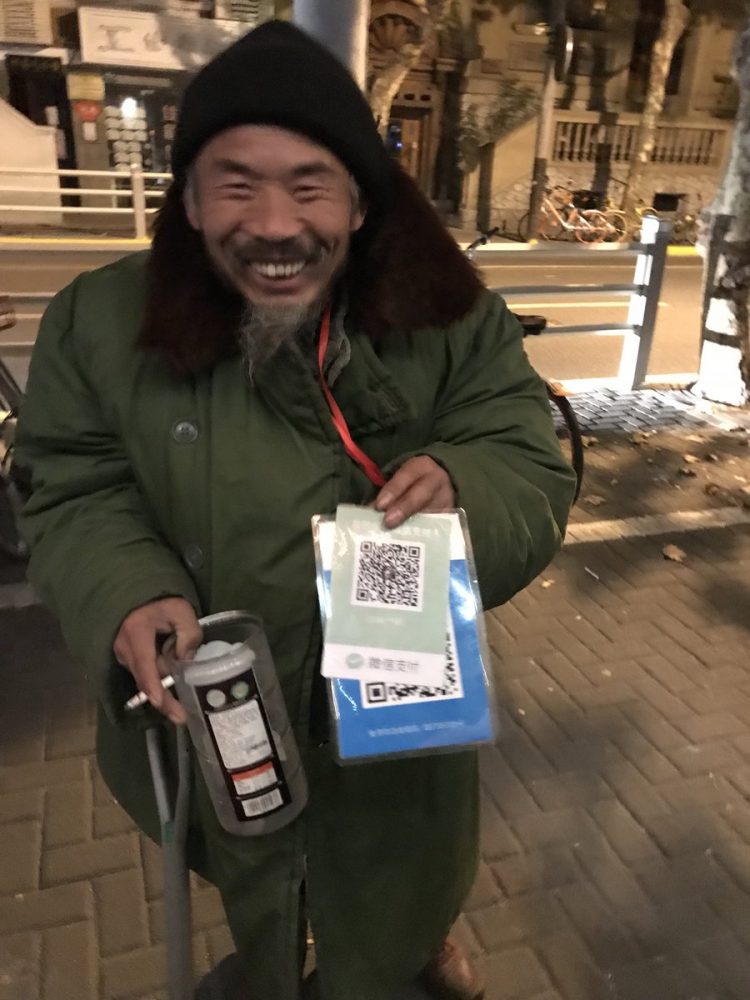
If you’re feeling generous, you can simply whip out your phone, scan a a printed QR code and transfer some money to the beggar’s account.
Local media have spread news of mobile-savvy beggars in the city of Jinan, in China’s Shandong province. They gather in areas popular with tourists, holding begging bowls that contain a QR code printout.
Anyone with Alipay, WeChat Wallet, or some other mobile payment app can scan the code and make a donation. Wait, beggars in China have mobile phones? Well, according to state media outlets, that’s not actually a rare thing.
One of the beggars who caught the media’s attention was reportedly a man with mental problems and the QR code he had was made by his family to help him. However, it appears that QR code begging serves other purposes besides generating income for people down on their luck.
According to digital marketing company China Channel, many beggars in Beijing receive payment from local businesses for every QR code scanned by passers-by. The enterprises use these scans to collect people’s data from WeChat profiles, then sell the IDs for quite a pretty penny to small businesses. The latter use the information to bombard the users with unsolicited in-app advertisements.
Since passers-by don’t actually have to give any money, they are not all that difficult to persuade. However, the “beggars” get paid for their efforts: each QR code scan pays between 0.7 and 1.5 yuan ($0.10 to $0.22). A 45-hour working week nets a monthly average of 4,536 yuan ($685), which is quite decent given what Chinese workers in minimum wage jobs get.
The whole thing may sound weird to foreigners, but it must be noted that China is perhaps the country closest to a cashless economy and QR codes are the reason for that.
The black-and-white, two-dimensional barcodes are used in all sorts of ways: from payment in shops to tips in restaurants and cash gifts at weddings. In fact, mobile payments in China exceed 50 times the volume for the US, where the 2016 tally was $112 billion.
According to consumer behavior researcher Chen Yiwen, China is on the verge of a“codeconomy.”
“China has started the transition to a cash-free economy faster than anyone could have imagined, largely because of the viral spread of two-dimensional barcode. It creates a new economy based on scannable codes.”
Interestingly, Western beggars are not that far behind their Chinese peers, when it comes to mobile payments. A few years ago, professional beggar Damien Preston-Booth made headlines for using a mobile card reader and accepting donations via credit card.
Latest Stories
-
NPP’s new executives will not alter our 2028 preparations – Tanko-Computer
21 seconds -
Tema East MP urges men to take active role in breast cancer awareness
5 minutes -
Hawa Koomson vows to bring experience and maturity to NPP women’s wing
9 minutes -
Opare Addo cautions NDC against adopting NPP’s aggressive politics
11 minutes -
NPP has 35 months to prepare for 2028 after early reorganisation – Political strategist
16 minutes -
All six passengers presumed dead after plane went missing off US coast
27 minutes -
Teachers’ promotion arrears to be paid by Oct. 30 – Education Minister
35 minutes -
Stop talking too much on stage – Kafui Dey warns MCs
41 minutes -
Government has Ho, Volta Region at Heart — Warlord of Asogli
48 minutes -
Mahama reaffirms commitment to Volta development at Asogli Te Za
56 minutes -
REGSEC orders immediate demolition of fire-ravaged building at Koforidua Jackson Park
1 hour -
Ambassador Boateng congratulates new NPP leadership, urges reconciliation, rebuilding
1 hour -
50 vetted to contest Effutu NDC executive positions
1 hour -
GACL enhances security screening at Accra International Airport
1 hour -
COCOBOD raises GH¢3.39bn at 11% in first Commercial Paper tranche
2 hours