

Audio By Carbonatix
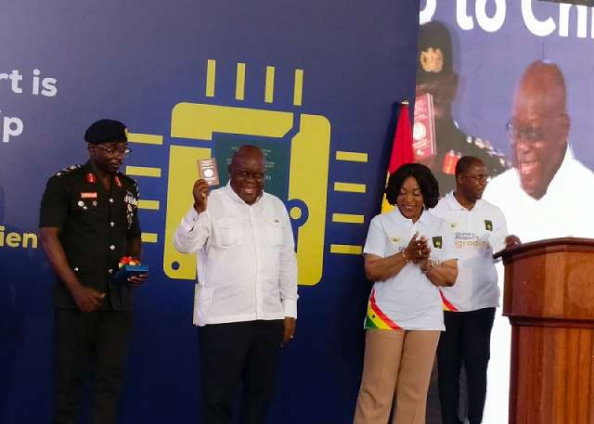
A chip-embedded Ghanaian passport with enhanced biometric features to make travelling seamless has been launched.
The travel document has a microprocessor that embeds the holder’s biometric and photo information.
It also has other unique security features such as an anti-fraud measure, with both latent and patent indicators to ensure unimpeachable security.
The chip-embedded or e-passport is an upgrade of the current biometric passport being used by Ghanaians.
Design
Its design incorporates elements of our rich cultural heritage, including Adinkra symbols such as “Fawohodie” (Freedom and Independence) and “Funtunfunefu Denkyemfunefu” (Democracy and Cooperation).
The event was attended by members of the diplomatic corps, and other personalities.
At the launch of the document yesterday, the President, Nana Nana Addo Dankwa Akufo-Addo, said the e-passport was not just a travel document but it was a symbol of the country’s progress, resilience and readiness to embrace the future with confidence.
Beyond its technological and practical advantages, he said the new Ghana Passport “is a celebration of our national identity.”The Ghanaian passport, he said, had carried the stories, dreams and aspirations of Ghanaians and had served as a gateway to opportunities, allowing Ghanaians to pursue education, business and family connections across borders.
“Alongside the new document, we are introducing system-wide upgrades, including modern security document printers, an enhanced online application platform and streamlined processes at passport offices across the country and Ghanaian missions abroad.
“These improvements aim to resolve long-standing challenges, including the inefficiencies and vulnerabilities that have enabled the scourge of “Goro boys.”
“Our goal is to establish a passport system that is transparent, efficient and worthy of the trust of every Ghanaian,” the President said.
Gateway
President Akufo-Addo noted that the Ghanaian passport had long been a gateway to the world for Ghanaians and that its evolution—from hand-written travel documents in the 1960s to type-written machine-readable passports in the 1990s, and to biometric passports in 2010—reflected “Our nation’s determination to adapt to global trends and standards. Each iteration has marked a step forward, affirming our commitment to providing Ghanaians with secure and efficient means of travel.”
He said that with the e-passport, the country had taken a giant leap forward and that it was not just about catching up with the rest of the world; it was about leading with innovation, putting Ghana on the map as a nation committed to excellence and making life easier for every Ghanaian.
“The chip-embedded passport we launch today represents the pinnacle of this journey. It embodies cutting-edge technology designed to enhance document security, safeguard national identity and meet the stringent standards of the International Civil Aviation Organisation (ICAO).
“At its core, the new passport is a pledge to protect the identity and dignity of every Ghanaian. With advanced biometric features securely embedded in a microchip, it is virtually impervious to tampering or forgery.
“This innovation is a crucial step in curbing identity theft and eliminating fraudulent access to Ghana’s travel documents,” President Akufo-Addo emphasised.
Symbol
The Minister of Foreign Affairs and Regional Integration, Shirley Ayorkor Botchwey, said the chip-embedded passport was not merely an upgrade in technology; it was rather a manifestation of the government’s dedication to efficiency, security and adherence to international standards.
“While the current biometric passport has served us steadfastly for over a decade, the demands of a fast-paced technological evolution have necessitated this upgrade,” she said.
Ms Botchwey stated that the ministry began the chip-embedded passport project in 2016 and that through a ‘build, operate, and transfer’ (BOT) arrangement, it partnered with Biometric Travel Solutions Limited (BTS), a private Ghanaian firm, to undertake the project.
The Chief Director of the Ministry of Foreign Affairs, Regional Integration, Ramses J. Cleland, said it was a gateway to new opportunities, fostering connections across borders, cultures, and ideas to advance economic growth and development in our dear country.
The Director of BTS, Dr Kwaku Ofosu-Adarkwa, said BTS was glad to have worked closely with the Ministry of Foreign Affairs and Regional Integration and the project steering committee to design and implement the state-of-the-art system.
The Hungarian Ambassador to Ghana, Tamas Feher, said the milestone underscored the importance of collaboration between nations and private partners.
Latest Stories
-
Tarkwa court jails labourer for three years over GH¢123,000 theft
53 minutes -
GAEC must retain nuclear scientists for Ghana’s nuclear ambitions – Minister
1 hour -
Man reportedly mistaken for game and shot by hunter dead in forest
1 hour -
19-year-old mason jailed 15 years for defiling seven-year-old pupil
2 hours -
Ghana’s banking sector assets rise 20.47% to GH¢500.2bn – BoG Governor
2 hours -
22 injured as Sprinter bus overturns at Sege after tyre burst
2 hours -
UN housing expert urges Ghana to strengthen Rent Control Department amid housing affordability concerns
2 hours -
Delta-BCI partnership reaches 166,000 people with breast cancer education
2 hours -
Power restoration fault suspected in Kumasi Central Market fire
7 hours -
The 7-foot giant of Ngleshie Amanfro: Seven-foot Ghanaian Ephraim Saawa dreams of joining the national basketball team
8 hours -
Government promises support for Kumasi Central Market fire victims
8 hours -
Vibes The Movie: Big Ghun’s Ghanaian film earns five nominations at 2026 REFFA
8 hours -
‘I’m a fulfilled man’—Justice Korbieh on missing out on Supreme Court despite two nominations
9 hours -
MamaCare CEO warns unresolved conflicts among health workers could undermine maternal and neonatal care
9 hours -
Health professionals urged to translate medical knowledge into practice to save mothers
9 hours