


Audio By Carbonatix
All sea life will be affected because carbon dioxide emissions from modern society are making the oceans more acidic, a major new report will say.
The eight-year study from more than 250 scientists finds that infant sea creatures will be especially harmed.
This means the number of baby cod growing to adulthood could fall to a quarter or even a 12th of today's numbers, the researchers suggest.
The assessment comes from the BIOACID project, which is led from Germany.
A brochure summarising the main outcomes will be presented to climate negotiators at their annual meeting, which this year is taking place in Bonn in November.
The Biological Impacts of Ocean Acidification report authors say some creatures may benefit directly from the chemical changes - but even these could still be adversely affected indirectly by shifts in the whole food web.
What is more, the research shows that changes through acidification will be made worse by climate change, pollution, coastal development, over-fishing and agricultural fertilisers.
Ocean acidification is happening because as CO2 from fossil fuels dissolves in seawater, it produces carbonic acid and this lowers the pH of the water.
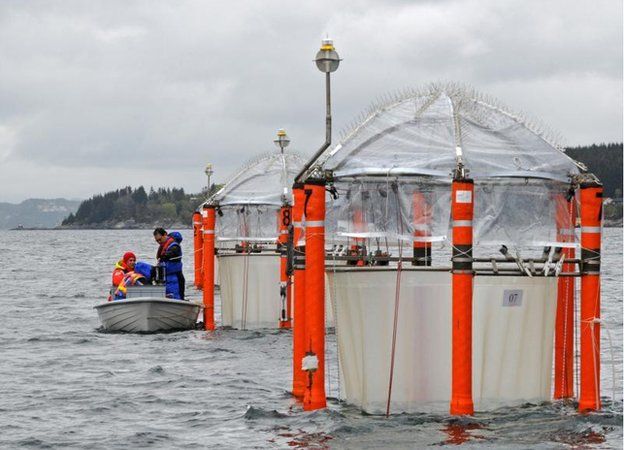
Mesocosms ("giant test tubes") allow scientists to study acidification effects on real-workd organisms
Since the beginning of the Industrial Revolution, the average pH of global ocean surface waters have fallen from pH 8.2 to 8.1. This represents an increase in acidity of about 26%.
The study's lead author is Prof Ulf Riebesell from the GEOMAR Helmholtz Centre for Ocean Research in Kiel.
He is a world authority on the topic and has typically communicated cautiously about the effects of acidification.
He told BBC News: "Acidification affects marine life across all groups, although to different degrees.
"Warm-water corals are generally more sensitive than cold-water corals. Clams and snails are more sensitive than crustaceans.
"And we found that early life stages are generally more affected than adult organisms.
"But even if an organism isn't directly harmed by acidification it may be affected indirectly through changes in its habitat or changes in the food web.
"At the end of the day, these changes will affect the many services the ocean provides to us."
On the agenda
Since 2009, scientists working under the BIOACID programme have studied how marine creatures are affected by acidification during different life stages; how these reactions reverberate through the marine food web; and whether the challenges can be mitigated by evolutionary adaptation.
Some research was done in the lab but other studies were conducted in the North Sea, the Baltic, the Arctic, and Papua New Guinea.
A synthesis of more than 350 publications on the effects of ocean acidification - which will be given to climate delegates at next month's summit - reveals that almost half of the marine animal species tested reacted negatively to already moderate increases in seawater CO2 concentrations.
Early life stages were affected in Atlantic cod, blue mussels, starfish, sea urchins and sea butterflies.
But an experiment with barnacles showed they were not sensitive to acidification. And some plants - like algae which use carbon for photosynthesis - may even benefit.
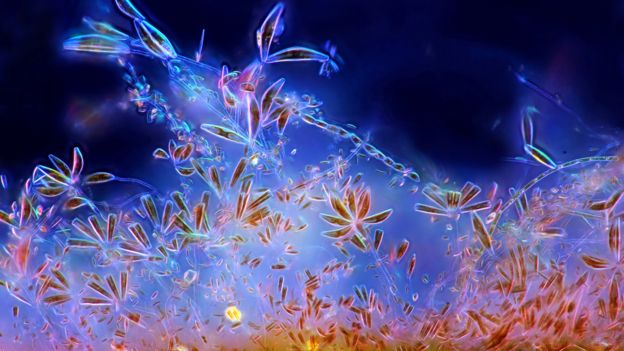
Organisms that use calcium carbonate to build their bodies will likely struggle
Dr Carol Turley, an ocean acidification expert from Plymouth Marine Labs in the UK described the BIOACID research as enormously important.
She told BBC News: "It's contributed enormous insights into the impacts that acidification can have on a wide range of marine organisms from microbes to fish.
"It's also explored how in combination with ocean warming and other stressors it might play out at the ecosystem level and affect human society.
"On the lead-up to the UN climate change negotiations in Bonn this November it is clear that the ocean and its ecosystems should not be ignored."
The conference is being held in Germany but it is being chaired by Fiji, which wants delegates to give due prominence to the effects of CO2 on the ocean.
Latest Stories
-
NEIP: Designing a Ghana Startup Agency that builds enterprises, not programmes
2 minutes -
Breast cancer diagnosis is not a life sentence – Gender Minister urges early treatment
4 minutes -
‘How does a bad settlement translate into criminality?’ – Atta Akyea questions EOCO
9 minutes -
Foreign Affairs Ministry launches ‘ECOWAS for All’ campaign to boost public awareness
17 minutes -
Baffour Awuah’s EOCO questioning centred on SIC matter – Bosome Freho MP
20 minutes -
Kwaku Bonsam appeals to Mahama, Ablakwa to facilitate his US travel for skin graft; says he’ll fund it
35 minutes -
Baffour Awuah arrested after surrendering to EOCO
37 minutes -
Baffour Awuah cooperating with investigators after surrender and arrest – EOCO
56 minutes -
Destruction of aspirants’ posters breaches democracy—Ashanti NPP Communications Director
1 hour -
BNI investigates Ampofo Ankrah over alleged $623,000 World Cup visa scheme
1 hour -
NPP National Delegates Conference: Police announce road closures, diversions around Baba Yara Stadium
1 hour -
Agric Committee demands financing plan for Pwalugu Irrigation Project before 2027 Budget
1 hour -
Minority calls for the immediate suspension of Ghana-Colombia maritime agreement
2 hours -
Ghanaian professional Sydney Hushie appointed UNFPA Chief of Digital Centre of Excellence
2 hours -
GHS urges health managers to use community scorecards to improve healthcare delivery
2 hours