


Audio By Carbonatix
Ghana was ranked 4th in terms of cocoa bean exports to Europe between 2021 and 2024, averaging 53.7%, Fitch Solutions has revealed.
Cameroon was the biggest exporter of cocoa beans to EU with 74.7%, followed by Nigeria, 57.8% and Côte d’Ivoire, 57.4%.
The UK-based firm said while domestic processing offers one avenue for capturing greater value, it expects sustainability and traceability requirements to become increasingly important in shaping export flows, particularly for exports destined for the EU.
However, it said, “We believe the EU’s central role in global cocoa bean imports leaves West African producers highly exposed to developments within the bloc.”
“West Africa remains the dominant player in global cocoa markets, accounting for roughly 65% of global production and over half of global cocoa bean exports. Despite this, we view the region’s role in the cocoa value chain to be concentrated in upstream production, with much of the value added occurring elsewhere, particularly Europe” it added.
According to CNBC Africa, Nigeria, Côte d’Ivoire, Ghana and Cameroon jointly account for roughly 70% of global cocoa production yet capture only about 6% of the value of a finished chocolate bar.
“In our view, this traditional model of exporting raw cocoa beans for processing elsewhere will face growing pressure over the coming years, with implications on the composition and direction of global cocoa trade flows”, Fitch Solutions alluded.
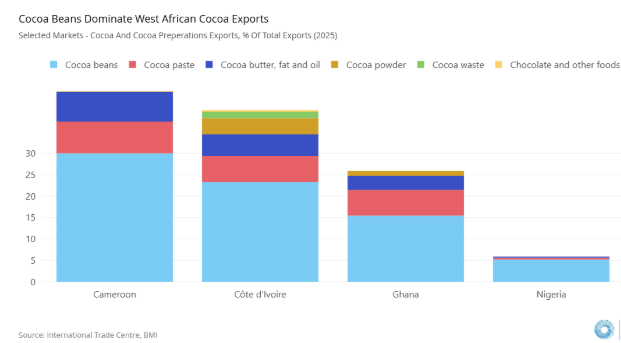
West Africa Remains Cornerstone of Cocoa Bean Production, Not Processing
The Uk-based firm continued that West Africa’s export profile highlights the extent to which cocoa trade in the region remains concentrated in upstream products, while higher-value cocoa products including cocoa paste, butter, powder and chocolate are predominantly exported by the EU.
According to the International Trade Centre (ITC), cocoa beans accounted for a significant share of exports across Cameroon, Côte d’Ivoire, Ghana and Nigeria in 2025, ranging from 5% in Nigeria to 30% in Cameroon and averaging 18% among the four countries.
By contrast, Fitch Solutions said processed and semi-processed goods represented a much smaller share, averaging 5% for cocoa paste, 4% for cocoa butter and just 1% for cocoa powder, while chocolate exports remained negligible in all four markets.
Meanwhile, the EU has consistently accounted for roughly two-thirds of global chocolate exports over the past five years, underscoring how much of the value added in the cocoa supply chain accrues outside producing countries.
Latest Stories
-
Ghana, India sign MoUs to deepen cooperation in agriculture, healthcare, railways and ICT
12 minutes -
Pete Edochie becomes first Pan-African honouree of Ghana’s Legacy Project
15 minutes -
GCB MSME Caravan Clinic unfolds in Accra, boosting support for Ghanaian small businesses
16 minutes -
AMA urged to crack down on unauthorised billboards in Accra
17 minutes -
Obuasi East Assembly orders removal of containers from road reservation
18 minutes -
From selling body splash to Best Female Graduating Student at UDS – Hamdia’s inspiring journey
18 minutes -
Ghana can learn from Nollywood’s pool of behind-the-scenes talent to revive the movie industry – Jackie Appiah
19 minutes -
Tension at Obuasi Rabb Junction as shop owners resist demolition exercise
25 minutes -
Ghana to apply to join BRICS – Okudzeto Ablakwa
29 minutes -
MTN SMEGA Awards: Ghana’s SMEs urged to expand operations and tap into international markets
33 minutes -
Galamsey could wipe out Ghana’s forest reserves, put Atewa Forest at risk – Afenyo-Markin
43 minutes -
Teachers strike: You cannot negotiate while holding the other party in handcuffs – Austin Gamey
57 minutes -
4 injured, including baby, in multi-vehicle crash at Sofoline flyover in Kumasi
60 minutes -
GES should consider regional processing of teacher promotions – FWSC CEO
1 hour -
Minerals Commission suspends reconnaissance license of Gold Coast GRC Ghana Limited
1 hour