

Audio By Carbonatix
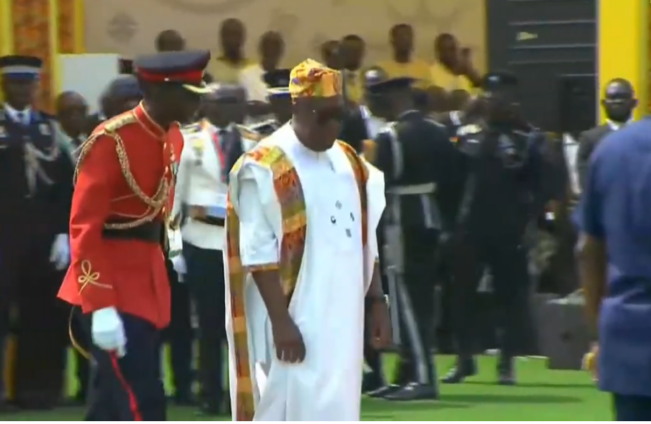
John Dramani Mahama officially commenced his second term as President of Ghana on Tuesday, 7th January 2025, following a grand swearing-in ceremony at Black Star Square in Accra.
The event, attended by over 21 heads of state, featured an inaugural address that boldly confronted the pressing issues facing the Ghanaian economy and charted a course for national progress.
In his address, President Mahama articulated a confident and inclusive vision for Ghana, focusing on economic renewal, transparency, and regional cooperation.
He presented a comprehensive roadmap to tackle the country’s immediate challenges while laying the foundation for sustainable, long-term growth.
The speech emphasised unity, collective responsibility, and self-reliance as key drivers of national transformation.
Addressing the economic difficulties that have plagued Ghana, Mahama underscored his administration’s commitment to tackling inflation and unemployment.
His emphasis on empowering local economies, promoting agribusiness, and fostering a “24-hour economy” showcased his ambition to create sustainable, grassroots-driven development. By advocating for fairer taxation and encouraging the Ghanaian diaspora to invest in the nation, he demonstrated a forward-thinking approach to shared economic prosperity.
Notably, his acknowledgment of BRICS (Brazil, Russia, India, China, and South Africa) as a potential strategic partner signalled a deliberate shift towards diversifying Ghana’s global alliances, reducing dependency on Western financial institutions.
The fight against corruption featured prominently in Mahama’s speech. He pledged to enhance transparency and accountability in governance, framing these principles as central to his administration’s mandate.
Referring to his government as “mandated by the people,” he invoked the democratic values that underpin Ghana’s political system.
However, delivering on these commitments will require moving beyond rhetoric. To build public trust, Mahama must remain connected to the realities of ordinary citizens and ensure the government operates in an open and accountable manner.
Mahama also highlighted the transformative potential of agriculture and infrastructure as key pillars of his administration’s agenda.
He outlined plans to boost job creation through agribusiness and enhance export revenues while promising targeted infrastructure investments to catalyse development across sectors.
On energy, he acknowledged the industry’s debt challenges and pledged to reform the sector sustainably.
His commitment to collaborating with private power producers was pragmatic, but the success of these reforms will depend on ensuring affordable energy access for all Ghanaians.
The president’s call for unity and his acknowledgment of diversity as governance pillars reflected his belief in collective effort as the foundation for national progress.
His outreach to the Ghanaian diaspora was particularly notable, recognising their potential to strengthen the country’s economic base through investment and global partnerships.
This inclusive approach demonstrated Mahama’s understanding of the need for collaboration in achieving his vision for Ghana.
Regional solidarity was also a key theme of the inauguration. Nigerian President Bola Ahmed Tinubu, who delivered a speech following Mahama’s address, underscored the importance of alliances within Africa.
This emphasis on cooperation is especially relevant in the context of emerging blocs like the Alliance of Sahel States, which highlight the continent’s evolving dynamics. Ghana’s role in promoting regional stability and fostering partnerships will be critical in this new landscape.
President Mahama’s speech struck a brave and optimistic tone, setting him apart from his predecessor by signalling a shift towards self-reliance and new global alliances.
While challenges such as corruption and energy sector reforms remain formidable, his vision outlined a presidency focused on meaningful progress. The peaceful transfer of power was a testament to Ghana’s democratic maturity and an example for a region often marked by political instability.
Mahama’s inaugural address was more than a ceremonial formality; it was a strategic blueprint for Ghana’s future.
Latest Stories
-
Power restoration fault suspected in Kumasi Central Market fire
3 hours -
The 7-foot giant of Ngleshie Amanfro: Seven-foot Ghanaian Ephraim Saawa dreams of joining the national basketball team
4 hours -
Government promises support for Kumasi Central Market fire victims
4 hours -
Vibes The Movie: Big Ghun’s Ghanaian film earns five nominations at 2026 REFFA
5 hours -
MamaCare CEO warns unresolved conflicts among health workers could undermine maternal and neonatal care
5 hours -
Health professionals urged to translate medical knowledge into practice to save mothers
5 hours -
Conflicts among care providers linked to maternal, neonatal deaths – Expert
7 hours -
GIS marks 10th TIME conference, champions improved teaching practices
7 hours -
BRICS Or Balance? What Ghana’s bid really means
7 hours -
GPRTU wants full TRAFFITECH-GH implementation to start in 2027
8 hours -
Mahama announces plans to import electric wheelchairs for PWDs
8 hours -
KGL U17 Colts 2026: Western beat Prempeh Elite Academy to set up final final with Greater Accra Region
8 hours -
Late Solanke strike salvages 10-man Spurs draw at Man United
8 hours -
Gender Ministry to monitor welfare of Nana Akua Addo’s children amid domestic violence case
8 hours -
Benedict Okyere Yeboah: Ghana’s football problem goes beyond sacking a coach
8 hours