

Audio By Carbonatix
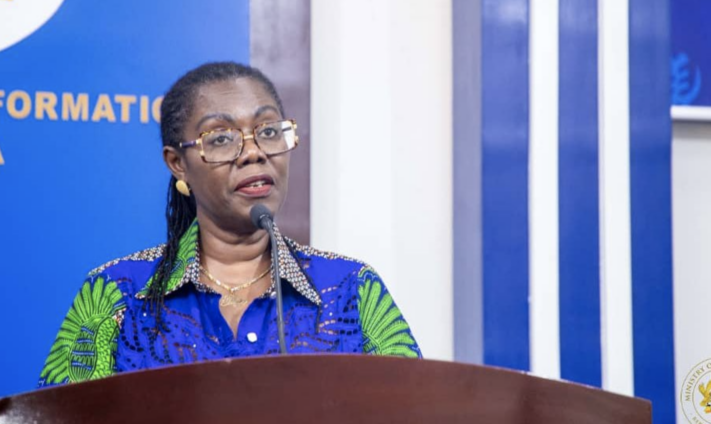
The Minister of Communications and Digitalisation, Ursula Owusu-Ekuful, on Thursday, launched Ghana’s Digital Economy Policy and Strategy to guide the implementation of the country’s technological advancement and consolidate the gains made.
The policy aims to leverage digital technologies to foster economic growth, improve public service delivery and ensure equitable access to digital resources.
At a media briefing in Accra to launch the policy document, Mrs Owusu-Ekuful highlighted the transformative power of digitalisation to the national economy, noting that access to digital technologies and services was no longer a luxury for the privileged few, but a human right.
The Minister mentioned the expansion of a high-speed e-Government network connecting 951 public institutions, backed by 3,500 kilometres of fibre optic cables laid in 2023 as a key milestone in bridging the digital divide.
She further stated that the Government was laying the groundwork for a digitally inclusive future, ensuring that every Ghanaian benefits from the opportunities of the digital era.
Madam Owusu-Ekuful highlighted five specific key areas of focus including entrepreneurship, digital skills, digital government, universal access, and emerging technologies, to deepen Ghana’s economic base.
She believed that the policy documents if fully implemented, would promote an ecosystem in which digital technology could drive inclusive growth and open opportunities for both individuals and companies.
Additionally, she said, the Government’s strategy was to leverage digital technologies to address Ghana’s present and future needs.
By aligning digital efforts with job creation and Gross domestic product (GDP) growth, she said, the policy would ensure that technology becomes a powerful tool for inclusive development, poverty alleviation and enhancing prosperity for all citizens.
“Through digital technologies, we are confident of seeing significant progress in entrepreneurship and efficient public service delivery,” Mrs Owusu-Ekuful stated.
The Minister acknowledged the support of key partners, including the World Bank and the Tony Blair Institute for Global Change in putting the policy documents together.
The Minister appealed for greater collaboration across various sectors of the economy to address connectivity gaps.
She reiterated the need for adaptive regulation to foster innovation and protect the citizens from risks such as fraud and misinformation while positioning Ghana as a leader in Africa’s digital future.
Latest Stories
-
Communities affected by construction of Akosombo Dam urge government to speed up compensation process
15 minutes -
World Cup visa scandal: Sports Ministry not shielding anyone – Sports Minister’s special aide
36 minutes -
World Cup visa scandal: Over 30 people misrepresented as GTA board members to US Embassy – Vincent Assafuah alleges
37 minutes -
Fire destroys wooden structure near Yesu Mo Villa at Bush Road
38 minutes -
NDC threatens sanctions over oversized campaign posters, gives aspirants 5 days to comply
2 hours -
Star Oil paid GH¢2.7bn in taxes, levies in nine months of 2026
2 hours -
Samson’s Take: The rule of law is cheaper before the bulldozer
2 hours -
GRA blames system failure for delay in issuing receipt over passenger’s customs duty
2 hours -
Livestream: Newsfile discusses World Cup visa scandal, beach demolitions, education strikes, BRICS bid
2 hours -
NC-PTAs welcomes end of teachers’ strike, urges parents to prepare children for Monday
2 hours -
Government procures over 2,000 transformers as Ghana’s electricity access hits 89.13% – Energy Minister
3 hours -
UTAG-UG threatens strike on October 19 over unpaid allowance
3 hours -
Let The Constitution direct Chieftaincy to deliver “All Development Is Local”
4 hours -
John Jinapor outlines renewable energy, nuclear power priorities for 2027
5 hours -
Ghana explores centre of excellence for hearing, communication and cochlear implant care
6 hours