

Audio By Carbonatix
Countries have been urged to turn their climate finance commitments into reality, a crucial step in unlocking meaningful progress on climate action.
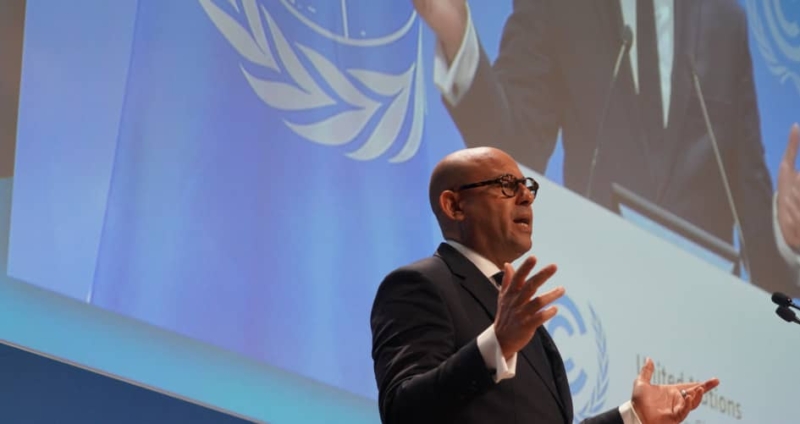
UN Climate Change Executive Secretary Simon Stiell emphasises that countries must make significant strides in climate finance before the Baku meeting, stressing that delay is not an option.
"Please, make every hour here count," Simon urged participants.
Simon says countries need more climate finance while, "we negotiate a future goal. Progress on one, enables the other."
This was contained in Simon's opening speech at the June UN Climate Meetings (60th Subsidiary Bodies) in Bonn.
The June UN Climate Meetings are a crucial stepping stone towards the COP29 UN Climate Change Conference in Baku, Azerbaijan, in November. Officially known as the 60th Subsidiary Bodies meetings, they will tackle technical, scientific, and implementation aspects of the climate agreements, laying the foundation for a successful conference in November.
Simon emphasizes that new grants and favorable financing for developing countries must be combined with comprehensive financial reforms that provide debt relief, affordable financing, and innovative funding sources.
He says countries need to improve carbon markets by making progress on Article 6 and harnessing their potential to unlock more funding for national climate initiatives and adaptation efforts.
"That's why we're convening Parties and stakeholders during these meetings, to build consensus on a way forward at COP29," he said.
NDCs as powerful blueprints for economies development
The new round Nationally Determined Contributions (NDCs 3.0) will be a crucial milestone in global efforts to address climate change. These plans have the potential to not only mitigate disasters by reducing emissions but also serve as a catalyst for economic growth, societal progress, and improved human well-being. Simon Stiell urges countries to make these plans more ambitious and focused on closing the implementation gap, building on past achievements to drive greater resilience, opportunity, and living standards.
"They should be broader, covering whole economies, all greenhouse gases and be 1.5-aligned.
And their benefits should flow to all, including women, Indigenous Peoples, youth and those most vulnerable to climate impacts hitting right now.
There is no one-size-fits-all; after all they are nationally determined.
And we know many Parties will need help putting them together, especially the most vulnerable nations."
The UN Climate Change Secretariat, in collaboration with the broader UN system and partners, is working to provide countries with practical resources and tools. The UNDP's Climate Promise initiative is a key part of the UN system's efforts to support countries in their climate goals, offering assistance to help them deliver on their commitments.
NDC 3.0 Navigator to be launched next week
NDC 3.0 Navigator, developed in collaboration with the NDC Partnership, will be launched next week to support countries in developing and implementing their new national climate plans (NDCs). The platform will provide easy access to relevant information, tools, and expert contacts to facilitate the development of NDCs that focus on practical implementation and tangible results.
"Next week we’ll also launch our NDC 3.0 Navigator, developed with the NDC Partnership, to help Parties access information, tools and contacts that can help them develop new NDCs with a focus on real implementation," Simon indicated.
Parties to submit first Biennial Transparency reports this year
As part of the Paris Agreement, countries committed to submit their initial Biennial Transparency reports in 2024, which will enhance the evidence base for increasing climate ambition.
Simon Stiell notes that these reports will also convey a strong message to donors and investors about the vast opportunities and specific needs, and confirms that the reporting tool is on track for completion by June 30th, enabling all countries to utilize it as scheduled.
"I urge all Parties - let’s not allow perfection to be the enemy of the good in getting this first round of BTRs submitted this year.
We're here to help you take that crucial first step, particularly through extensive capacity building and we will work with you to improve your reports over time."
He appeals to countries to put aside their differences and unite in their efforts, emphasizing that this conference is not a time for merely trying, but for finding concrete solutions and paving the way forward together.
Latest Stories
-
Schizophrenia-related disorders lead mental health cases recorded in Ghana
10 seconds -
Dutch authorities enlist Ghana in hunt for fugitive drug lord Bolle Jos
24 minutes -
Ghana housing finance conference adopts communiqué to improve affordable housing access
5 hours -
Special Initiatives Minister urges Wa Technical Institute to enrol more girls as EU-backed solar training lab opens
5 hours -
In the matter of my first year at the Bar
5 hours -
ActionAid Ghana calls for an end to child marriage, greater investment in girls’ rights
6 hours -
Newsfile to tackle World Cup visa scandal, beach demolitions, education strikes, BRICS bid
6 hours -
UK-Ghana Trade & Investment Summit: Trade Resource Centre to help businesses maximise UK-Ghana trade opportunities
6 hours -
Embassy of Denmark celebrates World Maritime Day
6 hours -
Linking LEAP to productive inclusion could cut extreme poverty by 2030 – UNICEF
7 hours -
Trade Ministry backs use of creative arts to rehabilitate prison inmates
7 hours -
Negotiations with government to continue despite strike suspension – GNAT
8 hours -
‘Ghana cannot afford to waste public resources; every cedi has a job’ – Ato Forson
8 hours -
Ghana expects economic boost as World Assemblies of God Congress brings 10,000 delegates to Accra
8 hours -
Joy in Nayilifong as Farouk Aliu Mahama donates 100kVA transformer to improve power supply
8 hours