

Audio By Carbonatix
A coalition of Ghanaian, South African, and Ukrainian civil society organisations (CSOs) are calling on the African Union (AU) and African states to among others initiate United Nations (UN) reforms that reduce the power of the veto right.
According to them, this means empowering the United Nations General Assembly to overrule a veto with a 2/3 majority.
They argue that Ukraine’s experience showed that over 141 states, the majority of countries condemned the Russian invasion of Ukraine and Russia could block any UN action to defend Ukraine by using its veto at the United Nations Security Council, UNSC.
They explained that changing the veto power distribution will help ensure global peace if any veto-holding country starts military aggression against another state.
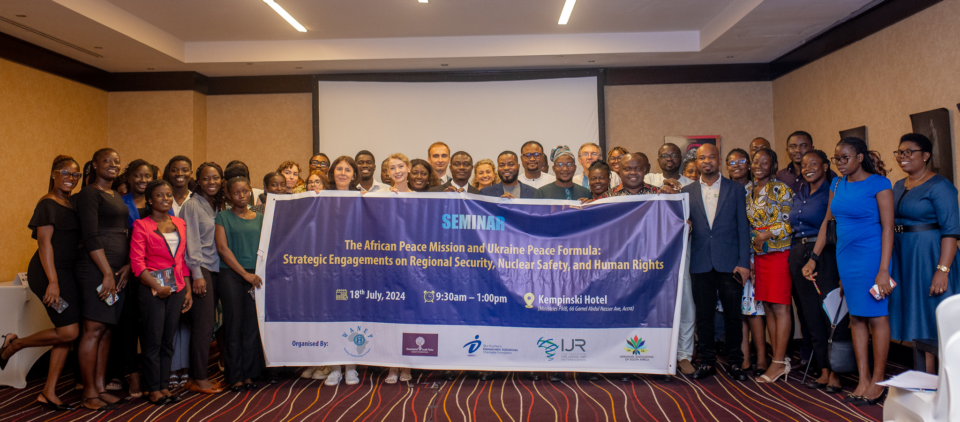
Speaking at the event at the Kempinski Hotel in Accra, the Founding Director of a Ukraine based Think Tank, Democratic Initiatives Foundation, Professor Oleksiy Haran said, while the UN system aims to maintain international peace and security worldwide, the number of conflicts in the last decade has increased.
He said this is partially due to the unequal distribution of power among countries, as the five permanent members of the UN Security Council (UNSC)-China, France, the Russian Federation, the United Kingdom, and the United States have more power through their right to veto any United Nations Security Council (UNSC)
He added that Russia's veto blocked the United Nations Security Council’s action against the Russian invasion of Ukraine in 2014. On the 24th February 2022, Russia, while holding the presidency of the UNSC, launched a full scale war by invading a fellow UN member’s territory.
Professor Haran said “delays in implementing systematic UN reforms to overcome the UNSC members veto rights will likely further deteriorate global security and humanitarian conditions”.
He added that the UN General Assembly must be given the right to overturn a UNSC permanent member’s veto.
Head of the Peacebuilding Interventions Programme, Professor Tim Murithi said Africa has a lot of role to play in bringing long lasting peace to Ukraine.
He said “long-lasting peace is needed in Ukraine and African countries have pivotal roles to play in realising that and that’s what we must strive for."
In his remarks, Regional Coordinator, Research and Capacity Building at the West Africa Network for Peacebuilding (WANEP-Regional) Dr Festus Kofi Aubyn said the situation in Ukraine is a stark reminder of the importance of negotiated diplomatic solutions to end the war
The coalition of CSOs also want the AU and African states to act immediately to uphold international obligations on non-proliferation and stop the aggression of nuclear-armed states against denuclearised nations.. They also want protection of peaceful nuclear power plants by approving new binding international legislation that prohibits military attacks on nuclear facilities.
According to the group, children are the first victims of military conflict. As of June 2024, Russia has unlawfully and forcibly deported 19,546 Ukrainian children. Post 2022, Russia has approved a new legislation allowing the change of citizenship, name, surname, and date of birth of Ukrainian children without parental consent.
Ukrainian children have been sent to 57 regions of Russia, with some already adopted into Russian families. Despite support from UN institutions, the International Red Cross, religious leaders such as the Vatican, and individual states like Qatar, only 388 children have been returned in nearly three years. There is a lack of effective mechanisms for their return.
The groups are calling on the Africa Peace Mission to continue working on the concerns and act on implementing them.
Russia militarily invaded Ukraine in 2014, and with the lack of international response to its aggression, it escalated its military invasion to a full-scale war in 2022.
The collaborative platforms for experts have been initiated by the Institute of Justice and Reconciliation, the Desmond and Leah Tutu Legacy Foundation, the Democratic Institute Foundation (DIF), and the Ukrainian Association of South Africa (UAZA).
Latest Stories
-
Anthony Joshua declines showdown with Tyson Fury but admits they ‘probably’ clash next
2 minutes -
Tyson Fury dominates Makhmudov, calls out Joshua next
21 minutes -
I have supported highway authority financially to fix roads in my constituency – A Plus
1 hour -
US, Iran fail to reach peace agreement after marathon talks in Pakistan
2 hours -
ECG kicks off Phase Two of transformer upgrades at Lashibi; brief outages expected
2 hours -
Port crises loom as 11,000 drivers threaten four-day strike
3 hours -
A source of excellence across generations – Vice President Opoku-Agyemang lauds Mfantsipim
4 hours -
(Photos) Mfantsipim School launches historic 150th anniversary
4 hours -
Knights and Ladies of Marshall group backs Catholic Bishops’ stance on anti-LGBTQ+
5 hours -
Bright Simons writes: All the Filla in the Ibrahim Mahama/E&P – Gold Fields Saga
6 hours -
Monetise Idiocy In Ghana
6 hours -
The Ghanaian prophet and the mysterious death of his scottish wife Charmain Speirs
7 hours -
Nearly 400 sentenced in Nigeria for links to militant Islamists
7 hours -
Ghana’s recovery supported by gold strength despite global oil price pressures – Standard Bank Research
7 hours -
Methodist Church hails Mfantsipim@150; calls for “fresh consecration” to excellence
8 hours