

Audio By Carbonatix
Ghana and the rest of the developing countries demand $1.3 trillion per year from Western countries to live with climate crisis impacts and to take actions to reduce all forms of emission is a “do or die” affair.
Under the New Collective Quantified Goal on Climate Finance (NCQG), the figure proposed seeks to accelerate the achievement of climate actions linked to Article Two of the Paris Agreement.
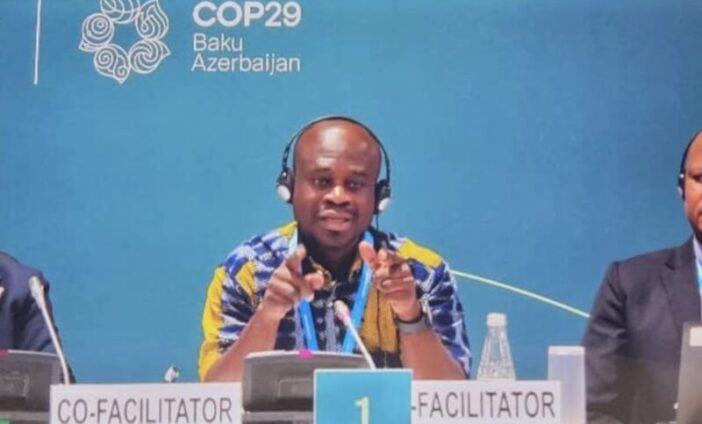
Dr Antwi-Boasiako Amoah, the Acting Director in charge of Climate Vulnerability and Adaptation at the Climate Change Department of the Environmental Protection Agency (EPA) told the Ghana News Agency at the ongoing global talks that a text covering the request had not yet been negotiated.
The 29th Conference of the Parties on Climate Change (COP29), christened the “Finance COP29, just began its second week of discussion which opens today in Baku Azerbaijan.
He said, “We spent the whole week trying to go over the things that we have gone through all these two years. The main objective of this COP is to have a decision that is going to take us forward, starting from 2025 to implement climate finance as a replacement of the $100 billion goal that we already had”. That was promised by developed countries in Copenhagen.
Per the procedure of the COP, Dr Amoah explained that every issue must have a text, which technical representatives of countries often called negotiators discuss line by line, agree and then adopt.
Dr Amoah said the issue under discussion was the definition of climate finance, “When we say climate finance from developed countries does it mean aid, grant or other funds that come to developing countries that do not specifically support climate change.”
“And this is very important for us developing countries because we have been duped before. Where funds that are not climate-related are branded as climate finance. This has been accounted for as part of the $100 billion.”
Dr Amoah noted developing countries were proposing that the new scheme must agree on what constitutes climate finance, the quantum of funds and the contributors.
“People are saying that at this moment, climate financing cannot be the sole burden of developed countries and therefore, the base must be widened up,” he said.
“However, under the Paris Agreement, where it says developed country parties are supposed to provide climate finance for developing countries to address their climate needs.”
Dr Amoah said the developing countries wanted the funding to be public climate finance, not loans, not other instruments like loans that would increase their debt burdens.
The effects of climate change, such as rising temperatures and changing rainfall patterns, are already being felt in sectors such as Agriculture, Coastal and Urban areas in Ghana.
Agriculture, which is a vital sector of the economy, is particularly susceptible to these changes. Decreased rainfall and prolonged droughts have led to lower crop yields, jeopardizing food security for many Ghanaians.
Climate variability and change are wreaking havoc on Ghana’s agriculture, crops, livestock, and fisheries sectors, with late-onset and early cessation of rainfall, droughts/dry spells, and floods of varying magnitudes and frequency.
The national economy stands to suffer from the impacts of climate change because it is dependent on climate-sensitive sectors, most especially agriculture.
Promoting adaptation and mitigation strategies is crucial for building resilience among smallholders and improving livelihoods at the local level, as some smallholder farmers engage in unsustainable agricultural systems contributing to the impact of climate variability and change.
Latest Stories
-
National Defence University to strengthen Ghana’s response to emerging security threats – Haruna Iddrisu
3 minutes -
Pupil arrested after two teachers shot at French school
9 minutes -
Lamisi takes ‘Let Us Clap’ tour across five countries and 18 dates
27 minutes -
DVLA cuts roadworthy contract cost from $155.4m to GH¢2m – CEO
29 minutes -
Okyeame Kwame calls for free university education for farmers’ children
32 minutes -
Black Stars: Two decades of coaching triumphs and turmoil (2006–2026)
36 minutes -
DVLA plans simulator-based driving tests to assess prospective drivers in Ghana
44 minutes -
FDA disposes of 40-foot container of non-compliant diapers imported from Spain
47 minutes -
PAC disappointed by Agric Ministry’s failure to present key witnesses in GH¢69bn special audit inquiry
55 minutes -
DVLA to digitise road accident reporting, requiring location coordinates before reports are filed
56 minutes -
GJA accepts Mahama’s request to organise national forum on hate speech
1 hour -
Democratizing the judiciary: Why Judges in Ghana should engage “We the People” through social media platforms.
1 hour -
Bond market: Turnover increases by 47% to GH¢4.07bn
1 hour -
DVLA prepares electronic queue system to reduce congestion
2 hours -
Hearts of Oak coach Kapor raises alarm over poor pitches in Ghana football
2 hours