

Audio By Carbonatix
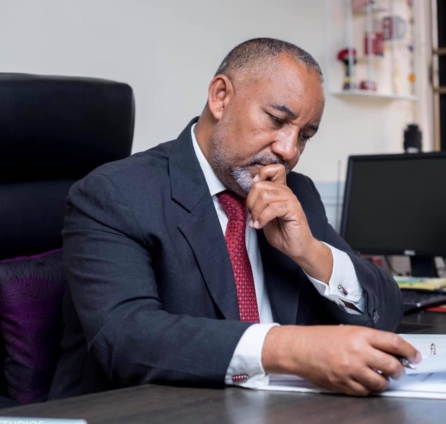
A former Executive Director of Standard Chartered Bank, Alexander Kofi-Mensah Mould has warned the economic contraction implications of the debt exchange programme will be dire.
According to him, if the Debt Exchange is carried out in its current form, would result in many banks losing as much as 60% of their revenue, since they depend on government treasury bonds.
“To be blunt, most banks will be making losses when you combine this loss of income with the high default rate on loans to SMEs and corporates,” he emphasized.
In a Facebook post, Mr. Mould said the main implication of the proposed Debt Exchange would be a general slowdown of the economy and “we will either not grow as anticipated, and, perhaps, even not exceed 2% GDP growth this year.”
He said government will have no other option than to cut down its discretionary expenditure and other non-productive policy programmes.
“We also expect a reduction in the construction of new roads as well as a slowdown in road maintenance, and a lot of non-essential government workers’ salaries being delayed or not paid at all etc ie more expenditure accruals,” he stated.
Read full statement
Gov't seems not to have thought through this debt exchange programme thoroughly; the economic contraction implications are dire!
There will be a general slowdown of the economy and we will either not grow as anticipated, or, perhaps, even not exceed 2% GDP growth this year.
This will be due to less demand, which means that there will be less production, fewer imports, and fewer services being given to the populace.
Now, what does this mean for government revenue?
Since the demand of goods and services will go down, it means people will be paying less taxes. Additionally, due to reduced demand - a result of less discretionary expenses - there be fewer imports and as such there will be less duty and other excise taxes collected at the ports.
So, government revenue will plummet and they may fall short of making the projected revenue in the approved budget.
The Debt Exchange, if carried out in its current form, will result in many banks not getting any income from Government Treasury Bonds they hold for almost 1.5 years! In some cases, this forms up to 60% of their revenue and is a huge contributor to their profits! To be blunt most banks will be making losses when you combine this loss of income to the high default rate on loans to SMEs and corporates.
With lower than expected revenue, Government will have no other option than to cut down its expenditure.
The first to go will be discretionary expenditure and other non-productive policy programmes.
We also expect a reduction in the construction of new roads as well as a slowdown in road maintenance, and a lot of non-essential government workers’ salaries being delayed or not paid at all etc ie more expenditure accruals.
Furthermore, with the statutory payments, like pension contributions, the situation will be worse than it currently is i.e. gov't backlog of unpaid pension contributions of gov't workers.
Government needs to re-visit this debt exchange program, and create policies that will bring back confidence in the economy, as well as attract investment to spur on the economy; resulting in more spending and increased savings.
Latest Stories
-
Over 38,000 commercial, 150,000 residential customers unbilled – Ghana Water MD
21 minutes -
Several injured as Sprinter bus collides with ‘trotro’ at Odorkor
22 minutes -
Ghana records progress on reparatory justice agenda – Ablakwa
39 minutes -
Mahama commissions Christian Tetteh Yohuno Ward Complex at Police Hospital
54 minutes -
Vice President calls for wider access to Ghana’s political party histories
54 minutes -
Republic Bank JoyNews Habitat Fair to connect prospective homeowners with exhibitors in Ho from October 16 to 18
1 hour -
Obaasima Summit: ‘AI is not a spiritual attack’ — Rev. Dr. Ofori-Boateng urges young women to embrace technology
1 hour -
GHS to distribute 80,000 pairs of locally-made protective footwear to health workers
1 hour -
GoldBod boosts local jobs as 90% of gold undergoes refining in Ghana – Sammy Gyamfi
1 hour -
The search for the politically unblemished: Are we asking the impossible of public appointees?
1 hour -
Ghana seeks climate finance access for debt-restructuring countries
2 hours -
Afenyo-Markin urges stronger media scrutiny of public institutions
2 hours -
GoldBod recovers GH¢38.7m in legacy PMMC debts, targets remaining arrears
2 hours -
62 out of every 100 commercial meters inspected missing from Ghana Water database – MD
2 hours -
GoldBod gets BoG authorisation to sell forex, Sammy Gyamfi tells PAC
2 hours