

Audio By Carbonatix
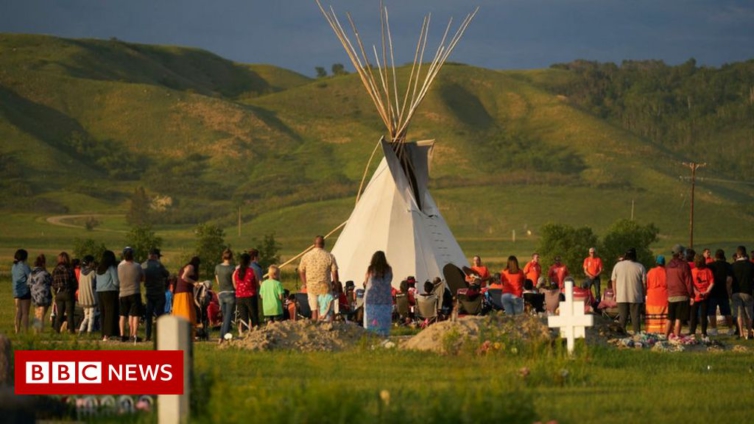
An indigenous nation in Canada says it has discovered evidence of 54 unmarked graves at the sites of two former residential schools in Saskatchewan.
Keeseekoose First Nation said the graves were found near Fort Pelly and St Phillip's residential schools.
It is the latest finding amid a wave that has triggered a national debate over the residential school system.
Indigenous investigations across the country have found evidence of more than 1,100 graves since last spring.
Just weeks ago, the Williams Lake First Nation announced it had found evidence of 93 unmarked graves on the grounds of St Joseph Mission, a former residential school.
These government-funded compulsory boarding schools were part of a policy meant to assimilate indigenous children and destroy indigenous cultures and languages.
Some 150,000 First Nations, Métis and Inuit children were taken from their families during this period and placed in these schools.
Survivors had long testified that children who died at the schools were buried in unmarked plots, now being rediscovered throughout the country.
Ted Quewezance, project leader of the Keeseekoose's search, said ground-penetrating radar technology suggested there were 42 grave sites at the grounds of Fort Pelly Residential School, and an additional 12 at St Phillip's.
At a news conference on Tuesday, Mr Quewezance said the discovery matched testimony of residential school survivors.
"It was not that they could not hear, but [that] they did not believe our survivors," he said.
Chief Lee Kitchimonia said that wintry weather would delay the investigation of the site.
"It's going to be a very tough time... knowing we have unmarked graves in our community, where we walk every day, drive every day," he said, according to CBC News.
"We passed by them, never realising that there were graves there."
Fort Pelley was open as a residential school from 1905-13.
The St Phillip's building was used as a boarding house for students from 1902-14 before it was shut due to poor conditions.
It was re-opened in 1927 as a residential school and, like the majority of Canada's residential schools, was run by the Roman Catholic Church.
Both were in eastern Saskatchewan.
More than 130 residential schools were operated in Canada between 1874 and 1996.
Conditions inside the schools were abhorrent. School buildings were often poorly built, poorly heated and unsanitary, and children were subject to emotional, physical and sexual abuse.
The landmark Truth and Reconciliation Commission (TRC) report, released in 2015, concluded Canada's residential school system amounted to "cultural genocide".
At least 3,200 children died while attending a residential school, though advocates have said this number is likely much higher. Former TRC chair Murray Sinclair estimated some 6,000 children may have never made it home.
Latest Stories
-
When the Gospel Becomes a Weapon: The church, blackmail and the abuse of faith
14 minutes -
JoyNews’ Jacqueline Ansomah Yeboah selected for UK Media Excellence for Emerging Technology Fellowship
31 minutes -
Mental Health Alliance urges government to operationalise Mental Health Fund
46 minutes -
Ghana–Holy See agreement heads to Parliament after Cabinet approval
50 minutes -
Luv FM Corporate Games 2026: Kumasi Central Prisons, Amanfiman Bank win big amid fun
1 hour -
WAFU B U17: Ghana top Group A after win over Togo
2 hours -
Ho Central Mosque reopens amid unresolved leadership dispute that led to closure
3 hours -
Minority caucus questions GH¢16.4m in Ablakwa’s SA evacuation spending, demands independent audit
3 hours -
Gender Ministry meets Nana Akua Addo’s husband over domestic violence after hospital discharge
4 hours -
UG Vice-Chancellor urges swift operationalisation of National Research Fund
4 hours -
Pope Leo to have surgery after lump found in lung
4 hours -
Joseph Cudjoe writes: Ghana must break free from the dangerous mindset that natural resources are the foundation for wealth
5 hours -
Children among 109 dead after boat capsizes off Djibouti, UN says
5 hours -
OmniBSIC Bank’s 11th health walk promotes fitness and business growth
5 hours -
2026 World Maritime Day: Danish Embassy organises “The Gulf of Guinea Speaks”
5 hours