

Audio By Carbonatix
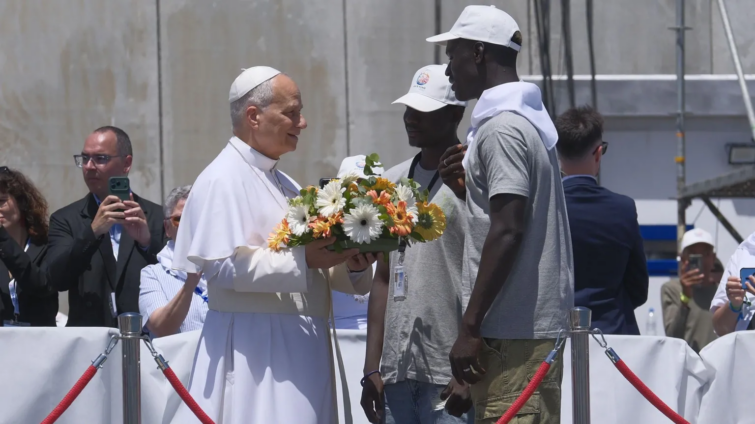
Pope Leo XIV began a two-day visit to the Canary Islands on Thursday by listening to the stories of migrants who have risked long and perilous journeys across the Atlantic to reach Europe.
"You are not numbers or files, you are people," the Pope told a gathering on the Spanish island of Gran Canaria, adding that he "bowed" before their dignity.
That recognition and solidarity is the theme of the Pope's visit to the island, a clear counterpoint to others' portrayal of migration in Europe as a crisis or an invasion.
Data from the UNHCR show that the number of arrivals by sea to Spain has fallen significantly this year, partly due to more interceptions off the West African coast by EU-funded naval patrols.
But many people are still trying to cross - and dying.
So, in the southern port of Arguineguín - often used by migrants - Pope Leo stressed the need for alternative "legal and safe pathways" above all. He called on the "conscience of Europe" not to "grow accustomed" to its seas becoming unmarked graves or to a world where "so many risk death to seek life."
That includes entire boatloads of migrants that have disappeared without trace.
The Pope then threw a wreath of flowers into the waves in memory of all the dead, lowering his head to pray.
Bakary Jaiju considers himself among the lucky ones.
He was 19 when he climbed into a wooden boat in the Gambia in search of a better life. He would be at sea for seven frightening days, supplies of food and water gradually running out.
"You can't even sleep in case you fall in," he recalled, now in Tenerife after finally reaching shore late last year.
"I decided to go, whether I survive or I die, because I want my family to be in a good condition," Jaiju said, explaining why he had left behind his wife and baby boy and set out on the treacherous route.
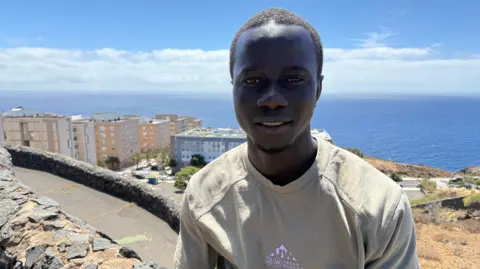
Among the 160-or-so people packed into his boat were women and children. When their fuel ran out off the tiny Spanish island of El Hierro, they were eventually spotted and rescued.
Jaiju then spent three "very cold, very difficult" months in a migrant camp until he joined a project helping him to learn Spanish and find a way to stay in Tenerife legally.
The driving force behind that is Padre Pepe, a chatty parish priest in jeans and checked shirt rather than a dog collar.
He realised the number of young migrants on the island was growing, but local authorities only looked after them until they turned 18. From then on, they were on their own.
"But the streets will eat you up, young people are like carrion there," said Padre Pepe.
The Good Samaritan Foundation now offers accommodation and all kinds of workshops to about 170 young men. "The labour market could absorb all these people, there is huge demand," the priest insists.
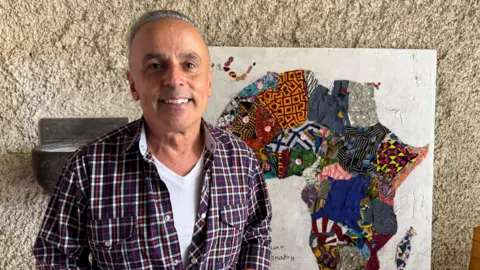
"It's hard for me to understand why the human heart is so hard," is the priest's take on toughening attitudes in Europe to migration. "If we do it well, integrate people well, there is nothing bad in it at all. Quite the contrary."
Bakary Jaiju's own route to residency has been eased by a rare opportunity.
Pedro Sánchez's Socialist-led government in Madrid is currently allowing hundreds of thousands of undocumented migrants to "regularise" their status, so anyone who arrived before last December can apply for residence and work permits.
Padre Pepe's team are scrambling to help everyone submit their paperwork before the deadline.
The one-off move has been criticised by Spain's opposition.
The conservative Popular Party has condemned an "irresponsible" move that goes against all EU immigration policies. And the far-right Vox party has called it an "invasion" that would attract more migrants to the country and cause the "collapse of the health service, housing and security".
For Spain's government, though, the move is a mix of the humanitarian, pragmatic and political: with an ageing, shrinking population it needs more workers – like all of Europe.
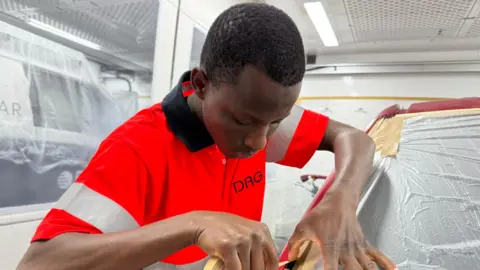
"We couldn't find local people who wanted to work with us," said Diana del Molino Rodriguez at the Domingo Alonso Group workshop in Las Palmas de Gran Canaria.
Unable to recruit bodywork painters or panel beaters, the car firm hooked up with the local government to hire young migrants once they turn 18 and leave state care.
Molino Rodriguez says they faced fierce criticism initially, with social media comments about people "stealing" Spanish jobs: "It was a really hard thing to do because immigration was not something seen as positive. Nobody was looking at migrants like persons."
Her firm now has around 30 people on its books, including 19-year-old Tiene Lama, who says he's able to send several hundred euros each month back to his family in Ivory Coast.
Dozens of companies, including big hotel chains on the holiday islands, have now signed up to the scheme.
As the Pope pushes against the tide, trying to change the tone on migration, a new EU pact kicks in this week aimed at tightening Europe's borders still further.
The idea is to make it easier to detain and deport those arriving by sea.
For young men like Bakary Jaiju, already prepared to risk everything, it is little deterrent; for human rights groups it brings new fears for asylum seekers and their struggle to be heard.
But it is officials on the Canary Islands, where that policy should play out, who are most damning.
"We have no-one to work in the hotels, drive our buses or work in construction; we don't have masons or mechanics," warns Francis Candil, deputy minister for welfare.
"What we need is a real migration policy that means people from African countries don't have to risk their lives but can come to Europe and have options for work."
"Instead, we have Europe trying to protect itself behind walls - and to expel people."
Latest Stories
-
Global economy’s resilience nearing limits – IMF
7 minutes -
Trust-building is crucial for sustaining confidence with communities – Police Commander
12 minutes -
Government to redevelop Aboabo Market in Tamale – Mahama Ayariga
18 minutes -
We haven’t handed over our forex role to Goldbod – BoG Governor Asiama
22 minutes -
AG urges Legal Aid Commission to expand services to districts
23 minutes -
Ghana calls for stronger African cooperation to tackle maritime threats
28 minutes -
‘Trust but verify’ – MTN Ghana urges SMEs to guard against cyber fraud
30 minutes -
Let us all be mentors to our younger generation – Mahama
35 minutes -
Assemblies of God Congress: Mahama urges churches to promote compassion, integrity
41 minutes -
North Korea and China open new bridge after 12-year delay
51 minutes -
Anthropic flags revenue surge to investors ahead of stock market debut
60 minutes -
Norway’s wealth fund set to overhaul ethical rules after US scrutiny
1 hour -
‘There can be no mistake, regardless of who is picked’ – Bentil on CJ contenders
1 hour -
Ghana needs a Chief Justice who inspires public confidence – Bentil
2 hours -
Government to introduce integrated basic education model schools from 2027 – Haruna Iddrisu
2 hours