

Audio By Carbonatix
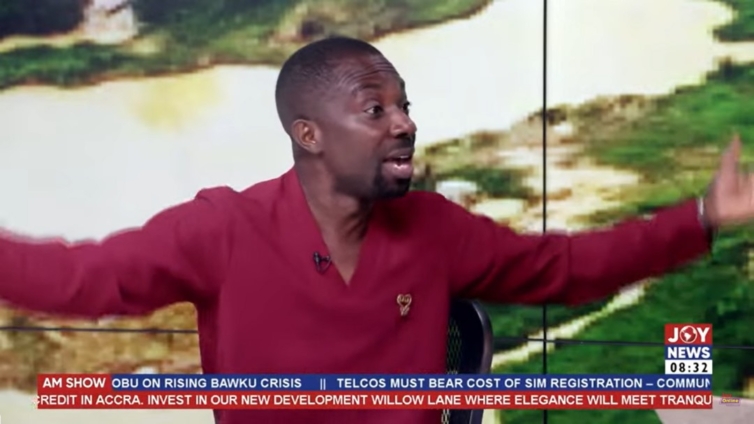
Dennis Miracles Aboagye, aide to former Vice President Dr Mahamudu Bawumia, has strongly criticised the Ghana Gold Board for its failure to effectively address the ongoing illegal mining (galamsey) crisis in Ghana.
He revealed that had Dr Bawumia won the 2024 presidential election, he would have established a Minerals Bank to provide a more structured and sustainable solution to the issue of illegal mining.
The Gold Board (GoldBod), has only recently come into being, having received presidential assent on 2nd April 2025.
In an interview on the AM Show on JoyNews, Miracles Aboagye expressed frustration over the lack of tangible results from the Gold Board, particularly regarding the formalisation of small-scale mining.
He pointed out that the Gold Board, despite its promises, had failed to address the root causes of illegal mining and had not brought about meaningful change.
“You said the Gold Board would do it, but have they done it? It’s not even clearly captured in the Gold Board law,” Mr Aboagye asked JoyNews’ AM Show host Benjamin Akakpo.
Mr Aboagye then outlined how Dr Bawumia’s plan would have taken a more comprehensive approach to tackling the problem.
Had Dr Bawumia won the 2024 election, his plan included setting up a Minerals Bank, which would have provided financial resources and infrastructure to support legal, small-scale mining.
According to him, this approach would have gone beyond existing systems, which were not effectively addressing the challenges posed by illegal mining.
“The government must put in place a system,” Mr Aboagye explained. “There must be a deliberate social reorientation to help illegal miners understand the devastating effects of galamsey on themselves, their communities, and the country. Along with this, we need to offer alternative livelihoods for those willing to transition to legal, small-scale mining.”
The proposed Minerals Bank would have provided miners with the necessary resources, machinery, and data to mine legally and efficiently.
One key aspect of the plan was to provide geological data to help miners locate gold deposits more effectively, reducing the environmental damage caused by indiscriminate mining.
He explained that this would have helped miners avoid the harmful practice of scavenging and instead focus on identified, profitable areas.
“Instead of just digging anywhere, they would have had data that shows exactly where the gold is,” Mr Aboagye said.
“The government would also have provided the necessary machinery and financial support to ensure miners could operate independently, reducing their reliance on foreign miners.”
A major issue raised by Mr Aboagye was the financial limitations faced by local miners. He pointed out that many Ghanaian landowners, particularly in mining areas like the Atiwa Forest, lacked the capital to acquire modern mining equipment.
As a result, they often turned to foreign miners—particularly Chinese nationals—which led to the exploitation of local miners and limited economic benefits for the landowners themselves.
“When Ghanaian landowners don’t have the financial muscle to bring in machinery, they end up relying on foreign miners, especially Chinese nationals,” Mr Aboagye explained. “But at the end of the day, even though it’s our people doing the mining, they get very little in return. Our local miners are being exploited.”
This, according to Mr Aboagye, is why Dr Bawumia’s proposed Minerals Bank was crucial. It would have empowered local miners by providing them with access to capital, machinery, and legal backing.
This, he said, would have enabled them to work independently and regulate small-scale mining, which was critical to reducing the environmental damage caused by illegal practices and equipping local miners with the tools they needed to thrive within the law.
Mr Aboagye argued that Dr Bawumia’s approach—through the establishment of the Minerals Bank—would have been a game-changing solution to the illegal mining problem.
Unlike the Gold Board’s efforts, which he described as ineffective, Dr Bawumia’s plan, he said, would have tackled the root causes of illegal mining, empowered local miners, and ensured a sustainable, regulated mining industry that benefits both the local economy and the environment.
Latest Stories
-
‘I resigned five months ago – BoG Governor Asiama explains GoldBod Board exit
52 seconds -
Trump confirms meeting with Anthropic’s Amodei, repeats dismissal of AI fears
27 minutes -
China pushes back against US on Iran and Cuba in UN speech
36 minutes -
OpenAI, Anthropic CEOs called to appear at Australian AI probe
57 minutes -
T-bills auction: Government exceeds target marginally; yield on 91-day bill remains unchanged
4 hours -
GPL 2026/27: 10-man Aduana hand Kotoko defeat in Kumasi
4 hours -
GPL 2026/27: Medeama ease past Basake Holy Stars
5 hours -
Appiah Adomako writes: Why DVLA must stop treating every expired licence holder as delinquent
5 hours -
Tuchel rues ‘big mistakes’ – did Manchester City charges have impact?
5 hours -
Localization must transfer decision-making power, not just project responsibilities
5 hours -
Modernising Ghana’s traditional markets through the 24-Hour Economy markets initiative
5 hours -
New economy will boost local production and create jobs – Finance Minister
5 hours -
Manchester City chairman confident club will prove innocence
5 hours -
Republic of Ireland ‘raised awareness worldwide’ in Israel game
5 hours -
Germany still winless under Klopp after loss to Greece
5 hours