

Audio By Carbonatix
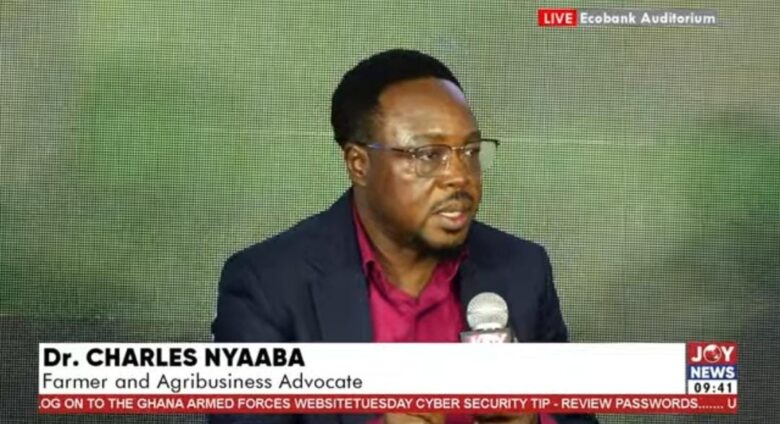
A former Director of the Peasant Farmers Association of Ghana (PFA), Dr Charles Nyaaba, is making a strong case for greater investment in sustainable transport systems and environmentally friendly agricultural inputs to help farmers reduce production challenges.
He says inadequate transportation from farms to markets continues to leave many farmers stranded with their produce, particularly in farming communities where access to reliable transport remains limited.
Speaking at the Ecobank-JoyBusiness Financial Dialogue Series, Dr Nyaaba said innovative transport solutions, including battery-powered vehicles, could help improve the movement of farm produce from production centres to markets.
He cited the use of rechargeable battery-powered yards as an example of how alternative energy solutions could be adapted to support agricultural communities.
“How can we make such transport system available to most of the farmers who are stranded in the farm gate?”
Dr Nyaaba said improving transport infrastructure and systems at the farm-gate level would help farmers move their produce to nearby markets and ultimately connect them more efficiently to consumers.
He also raised concerns about farmers' continued dependence on chemical pesticides and fertilizers, stressing the need to improve access to organic alternatives.
According to him, although organic fertilizers and pesticides are gradually entering the market, challenges remain with their quality, availability and uptake among farmers.
“Majority of farmers today still depend on chemical pesticides and fertilizers,” he said, adding that access to organic alternatives remains a major challenge.
Dr Nyaaba therefore called for greater support for the development and distribution of quality organic fertilizers and pesticides, as well as financing mechanisms that can make such products more accessible to smallholder farmers.
He said a broader approach to green financing should address not only renewable energy for agricultural production but also sustainable transportation and environmentally friendly farm inputs.
Such interventions, he noted, could help reduce the environmental impact of agriculture while improving farmers' ability to transport their produce, lower production costs and access markets.
Latest Stories
-
When dialogue fails and strikes speak: Is industrial action the only language government understands?
33 seconds -
Ghana launches Social Protection Act regulations and Affirmative Action Gender Equity Regulations
2 minutes -
Mahama swears in Emelia Afi Agbenyo, Joseph Kwaku Asamoah as EC Deputy Commissioners
11 minutes -
Wetland communities in Northern Ghana face a hotter, flood-prone future as climate risks intensif
14 minutes -
Sam George tasks KNUST to develop Twi AI model as Ghana plans local-language artificial intelligence
16 minutes -
Poor roads choking eco-tourism potential – Avatime Paramount Chief cries out
21 minutes -
DVLA records GH¢25 million surplus in 2025 as contributions to state funds reach GH¢98.1 million
26 minutes -
Over 10 suspected scam centre kingpins arrested and remanded – CSA
31 minutes -
Ministers, CEOs, policymakers to grace 7th Africa Public Sector Conference in Accra
33 minutes -
NDC sets filing fees for national executive elections, with chairman aspirants paying GH¢100,000
35 minutes -
Muntaka urges Ghanaian cannabis growers to form cooperatives under licensed cultivation framework
44 minutes -
84 suspected drug offenders in custody as NACOC freezes nearly 73 assets – Muntaka
54 minutes -
Immediate reconciliation key to building united NPP — COKA
57 minutes -
MPs, CSOs push for dedicated budget line for malaria
57 minutes -
Jeffrey Nortey’s viral Kanayo O. Kanayo bar gets the legend’s attention, leads to a meet-up
59 minutes