

Audio By Carbonatix
Four mountain bongos, a rare type of antelope native to Kenya's highland forests, have arrived in Kenya after being sent from a zoo in the Czech Republic.
The male antelopes arrived in the country on Tuesday night and were welcomed at Nairobi's main airport by Kenya's foreign and tourism ministers, along with other officials. They have since been moved to a private wildlife reserve in central Kenya.
The Kenya Wildlife Service (KWS) hailed the "historic homecoming" of the antelopes as a "meaningful step" to their recovery in the wild.
From about 500 in the 1970s, fewer than 100 are estimated to remain in the wild – fewer than live in zoos around the world, according to KWS.
KWS director-general Erustus Kanga described Tuesday's arrival of the bongos as a "moment of hope, responsibility, and renewed commitment to securing the future of one of the world's rarest large mammals".
KWS noted that the four male bongos would "play an important role in strengthening the gene pool" of the endangered animals by breeding with the existing population of 102 mountain bongos at the Mount Kenya Wildlife Conservancy (MKWC).
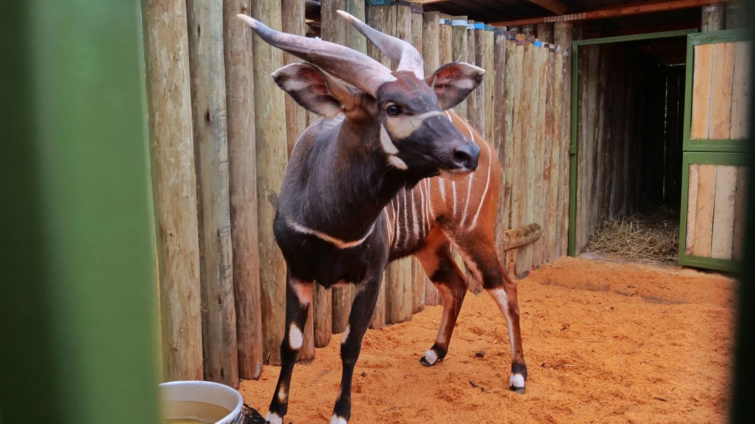
The mountain bongo is a large, chestnut-red antelope with narrow white vertical stripes and long spiral horns.
The KWS and conservation partners have been working to breed the animals and introduce them into the wild in a bid to restore the populations.
Last year, about 17 mountain bongos were repatriated from the Rare Species Conservation Foundation in Florida. The first repatriation to Kenya was in 2004 when 18 mountain bongos were flown into the country.
According to the foundation, about 400 mountain bongos live in captivity in North America. Others are held in European zoos.
Before being introduced to the wild from captivity, bongos undergo a series of adaptation phases to build the immunity needed to survive.
Ahead of their repatriation to Kenya, Prague Zoo said each animal would undergo "acclimatisation and detailed monitoring before being gradually integrated" at the MKWC's breeding programme.
It said they would help strengthen the population's genetic value and are expected to help produce viable offspring to be introduced into the wild in future.
On Wednesday morning, KWS posted images of the antelopes, saying they had arrived safely at the conservancy at the foot of Mount Kenya, and were "now settling in under close care".
"This marks a quiet but vital step in strengthening their population and securing their future," it added.
In 2022, the conservancy told local media that some previously repatriated mountain bongos had successfully been reintegrated into the wild and had begun breeding. Others, however, had died from tick-borne diseases.
Kenya aims to raise the mountain bongo's wild population to about 700 by 2050, through a national recovery plan led by the KWS.
Latest Stories
-
The illusion of a good deal: Why some everyday money-saving habits may be costing you more
12 minutes -
Family seeks autopsy, police investigation into death of student 12 days after Abomosu SHS enrolment
20 minutes -
Trade Minister urges employers to leverage industrial opportunities to create jobs
27 minutes -
Asantehene plants trees to commence Jimi Watercourse Rehabilitation destroyed by galamsey
51 minutes -
15 arrested, 6 trucks impounded over sandwinning activities on Kumasi-Accra Expressway
51 minutes -
OFFICIAL: Vinicius will miss El Clásico, suspended four games
55 minutes -
Prayer vigil held after four arson attack murders
1 hour -
GRA fully recovers $154k legacy debt owed by foreign entities between 2022 and 2024
1 hour -
Kwesi Pratt Jr warns bus preachers are adding to passengers’ stress with accident prophecies
1 hour -
MTN Ghana to spend $1.1bn in 3 years, build 500 new sites as MoMo hits 44% Growth
1 hour -
I have no regrets joining Assemblies of God – Mahama
1 hour -
Starlink restrictions in Ukraine war linked to political situation, Zelensky aide says
1 hour -
Furniture boost for Techiman North schools as MP donates to 20 institutions
1 hour -
Assemblies of God to loan 10,000-seater dome for Ghana@70 celebrations
1 hour -
Government to audit 2,016 community network sites – Communications Minister
1 hour